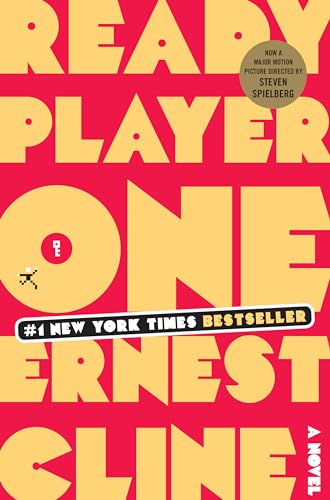

In one sentence
Ready Player One celebrates imaginative play and shared culture while arguing that escapism becomes dangerous when it replaces responsibility, embodied relationships, and engagement with the damaged world outside the game.
Overview
Wade Watts—known in the OASIS as Parzival—lives in a bleak future where the virtual world is central to education, work, entertainment, and social life. After OASIS creator James Halliday leaves his fortune and control of the system to whoever solves a sequence of puzzles, Wade joins a global contest involving independent “gunters,” corporate players, and lethal competition. The plot is structured as a chain of clues, discoveries, rivalries, and tests rather than as a conventional coming-of-age journey.
Core ideas
Escapism versus reality
The OASIS is not merely a game: it is a refuge from poverty, environmental decline, and social breakdown. The novel sympathizes with the need to escape, but its emotional direction suggests that a perfect virtual refuge cannot by itself repair the world or meet every human need.
Nostalgia as both inheritance and trap
Halliday’s puzzles depend on his fixation with 1980s films, music, games, and technology. This makes cultural knowledge powerful and communal, but it also exposes nostalgia as selective: the past becomes a designed fantasy rather than a complete historical reality. The recurring 1980s motif is central to the book’s identity.
Identity, anonymity, and disclosure
Avatars allow people to experiment with gender, appearance, status, and personality. That freedom can make relationships more honest, yet concealment also creates distance and vulnerability. The novel repeatedly tests whether identity is something performed online, revealed offline, or built through both.
Friendship over solitary mastery
Wade begins as an isolated obsessive whose expertise makes him valuable, but the quest increasingly depends on trust and cooperation. The book’s competitive structure therefore contains a counterargument to winner-take-all individualism: knowledge matters, but durable achievement requires people.
Technology and corporate power
The contest turns a shared virtual commons into a potential prize for private control. The conflict between players seeking discovery and an organization seeking ownership gives the adventure a political dimension, even when the novel’s treatment of economics remains more schematic than fully developed.
A quest shaped by the author’s enthusiasms
Cline designed the story so that accumulated knowledge of games and popular culture becomes narratively useful; he described the premise as a way to make seemingly useless trivia valuable. This creates energetic wish fulfillment, though it can also make the novel feel like an extended catalogue of references.
Practical takeaways
- Notice which forms of nostalgia enlarge your sense of connection and which merely help you avoid the present.
- Online identity can enable genuine self-expression, but trust still depends on honesty and accountability.
- Expertise becomes more meaningful when shared rather than used only as a route to status.
- A compelling virtual environment may reveal what is missing in ordinary life; it does not automatically solve those absences.
- When rereading, separate the novel’s affection for pop culture from its larger question: what responsibilities remain after the game ends?
Caveats and counterpoints
- The novel’s strongest pleasures are momentum, puzzles, world-building, and enthusiasm; its characterization and prose have been criticized as comparatively thin or overdependent on exposition. Kirkus specifically found too much puzzle-solving and not enough suspense.
- Its critique of escapism is somewhat softened by how appealing and socially useful the OASIS is, making the boundary between warning and wish fulfillment deliberately—and sometimes unevenly—drawn.
- The book’s treatment of nostalgia is broad rather than deeply historical: the 1980s often function as a shared imaginative code more than as a carefully examined period.
- These notes concern the novel, not the 2018 film adaptation, which changes elements of the quest and should not be used as a substitute for the book.
Questions worth revisiting
- Is the OASIS primarily a social achievement, an addictive escape, or both?
- Does Wade grow beyond his obsessions, or does he simply become successful because of them?
- What does the novel imply about the difference between loving a cultural artifact and understanding its historical context?
- Which relationships become more authentic through avatars, and which require physical presence?
- Would control of the OASIS be safer in the hands of one idealistic winner, a collective, or no single owner at all?
Return to this when…
Return when you want a fast refresher on the novel’s central tension between virtual freedom and real-world responsibility, or when revisiting how nostalgia, gaming, friendship, and identity interact in the quest.
References
- Ready Player One: Synopsis | Warner Bros.
- READY PLAYER ONE | Kirkus Reviews
- Ready Player One by Ernest Cline: 9780307887443 | PenguinRandomHouse.com: Books
- assets.penguinrandomhouse.com
- Ready Player One: Motifs | SparkNotes
- rottentomatoes.com
- audible.com
- ttbook.org
- supersummary.com
- wired.com
- Ready Player One: Ernest Cline on how his gamer fantasy became a Spielberg film | Games | The Guardian
- en.wikipedia.org