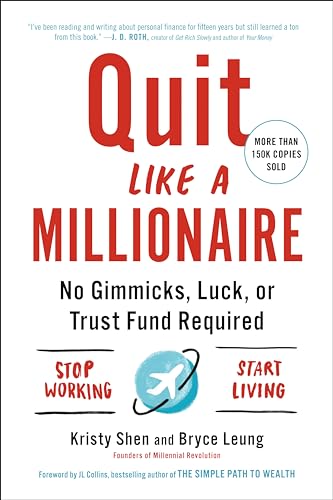

In one sentence
You do not need luck, entrepreneurship, property speculation, or a trust fund to retire early. The authors’ central formula is to widen the gap between income and spending, invest the surplus simply and cheaply, and reduce the portfolio required for independence by lowering ongoing expenses—sometimes through geographic arbitrage.
Overview
The book is part personal narrative and part implementation manual. Shen describes moving from severe childhood poverty to financial independence at 31; Leung contributes the couple’s shared financial and travel strategy. The progression moves from earning and spending, through investing and tax shelters, to retirement withdrawals, contingency planning, travel, children, and the psychological complications of leaving work. The published contents include chapters on debt, consumer psychology, housing, cash reserves, the “Yield Shield,” travel, children, and the limits or difficulties of early retirement.
Core ideas
Financial independence is primarily a spending problem
The target portfolio is tied to annual spending rather than status or salary. Lower recurring expenses reduce both the amount needed to retire and the amount that must be saved; the authors therefore treat housing, transportation, consumption habits, and location as major financial levers.
Optimize for earning power before optimizing investments
Early in the journey, career choice and income growth can matter more than fine distinctions between investments. The book’s contrarian emphasis is to choose financially viable work, save aggressively, and avoid allowing “follow your passion” advice to override basic arithmetic.
Use simple, low-cost, diversified investing
The strategy favors broad index funds and disciplined asset allocation over stock picking, hot real estate, or attempts to beat the market. The point is to make wealth accumulation repeatable rather than dependent on a lucky bet.
Protect the portfolio from bad early returns
Retirement introduces sequence-of-returns risk: a severe downturn near the beginning of withdrawals can do disproportionate damage. The authors propose a cash reserve and a “Yield Shield”—income-producing assets and cash intended to reduce the need to sell depressed equities—along with portfolio “buckets” and backup plans. This is a risk-management framework, not a guarantee that income-producing assets are safer or superior in every market.
Geographic arbitrage changes the retirement math
Earning in a high-income currency while living or traveling in lower-cost locations can extend portfolio life and make early retirement feasible with less capital. The idea depends on mobility, legal residency, healthcare access, safety, family obligations, and the reader’s willingness to trade familiarity or community for lower expenses.
Retirement is a design problem, not merely an account balance
The book treats early retirement as a shift from accumulating money to managing uncertainty, identity, time, relationships, healthcare, and purpose. Its inclusion of “The Dark Side of Early Retirement” signals that leaving work can create problems that money alone does not solve.
Practical takeaways
- Calculate annual spending carefully, then use it—not a round-number wealth goal—to estimate the portfolio required for independence.
- Separate fixed costs from discretionary costs; housing is especially consequential because a permanent reduction compounds every year.
- Increase savings through both income and spending decisions. Avoid assuming investment returns will rescue a weak savings rate.
- Prefer diversified, low-cost index investing and a written asset-allocation policy over continual prediction or trading.
- Before quitting, model several bad-market scenarios, especially losses during the first years of retirement; maintain an accessible reserve or other withdrawal flexibility.
- Treat tax-advantaged accounts, tax-efficient asset location, and withdrawal sequencing as part of the plan rather than afterthoughts.
- If considering geographic arbitrage, test the destination first and investigate visas, taxes, insurance, healthcare, banking, inflation, and exit options.
- Define what “enough” means in lifestyle terms. A lower-cost, flexible life may be more powerful than pursuing a larger portfolio indefinitely.
Caveats and counterpoints
- The book’s examples and tax discussion are especially relevant to Canadian and U.S. readers; account rules, healthcare systems, taxes, and withdrawal options do not transfer cleanly to every country.
- The familiar 4% rule is a historical rule of thumb generally associated with a roughly 30-year retirement horizon, not a promise for someone retiring in their thirties or forties. A very long retirement, changing valuations, taxes, fees, and uncertain spending require additional margin and flexibility.
- A Yield Shield can reduce forced equity sales, but dividends, bond interest, preferred shares, REIT distributions, and cash yields are not automatically safer, stable, or tax-efficient. Focusing on “income” can obscure total-return risk.
- Geographic arbitrage is unavailable or unattractive to people tied to local employment, family care, disability services, immigration constraints, or dependable domestic healthcare. Lower prices may also come with costs in distance, safety, infrastructure, and belonging.
- The authors’ unusually high savings, technical careers, mobility, and willingness to live unconventionally make their path reproducible in principles but not necessarily in pace. The strategy can be adapted without assuming a retirement date of 31.
Questions worth revisiting
- What annual spending level would actually make me feel secure, including healthcare, taxes, travel, repairs, and family support?
- Which expenses are genuinely fixed, and which are lifestyle defaults I could change without reducing quality of life?
- Am I relying on a long-term return assumption, a 4% withdrawal rate, or geographic arbitrage more heavily than the evidence warrants?
- What would I do if markets fell sharply during my first five years after quitting?
- Would I still want the proposed retirement if it required frequent international moves or living far from family?
- Which parts of the plan depend on Canadian or U.S. tax rules and need local professional verification?
Return to this when…
Return to the book when setting a FIRE target, revisiting housing and location choices, or stress-testing a retirement plan. The most useful sections are the spending/portfolio arithmetic, portfolio defenses against early bear markets, and the discussion of what early retirement is like after the numerical goal is reached.
Highlights
When Bryce asked Mario how he learned this mind-set, Mario replied, “I grew up in a war zone.” Mario is Lebanese and from the 1970s to the early 2000s, Lebanon’s history can be summarized as a mixture of “horrible civil war” and “horrible regular war.” When a bomb obliterates a building or explodes in a crowded marketplace, you don’t have the luxury of dwelling on the past. Questions like “Why did we have to come to the market today?” and “Why did we choose to live in this neighborhood?” are pointless. In that moment, you have two choices: Pick up a bucket and help put the fire out. Watch more people die.
YOUR HOUSE IS NOT AN INVESTMENT I’ve talked a lot about my upbringing already, and you might be thinking there were a lot of ugly moments. Please understand it’s not my intention to depict my culture as being all about physical abuse and abandonment issues; there are downsides as well. Namely, our attitude toward housing. As we discussed, when famine and instability can instantly destroy your sense of peace, your approach to money naturally becomes conservative. We don’t waste anything. We hoard our savings. We fear debt. These attitudes have generally served us well in helping us become resilient as we assimilate into new communities and cultures. But all these lessons fly right out the window when it comes to housing. In Chinese culture, a house is the be-all-end-all status symbol and the only thing we throw our hard-earned money at. It’s also the only thing that we are willing to go into debt for. I’ve seen friends who spend hours clipping coupons to save a dollar off toilet paper overspend by hundreds of thousands of dollars on a condo, caught up in the excitement of a bidding war. This obsession is anything but benign. Our hatred of debt, our ability to live on almost nothing, and our emphasis on education are powerful tools that allow tons of immigrants like my family to escape poverty. But it’s still rare for those same immigrant families to become truly rich. The reason for this, as it turns out, is housing. My own parents, who lived through a famine, who survived on $0.44 USD a day for years, started asking me a few weeks after I had graduated when I was going to buy a home. (And they’ve never stopped asking.) At the time, I didn’t know better either, so after I settled into my first full-time job, my then-boyfriend, Bryce, and I started to look for a house.
The first lesson came from Robert Kiyosaki, in his bestselling book Rich Dad Poor Dad. In it, he claims (and I’m paraphrasing here): Poor people buy stuff. The middle class buys houses. Rich people buy investments.
References
- Quit Like a Millionaire: No Gimmicks, Luck, or Trust Fund Required - Kristy Shen, Bryce Leung - Google Books
- books.google.com
- books.google.com
- Book Review & Summary: 'Quit Like a Millionaire' by Kristy Shen and Bryce Leung.
- empowerprocess.com
- Quit Like a Millionaire — Reader Q&A
- biggerpockets.com
- befreed.ai
- penguinrandomhouse.com
- salon.com
- financialindependencecampaign.blog
- winchellhouse.com