
In one sentence
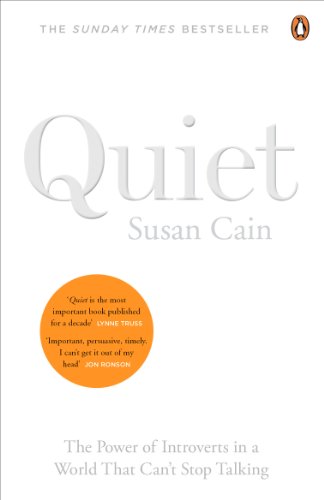
Introversion is a normal temperament, not a defect to overcome. When institutions equate influence with talkativeness and social ease, they waste abilities that often emerge through preparation, solitude, careful observation, and deep focus. The goal is not introvert dominance, but a better balance between quiet and outgoing modes of working and leading.
Overview
Cain organizes the book around three questions: how Western culture came to prize extroversion; what biology and psychology suggest about introversion and sensitivity; and how people can navigate environments built around group participation and self-promotion. She uses research, historical examples, interviews, and personal experience rather than presenting a single formal theory. The book’s central distinction is between a person’s preferred stimulation level and learned social behavior: introverts can speak publicly, lead, network, or act boldly when the situation matters.
Core ideas
The “extrovert ideal” is culturally produced
Cain describes a shift from a character-centered culture, associated with integrity and restraint, toward a personality-centered culture that rewards charm, assertiveness, visibility, and salesmanship. Her point is not that earlier culture was uniformly better, but that current standards often mistake performance for competence.
Introversion is not shyness or antisocial behavior
Introversion concerns how people respond to stimulation and where they tend to restore energy; shyness is fear or anxiety about social judgment. A quiet person may be socially confident, while an outgoing person may still experience insecurity. Treating these as identical creates bad advice and bad expectations.
Temperament has biological components, but it is not destiny
Cain draws on developmental and personality research suggesting that some people are more physiologically reactive to stimulation. This can make crowded, fast-moving environments costly, while supporting concentration and deliberate processing. Biology establishes tendencies; context, experience, values, and practice shape behavior.
Solitude can support creativity and judgment
The book challenges the assumption that collaboration is automatically superior. Group work can generate energy and useful exchange, but constant interaction can produce conformity, social loafing, or pressure to agree. Independent preparation and protected solitary work are often necessary complements to collaboration.
Leadership does not require flamboyance
Cain argues that quiet leaders may be especially effective when teams are proactive, because they are more likely to listen, absorb suggestions, and give others ownership. Extroverted leadership can be valuable too, particularly when enthusiasm, persuasion, or rapid mobilization is needed; the fit between leader and situation matters.
Acting extroverted can be worthwhile—but should be strategic
Cain does not recommend retreating permanently into a comfort zone. People can temporarily adopt unfamiliar behaviors in service of a “core personal project”—a value, relationship, or purpose important enough to justify the effort. The trade-off is sustainable when chosen, bounded, and followed by recovery.
Institutions should offer multiple participation routes
Schools and workplaces should not treat frequent speaking, open-plan interaction, or spontaneous brainstorming as the only evidence of engagement. Better designs include advance materials, written input, quiet work areas, small-group options, pauses for reflection, and evaluation based on results rather than visibility.
Practical takeaways
- Separate preference from limitation: ask whether you dislike an activity, fear it, lack practice, or simply need a lower-stimulation format.
- Prepare before high-stakes conversations or meetings; written thinking can convert quiet expertise into visible contribution.
- Protect blocks of uninterrupted work and treat recovery after intense social performance as a legitimate requirement, not a character flaw.
- Use a deliberate mix of solo work, one-to-one discussion, and group collaboration rather than accepting “teamwork” as a universal solution.
- When managing others, evaluate substance, reliability, listening, and follow-through—not only confidence, speed, or verbal dominance.
- For children or students, provide gentle opportunities to participate without implying that reservedness itself needs fixing.
- Distinguish authentic adaptation from self-erasure: stretch when the goal matters, but do not build an entire life around performing someone else’s temperament.
Caveats and counterpoints
- The book is an advocacy-oriented synthesis, not a neutral review of every personality finding. Its memorable contrast between introverts and extroverts can make people seem more neatly divided than they are.
- Cain’s use of biological sensitivity, creativity, leadership, and historical examples is persuasive at a broad level but should not be read as proof that introverts are inherently wiser, more ethical, or more creative. A serious review notes that the argument is compelling but not entirely original.
- “Introversion” is used across overlapping traditions—personality preference, sensitivity to stimulation, shyness, and related traits—so some scientific claims may not map cleanly onto one definition. The book itself warns against treating temperament as a rigid identity.
- The practical advice is strongest where a person has genuine control over work design or communication norms. It is less immediately applicable in jobs, cultures, or relationships that impose unavoidable social demands.
- The book’s cultural focus is particularly American and Western; its account should not automatically be generalized to every society or workplace.
Questions worth revisiting
- Where am I mistaking verbal immediacy for intelligence, commitment, or leadership?
- Which environments reliably overstimulate me, and what specific design change would help?
- When have I successfully acted outside my usual temperament for a meaningful purpose?
- Do my meetings and decisions reward the loudest contribution or the best-supported one?
- Which activities genuinely restore me, rather than merely helping me avoid discomfort?
- How could I give people more time to think before asking them to perform publicly?
Return to this when…
Return to the book when designing work or study routines, rethinking participation and collaboration, supporting a reserved child or colleague, preparing for a socially demanding role, or feeling pressured to treat quietness as a personal deficit. The most useful reminder is not “always be quiet,” but “do not confuse one culturally favored style with the whole of human ability.”
Highlights
Psychologists often discuss the difference between “temperament” and “personality.” Temperament refers to inborn, biologically based behavioral and emotional patterns that are observable in infancy and early childhood; personality is the complex brew that emerges after cultural influence and personal experience are thrown into the mix. Some say that temperament is the foundation, and personality is the building. Kagan’s work helped link certain infant temperaments with adolescent personality styles like those of Tom and Ralph.
In fact, public speaking anxiety may be primal and quintessentially human, not limited to those of us born with a high-reactive nervous system. One theory, based on the writings of the sociobiologist E. O. Wilson, holds that when our ancestors lived on the savannah, being watched intently meant only one thing: a wild animal was stalking us. And when we think we’re about to be eaten, do we stand tall and hold forth confidently? No. We run. In other words, hundreds of thousands of years of evolution urge us to get the hell off the stage, where we can mistake the gaze of the spectators for the glint in a predator’s eye. Yet the audience expects not only that we’ll stay put, but that we’ll act relaxed and assured.
When combined with Kagan’s findings on high reactivity, this line of studies offers a very empowering lens through which to view your personality. Once you understand introversion and extroversion as preferences for certain levels of stimulation, you can begin consciously trying to situate yourself in environments favorable to your own personality—neither overstimulating nor understimulating, neither boring nor anxiety-making. You can organize your life in terms of what personality psychologists call “optimal levels of arousal” and what I call “sweet spots,” and by doing so feel more energetic and alive than before.
But there were also new insights. The highly sensitive tend to be philosophical or spiritual in their orientation, rather than materialistic or hedonistic. They dislike small talk. They often describe themselves as creative or intuitive (just as Aron’s husband had described her). They dream vividly, and can often recall their dreams the next day. They love music, nature, art, physical beauty. They feel exceptionally strong emotions—sometimes acute bouts of joy, but also sorrow, melancholy, and fear.
And it suggests, says Jadzia Jagiellowicz, the lead scientist at Stony Brook, that sensitive types think in an unusually complex fashion. It may also help explain why they’re so bored by small talk. “If you’re thinking in more complicated ways,” she told me, “then talking about the weather or where you went for the holidays is not quite as interesting as talking about values or morality.”
Flow often occurs, he writes, in conditions in which people “become independent of the social environment to the degree that they no longer respond exclusively in terms of its rewards and punishments. To achieve such autonomy, a person has to learn to provide rewards to herself.”
You also risk your physical health. “Emotional labor,” which is the effort we make to control and change our own emotions, is associated with stress, burnout, and even physical symptoms like an increase in cardiovascular disease. Professor Little believes that prolonged acting out of character may also increase autonomic nervous system activity, which can, in turn, compromise immune functioning.
It can be hard for extroverts to understand how badly introverts need to recharge at the end of a busy day. We all empathize with a sleep-deprived mate who comes home from work too tired to talk, but it’s harder to grasp that social overstimulation can be just as exhausting. It’s also hard for introverts to understand just how hurtful their silence can be. I interviewed a woman named Sarah, a bubbly and dynamic high school English teacher married to Bob, an introverted law school dean who spends his days fund-raising, then collapses when he gets home. Sarah cried tears of frustration and loneliness as she told me about her marriage.
In The Audacity of Hope, for example, President Obama confides that early in his marriage to Michelle, he was working on his first book and “would often spend the evening holed up in my office in the back of our railroad apartment; what I considered normal often left Michelle feeling lonely.” He attributes his own style to the demands of writing and to having been raised mostly as an only child, and then says that he and Michelle have learned over the years to meet each other’s needs, and to see them as legitimate.
And fighting back may not invite retaliation, as Emily fears; instead it may encourage Greg to back off. She need not put on a huge display. Often, a firm “that’s not OK with me” will do.
Why do we accept this one-size-fits-all situation as a given when we know perfectly well that adults don’t organize themselves this way? We often marvel at how introverted, geeky kids “blossom” into secure and happy adults. We liken it to a metamorphosis. However, maybe it’s not the children who change but their environments. As adults, they get to select the careers, spouses, and social circles that suit them. They don’t have to live in whatever culture they’re plunked into. Research from a field known as “person-environment fit” shows that people flourish when, in the words of psychologist Brian Little, they’re “engaged in occupations, roles or settings that are concordant with their personalities.” The inverse is also true: kids stop learning when they feel emotionally threatened.
Relationships make everyone happier, introverts included, but think quality over quantity.
Spend your free time the way you like, not the way you think you’re supposed to. Stay home on New Year’s Eve if that’s what makes you happy. Skip the committee meeting. Cross the street to avoid making aimless chitchat with random acquaintances. Read. Cook. Run. Write a story. Make a deal with yourself that you’ll attend a set number of social events in exchange for not feeling guilty when you beg off.
References
- Quiet: The Power of Introverts in a World That Can't Stop Talking by Susan Cain – review | Society books | The Guardian
- Quiet - Susan Cain
- Book Review / Quiet: The Power of Introverts in a World That Can't Stop Talking by Susan Cain
- editorsreads.com
- sites.psu.edu
- kirkusreviews.com
- pmc.ncbi.nlm.nih.gov
- theguardian.com
- englewoodreview.org
- bookmarks.reviews
- kirkcenter.org
- sciencenews.org