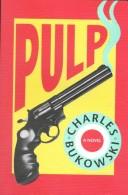

In one sentence
Pulp uses the detective novel as a deliberately unreliable container: Bukowski both imitates and sabotages pulp conventions, turning a familiar search narrative into a comic meditation on death, bad writing, and the failure of rational explanations. Its value is less in plot satisfaction than in its abrasive, self-conscious final gesture.
Overview
Nicky Belane is a broke, aging Los Angeles private detective whose cases become increasingly improbable. He is hired to locate Céline, a French author who should be dead, and later becomes entangled with the elusive Red Sparrow. The novel mixes noir clichés, sexual crudity, violence, aliens, literary jokes, and metaphysical intrusions. Avoid expecting a tightly engineered mystery: the book’s looseness is part of its parody, though some reviewers regarded that looseness as a serious weakness.
Core ideas
Pulp as self-parody
The novel borrows the private-eye office, femme-fatale atmosphere, cynical dialogue, and Los Angeles setting associated with writers such as Raymond Chandler and Dashiell Hammett—then makes the conventions visibly tawdry, repetitive, and unstable. Its dedication to “bad writing” frames the book as an experiment in intentionally low literary seriousness.
Mortality invading the genre
Lady Death is not merely a threat in the background; death becomes an active presence in Belane’s professional and imaginative world. Read biographically only with caution, but the timing matters: Bukowski completed the novel shortly before his death, making the book’s comic treatment of mortality difficult to separate entirely from its late-career context.
The detective who cannot master reality
Belane is a detective defined less by competence than by delay, irritation, appetite, and survival. He investigates without gaining dependable control over events. The resulting anti-detective structure mocks the genre’s promise that clues, intelligence, and persistence will restore order.
Literature as both object and joke
Céline, the missing author, makes literary reputation part of the mystery. The novel treats writers, publishers, genres, and interpretation as suspect institutions: books may be valuable, fraudulent, disposable, or simply evidence of someone’s need to impose meaning on chaos. Critics differ on whether this metafictional play is energetic or merely thin.
Bukowski’s familiar world in an unfamiliar form
Unlike the more autobiographical novels centered on Henry Chinaski, Pulp uses an invented detective protagonist and a more openly fantastical plot. Yet it retains Bukowski’s recurring concerns with drinking, sex, money, humiliation, antagonism toward respectable culture, and the drudgery of staying alive.
The tension between comic freedom and artistic failure
The book’s disorder can feel liberating: it refuses polished mystery mechanics and lets absurdity interrupt realism. But the same refusal can look like underdevelopment. Publishers Weekly judged it weak beside Chandler and Hammett, while more sympathetic readings see its roughness as an intentional farewell to literary decorum.
Practical takeaways
- A genre can be criticized most effectively by inhabiting its clichés and pushing them until they expose their assumptions.
- A narrator’s confidence is not evidence of competence; Belane’s voice repeatedly disguises confusion as experience.
- Absurdity in the novel is not pure escapism. It functions as a way of representing a world in which death, desire, commerce, and art resist orderly explanation.
- The book is useful as a reminder that an author’s late work may be artistically uneven while still clarifying long-running preoccupations.
- When rereading, notice where the novel shifts from ordinary noir realism into metaphysical or science-fictional material; those breaks reveal how unstable its worldview is.
Caveats and counterpoints
- This is an atypical Bukowski novel: readers seeking the autobiographical realism of Post Office, Factotum, or Ham on Rye may find its detective and science-fiction elements jarring.
- Its treatment of women, sex, drinking, and violence is deliberately abrasive but also limited by Bukowski’s recurring male-centered perspective; comic intent does not remove the misogyny or objectification many readers may find objectionable.
- Critical response is sharply divided. Some readers value the novel’s self-conscious absurdity and death-haunted humor; others find the parody less funny and less controlled than the hard-boiled fiction it invokes.
- The biographical reading—Belane as a loose surrogate for Bukowski confronting his own death—is suggestive, not a complete explanation of the novel.
Questions worth revisiting
- Is the dedication to “bad writing” a genuine aesthetic program, a pre-emptive defense, or both?
- Does Belane’s failure to solve reality undermine the detective genre, or merely replace one kind of convention with another?
- When does the novel’s vulgarity create comic energy, and when does it become repetitive or evasive?
- Is Lady Death best read as an allegorical figure, a genre character, or a deliberately unresolved combination of both?
- Does the novel’s roughness feel more like artistic freedom or unfinished construction?
- How does the book’s final-novel status affect interpretation—and how might it read without that biographical knowledge?
Return to this when…
Return to Pulp when studying Bukowski’s relationship to genre, late-style experimentation, metafiction, or comic treatments of mortality. It is especially worth revisiting alongside Chandler or Hammett, and alongside Bukowski’s more autobiographical novels, to see what changes when his usual persona is placed inside a deliberately malfunctioning detective story.
Highlights
Sometimes things are just what they seem to be and that’s all there is to it. The best interpreter of the dream is the dreamer. Keep your money in your pocket. Or bet it on a good horse.
“All right. I’m leaving for the airport in an hour. Got business back east. I’ll be back in 6 days.” “Everything will be solved, baby.” “Don’t call me baby. What’s this ‘baby’ shit?” “Just a manner of speaking…” “You clean up this mess or I’ll see you in hell, motherfucker!” “You talking to me, Jack?”