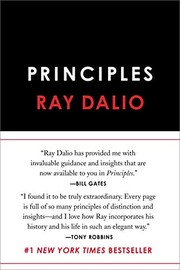

In one sentence
Success comes from repeatedly confronting reality, identifying your weaknesses, learning from painful outcomes, and converting those lessons into explicit principles. Dalio argues that individuals and organizations improve when they treat decision-making as a system: define goals, diagnose problems, weigh evidence, decide, execute, and learn.
Overview
The book has three broad movements: Dalio’s career and the development of Bridgewater; “Life Principles” for personal decisions and growth; and “Work Principles” for building an organization. Its central organizational ideal is an “idea meritocracy,” where the best reasoning—not rank, confidence, or office politics—should prevail.
Core ideas
Reality over preference
Start with what is actually happening, not what you wish were happening. Problems are useful data: identify the gap between the desired outcome and reality, then investigate its causes rather than blaming circumstances or people.
Pain plus reflection becomes progress
Failure, conflict, and discomfort can reveal weaknesses in judgment or design. The productive response is reflection: determine what happened, why it happened, and what rule or system should change so the same failure becomes less likely.
Use an explicit decision loop
Separate the stages of work: set clear goals, identify problems, diagnose root causes, design solutions, and execute. Dalio’s emphasis is procedural: do not jump to solutions before understanding the problem.
Know your strengths and weaknesses
Good decisions depend on recognizing one’s own cognitive and interpersonal limitations. Build complementary teams rather than expecting one person to excel at every role; assign people to work that fits their abilities while helping them develop.
Idea meritocracy
A strong decision process combines radical truth, radical transparency, and believability-weighted judgment. Encourage disagreement, evaluate the reasoning and track record behind an opinion, and distinguish confidence from demonstrated expertise.
Treat organizations as machines
An organization is a system made of people and culture. When results are poor, examine the machine: roles, incentives, information flows, decision rights, and feedback loops—not merely the individual who appears closest to the failure.
Turn experience into principles
A principle is a reusable rule for handling a recurring class of situations. Writing principles down makes judgment more consistent and allows a team to improve its operating system rather than repeatedly improvising from scratch.
Design for the right people and culture
Dalio presents Bridgewater’s unusually direct culture as a deliberate fit for people willing to expose mistakes, challenge one another, and tolerate scrutiny. A demanding system may work for a carefully selected group without being appropriate for every organization.
Practical takeaways
- After a meaningful mistake, write a short diagnosis: what happened, the root cause, the relevant weakness, and the rule or process change that follows.
- For an important decision, separate facts, assumptions, uncertainties, and judgments; record the reasoning before the outcome is known.
- Ask for disagreement from people with relevant experience, not simply from the loudest or most senior participants.
- Weight advice by demonstrated ability in the specific domain, while remaining alert to expertise becoming status or authority.
- Use a recurring review cycle: goals, outcomes, deviations, causes, corrective action, and whether the corrective action worked.
- When managing someone, distinguish a performance problem from a role-design, training, motivation, or culture problem.
- Create transparency with boundaries: share information that improves decisions, but protect privacy, dignity, and psychological safety.
- Treat Dalio’s rules as hypotheses to test in your context, not commandments to copy.
Caveats and counterpoints
- The book is a self-authored account of Dalio’s success and may overattribute Bridgewater’s results to its culture and principles. It is better read as Dalio’s operating philosophy than as neutral evidence that the system caused the firm’s investment performance.
- “Radical transparency” can expose problems quickly, but unrestricted criticism, constant evaluation, or public performance tracking can create fear, conformity, and abuse rather than truth-seeking. Later reporting and reviews of Bridgewater describe a much darker experience for some employees than Dalio’s account emphasizes.
- Believability-weighting can improve judgment when expertise is relevant and measurable, but it can also reproduce hierarchy, make newcomers hesitant to speak, and confuse past success with present accuracy.
- The machine metaphor is useful for diagnosing systems but reductive when applied to human relationships. Motivation, identity, fairness, trust, and moral responsibility cannot be fully engineered like investment processes.
- The advice is strongest for high-stakes decisions, reflective managers, and teams with clear goals. It may fail in creative, caregiving, educational, or civic settings where experimentation, inclusion, and emotional safety matter as much as speed and analytical rigor.
Questions worth revisiting
- Which recurring problem in my life or work deserves a written principle rather than another improvised response?
- What evidence would change my mind about an important decision?
- Am I seeking truth, or merely recruiting support for a preferred conclusion?
- Who has demonstrated relevant expertise—and who might be excluded by my current decision process?
- Where would greater transparency improve performance, and where would it violate privacy or reduce trust?
- Which part of Dalio’s framework is genuinely transferable to my setting, and which part depends on Bridgewater’s unusual culture?
- After my last significant failure, did I identify a root cause and change a system, or only assign blame?
Return to this when…
Return to the decision loop and the caveats when facing a consequential choice, diagnosing a repeated failure, designing team roles, or considering a culture of radical candor. Revisit the organizational caveats before applying Bridgewater-style transparency, rankings, or confrontation.
References
- forbes.com
- Principles | Book by Ray Dalio | Official Publisher Page | Simon & Schuster
- Ray Dalio explains his principles - 60 Minutes - CBS News
- morningbrew.com
- rd.me
- thegrowthfaculty.com
- economictimes.indiatimes.com
- reddit.com
- reiprime.com
- cbsnews.com
- grahammann.net
- bankers-anonymous.com
- principles.com
- kirkusreviews.com