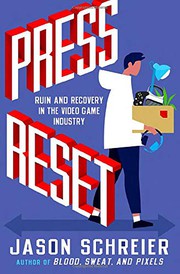

In one sentence
The video-game business can produce enormous cultural and financial success while remaining structurally hostile to stable creative careers. Studio closures are not isolated tragedies or simple failures of talent: they arise from publisher risk management, volatile funding, ownership changes, unrealistic production demands, and an industry organized around projects rather than durable teams.
Overview
Schreier follows developers and studios through celebrated projects, commercial disappointments, acquisitions, leadership conflicts, and shutdowns. The recurring pattern is that a successful game does not necessarily protect its creators; teams may be dismantled after a hit, absorbed into a larger company, or abandoned when a publisher changes strategy. The second half of the story is recovery: some developers form new studios, some move into independent work, and others leave game development altogether.
Core ideas
Success can intensify instability
A hit game may increase expectations, budgets, and organizational pressure rather than secure a studio’s future. Schreier’s cases challenge the assumption that quality work or strong sales automatically create institutional stability; Irrational Games, for example, was closed despite the success of the BioShock series.
Publishers optimize portfolios, not necessarily people
Large companies can treat studios as flexible assets within a portfolio. A project may be cancelled, a team restructured, or a studio closed because of strategic priorities, financing problems, or corporate decisions that are only partly connected to the developers’ performance.
The project-based model shifts risk downward
Publishers and investors can end a project or close a studio, while workers bear the immediate consequences: layoffs, relocation, lost income, disrupted careers, and the need to rebuild professional networks. The book’s focus is less on games as products than on who absorbs the industry’s uncertainty.
Creative ambition can become a management liability
The same passion and autonomy that help produce distinctive games can also enable scope creep, prolonged development, leadership breakdowns, and burnout. Schreier does not reduce these outcomes to individual incompetence; he connects them to weak management and incentives that reward ambition while postponing difficult constraints.
Recovery is possible but uneven
After shutdowns, developers may find resilience through independent studios, new collaborations, or more sustainable teams. Recovery is not equally available to everyone, however: financial reserves, reputation, location, networks, and willingness to leave the industry shape who gets a second chance.
The book is a labor critique as much as an industry history
Its central question is not simply why games are difficult to make, but why making them is so often an insecure way to earn a living. The narrative exposes the gap between the industry’s prestige and revenue—described in contemporary reviews as roughly $150 billion annually—and its frequent layoffs, burnout, and poor working conditions.
Practical takeaways
- When evaluating a game company, look beyond its latest hit: examine ownership, funding, leadership continuity, project pipeline, and treatment of staff.
- Creative success is not the same as organizational health. Ask whether the team has repeatable production practices, realistic scope, and authority to make trade-offs.
- For workers, portability of skills and professional relationships matters because studio loyalty may not be reciprocated by corporate structures.
- Independent development can restore autonomy, but it transfers financial, managerial, and distribution risks to the creators rather than eliminating them.
- Treat accounts of “failed” games cautiously: project outcomes often reflect financing, executive decisions, and changing strategy—not merely the quality or effort of the development team.
Caveats and counterpoints
- The book was published on May 11, 2021, and its reporting mainly reflects developments through the period in which it was written; it should not be treated as a current account of the industry.
- It is a journalistic collection of case studies, not a comprehensive economic survey. Its vivid examples support a structural argument but cannot establish that every studio or publisher operates identically.
- The labor critique is persuasive but necessarily emphasizes breakdown, precarity, and recovery. It gives less analytical space to studios that maintain stable employment or to the technological and market forces that may constrain publishers.
- Because the narrative depends heavily on interviews, readers should distinguish reported participant perspectives from independently demonstrated causal explanations.
Questions worth revisiting
- Which recurring failure is most fundamental: publisher incentives, poor project management, dependence on hit-driven revenue, or weak labor protections?
- When does independence genuinely improve working conditions, and when does it merely relocate risk from a corporation to a small group of founders?
- What would a studio structure look like if retaining experienced teams were valued as highly as shipping the next major release?
- How much responsibility belongs to publishers, investors, executives, and consumers who reward ever-larger games and compressed release cycles?
- Which of the book’s proposed forms of recovery are durable, and which depend on unusual personal resources or timing?
Return to this when…
Return to these notes when assessing game-industry layoffs, studio closures, acquisitions, crunch, or claims that a successful release guarantees a team’s future. The key reminder is that game development is a creative activity embedded in unstable corporate and financial systems—not a meritocracy in which good work reliably protects the people who made it.
References
- PRESS RESET | Kirkus Reviews
- Press Reset: Ruin and Recovery in the Video Game Industry by Jason Schreier | Goodreads
- books.google.com
- goodreads.com
- bookmarks.reviews
- bookmarks.reviews
- Press Reset | Library Journal
- search.worldcat.org
- forbes.com
- catalog.library.nashville.org
- thevideogamelibrary.org
- play.google.com