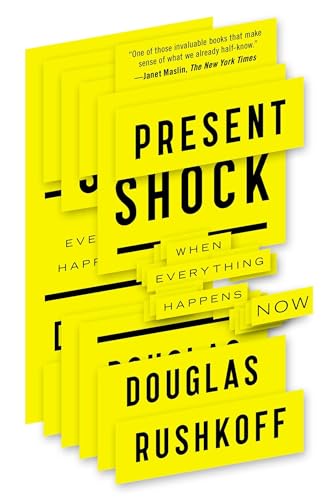

In one sentence
Rushkoff argues that society has moved beyond Alvin Toffler’s “future shock.” Instead of being overwhelmed by rapid change while trying to reach the future, we are trapped in an endless present: real-time media, instant feedback, and always-on connectivity erode narrative, stable identity, long-term planning, and confidence in the future.
Overview
The book develops five symptoms of “present shock”: narrative collapse, digiphrenia, overwinding, fractalnoia, and apocalypto. These describe, respectively, the weakening of coherent stories; the conflict between digital and embodied selves; the compression and stretching of time; the search for meaningful patterns in overwhelming feedback; and the cultural fixation on catastrophe or collapse.
Core ideas
1. Narrative collapse
Traditional narratives organize experience around sequence, causality, development, and an ending. Rushkoff sees contemporary media moving toward fragments, updates, mashups, reality formats, and perpetual continuation. The result is not simply shorter attention spans: it is difficulty understanding events as parts of a shared story with direction or resolution.
2. Digiphrenia
Digital systems let one person maintain several simultaneous identities, conversations, timelines, and obligations. This creates a mismatch between the speed and multiplicity of online selves and the slower limits of an embodied person. The practical problem is divided presence: being technically connected while mentally unavailable to the people or activity in front of you.
3. Overwinding: the short forever
Digital culture compresses time while also making experiences effectively permanent. Messages, transactions, news cycles, and cultural moments arrive faster, but remain searchable, repeatable, and difficult to leave behind. Rushkoff connects this altered timescale to finance, media, and the pressure to achieve immediate results rather than work within natural or institutional rhythms.
4. Fractalnoia
When feedback is abundant, people look for patterns everywhere: in data, networks, coincidences, markets, and cultural fragments. This can reveal genuine connections, but it can also encourage overinterpretation. The challenge is distinguishing useful systems thinking from the need to impose meaning on noise.
5. Apocalypto
A culture unable to imagine a credible long-term future becomes fascinated by endings: zombies, collapse, extinction, and post-apocalyptic survival. Rushkoff interprets this partly as an escape from a complicated, overmediated society and a fantasy of returning to direct, tangible needs. The collapse imaginary therefore expresses both fear and a desire for reset.
The underlying political question
The book is not merely about distraction. Its deeper concern is agency: who benefits when people remain reactive, synchronized to feeds, and focused on immediate signals? Recovering temporal perspective means reclaiming the ability to pause, interpret, remember, plan, and participate rather than simply respond. This is an interpretive synthesis of Rushkoff’s framework, not a direct quotation.
Practical takeaways
- When confronted with a live feed, ask what context or longer story has been removed.
- Separate urgent communication from the expectation of constant availability.
- Protect activities that require duration: reading, conversation, deliberation, craft, and sleep.
- Treat patterns in data or social media as hypotheses, not conclusions.
- Notice whether catastrophe-focused entertainment is functioning as critique, escapism, or a desire for simpler forms of life.
- Design personal and organizational rhythms that are slower than the systems demanding immediate response.
Caveats and counterpoints
- The book is cultural criticism rather than a systematic empirical study; its memorable labels often function as interpretive lenses, not validated psychological diagnoses.
- Rushkoff’s examples and tone can be sweeping and technologically deterministic. Kirkus criticized the book for exaggerated conclusions and dated cultural touchstones, while still acknowledging useful ideas about time, markets, politics, and catastrophe.
- Because it was published in 2013, some examples center on Twitter, early social media, reality television, and pre-generative-AI digital culture. The framework may still be useful, but particular examples should not be mistaken for current evidence.
- The critique can undervalue the benefits of immediacy: rapid coordination, access to information, marginalized voices, and real-time responses to crises. The publisher’s description itself presents the present-focused condition as potentially both disorienting and energizing.
Questions worth revisiting
- Which parts of my life are genuinely urgent, and which are merely synchronized to someone else’s notification system?
- Where has immediacy improved coordination rather than damaged attention or judgment?
- What stories—personal, political, or institutional—still give my actions a longer horizon?
- When I see patterns in a stream of information, what evidence would show that the pattern is real?
- Do my visions of the future involve constructive possibilities, or mainly avoidance and collapse?
Return to this when…
Return to this book when constant updates make the world feel simultaneous, directionless, or psychologically crowded. Its most useful reminder is that attention is also temporal agency: choosing what deserves duration can be a way of resisting an environment organized around reaction.
References
- Present Shock — Douglas Rushkoff
- Present Shock: When Everything Happens Now - Douglas Rushkoff - Google Books
- Present shock : when everything happens now / Douglas Rushkoff.
- publishersweekly.com
- penguinrandomhouse.com
- PRESENT SHOCK | Kirkus Reviews
- blinkist.com
- kirkusreviews.com
- kobo.com
- en.wikipedia.org
- brieflane.com
- images.penguinrandomhouse.com