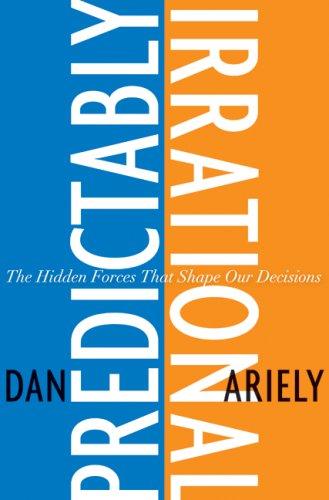

In one sentence
Human decisions often depart from classical economic rationality in recurring, measurable ways. Because these departures are systematic rather than random, the environments in which choices are presented can strongly influence behavior—for better or worse.
Overview
Ariely presents behavioral-economics experiments as short stories about everyday choices. The sequence moves from relativity and anchoring to the special power of zero price, the tension between social and market norms, emotional arousal, procrastination, ownership, keeping options open, expectations, price and placebo effects, and the limits of standard economic models.
Core ideas
Relativity and arbitrary anchors
People evaluate options comparatively, not in isolation. An initial price, salary, product, or alternative can become an anchor, making later judgments seem coherent even when the starting point was arbitrary. This helps explain why “middle” options and strategically arranged comparisons are persuasive.
Zero is not merely a lower price
“Free” changes the emotional calculation: it can make an offer disproportionately attractive and alter how much people take. Ariely’s broader point is that price changes can change the meaning of an option, not just its cost. Later research with collaborators continued examining this zero-price effect.
Social norms versus market norms
People respond differently when an interaction is framed as a favor, gift, or shared obligation than when it is framed as a paid transaction. Introducing money can make an exchange feel less generous and more contractual; once market norms enter, it may be difficult to return smoothly to a purely social frame.
Emotion changes what we think we will do
In a calm state, people routinely underestimate how strongly anger, sexual arousal, hunger, fear, or excitement will alter later choices. The practical implication is to make important decisions before the high-emotion state—or create safeguards that operate during it.
Self-control is easier when precommitted
Knowing what would be good for us is not enough when immediate rewards compete with delayed benefits. Ariely emphasizes commitment devices—deadlines, restrictions, automatic contributions, and other arrangements that reduce the need for willpower at the decisive moment.
Ownership raises perceived value
Once people possess, customize, or emotionally invest in something, they tend to value it more and resist giving it up. This can produce endowment effects, attachment to sunk costs, and difficulty judging a purchase as if it were still an outside option.
Expectations shape experience
Beliefs about quality, effectiveness, or pleasure can influence the experience itself. Price and presentation may therefore affect perceived benefit, including placebo-like responses; the effect is not proof that expensive or prestigious options are objectively better.
The standard model is a useful baseline, not a complete psychology
Ariely uses departures from supply-and-demand reasoning to argue that economics needs psychologically informed models of choice. His target is not every use of rational-choice theory, but the assumption that people consistently know what they want and evaluate alternatives independently of context.
Practical takeaways
- Before comparing prices, write down your independent estimate of value; otherwise the first number may silently set the range.
- Treat “free,” limited-time, bundled, and default offers as psychologically special—not automatically as bargains.
- Keep gifts, favors, and paid work conceptually distinct when preserving trust or goodwill matters.
- Make high-stakes decisions before predictable emotional triggers, or use cooling-off periods and precommitments.
- When selling or buying, inspect the comparison set: the “reasonable” option may have been designed by the way alternatives were arranged.
- Reassess possessions and subscriptions by asking: “Knowing what I know now, would I choose this again?”
- Interpret vivid experiments as prompts for better questions, not as guarantees that every individual will behave identically.
Caveats and counterpoints
- The book is a popular introduction, not a systematic review or a replacement for the original studies. Its entertaining anecdotes can make findings feel more universal and settled than the evidence warrants.
- “Irrational” is used relative to classical economic benchmarks; a choice that violates those benchmarks may still be understandable or adaptive given incomplete information, limited time, or social goals.
- Behavioral findings are often context-sensitive. A laboratory result may identify a tendency without predicting its size in a different population, market, or institutional setting.
- Psychological science has faced substantial replication problems; a large replication effort reported that roughly half of 28 tested findings did not reproduce under near-ideal conditions. Individual claims from an older popular book should therefore be checked against later evidence.
- The book’s core framework remains useful as a set of hypotheses about decision environments, but its examples should not be treated as equally robust, nor as evidence that people are simply defective decision-makers.
Questions worth revisiting
- Which of my current decisions is being driven by an anchor I did not choose?
- Where am I treating “free” as evidence of value rather than as a pricing condition?
- Have I accidentally shifted a relationship from social norms to market norms—or vice versa?
- What recurring situation reliably defeats my intentions, and what precommitment could change the choice architecture?
- Which possessions, plans, or commitments would I decline if I were evaluating them from scratch?
- Which claims in the book are strongest because they have survived later replication, and which should remain provisional?
Return to this when…
Return to the notes before negotiating a price, designing a product or policy, making a major purchase, setting a habit, or deciding under strong emotion. The most useful reminder is: choices are shaped not only by preferences, but by comparison points, framing, timing, expectations, and the norms surrounding the decision.
Highlights
As you can see, the middle circle can’t seem to stay the same size. When placed among the larger circles, it gets smaller. When placed among the smaller circles, it grows bigger. The middle circle is the same size in both positions, of course, but it appears to change depending on what we place next to it. This might be a mere curiosity, but for the fact that it mirrors the way the mind is wired: we are always looking at the things around us in relation to others. We can’t help it. This holds true not only for physical things—toasters, bicycles, puppies, restaurant entrées, and spouses—but for experiences such as vacations and educational options, and for ephemeral things as well: emotions, attitudes, and points of view.
My advice? Understand that relativity is everywhere, and that we view everything through its lens—rose-colored or otherwise. When you meet someone in a different country or city and it seems that you have a magical connection, realize that the enchantment might be limited to the surrounding circumstances. This realization might prevent you from subsequent disenchantment.
“Tom had discovered a great law of human action, namely, that in order to make a man covet a thing, it is only necessary to make the thing difficult to attain.”
What did we show? That our first decisions resonate over a long sequence of decisions. First impressions are important, whether they involve remembering that our first DVD player cost much more than such players cost today (and realizing that, in comparison, the current prices are a steal) or remembering that gas was once a dollar a gallon, which makes every trip to the gas station a painful experience. In all these cases the random, and not so random, anchors that we encountered along the way and were swayed by remain with us long after the initial decision itself.
Whereas Dunkin’ Donuts had small, medium, and large coffees, Starbucks offered Short, Tall, Grande, and Venti, as well as drinks with high-pedigree names like Caffè Americano, Caffè Misto, Macchiato, and Frappuccino. Starbucks did everything in its power, in other words, to make the experience feel different—so different that we would not use the prices at Dunkin’ Donuts as an anchor, but instead would be open to the new anchor that Starbucks was preparing for us. And that, to a great extent, is how Starbucks succeeded.
I believe the answer is this. Most transactions have an upside and a downside, but when something is FREE! we forget the downside. FREE! gives us such an emotional charge that we perceive what is being offered as immensely more valuable than it really is. Why? I think it’s because humans are intrinsically afraid of loss. The real allure of FREE! is tied to this fear. There’s no visible possibility of loss when we choose a FREE! item (it’s free). But suppose we choose the item that’s not free. Uh-oh, now there’s a risk of having made a poor decision—the possibility of a loss. And so, given the choice, we go for what is free.
OK. Here’s a quiz. Suppose I offered you a choice between a free $10 Amazon gift certificate and a $20 gift certificate for seven dollars. Think quickly. Which would you take? If you jumped for the FREE! certificate, you would have been like most of the people we tested at one of the malls in Boston. But look again: a $20 gift certificate for seven dollars delivers a $13 profit. That’s clearly better than getting a $10 certificate free (earning $10). Can you see the irrational behavior in action?
When we keep social norms and market norms on their separate paths, life hums along pretty well. Take sex, for instance. We may have it free in the social context, where it is, we hope, warm and emotionally nourishing. But there’s also market sex, sex that is on demand and that costs money. This seems pretty straightforward. We don’t have husbands (or wives) coming home asking for a $50 trick; nor do we have prostitutes hoping for everlasting love.
Indeed, just thinking about money makes us behave as most economists believe we behave—and less like the social animals we are in our daily lives. This leads me to a final thought: when you’re in a restaurant with a date, for heaven’s sake don’t mention the price of the selections. Yes, they’re printed clearly on the menu. Yes, this might be an opportunity to impress your date with the caliber of the restaurant. But if you rub it in, you’ll be likely to shift your relationship from the social to the market norm. Yes, your date may fail to recognize how much this meal is setting you back. Yes, your mother-in-law may assume that the bottle of wine you’ve presented is a $10 blend, when it’s a $60 special reserve merlot. That’s the price you have to pay, though, to keep your relationships in the social domain and away from market norms.
SO WE LIVE in two worlds: one characterized by social exchanges and the other characterized by market exchanges. And we apply different norms to these two kinds of relationships. Moreover, introducing market norms into social exchanges, as we have seen, violates the social norms and hurts the relationships. Once this type of mistake has been committed, recovering a social relationship is difficult. Once you’ve offered to pay for the delightful Thanksgiving dinner, your mother-in-law will remember the incident for years to come. And if you’ve ever offered a potential romantic partner the chance to cut to the chase, split the cost of the courting process, and simply go to bed, the odds are that you will have wrecked the romance forever.
This experiment illustrates an unfortunate fact: when a social norm collides with a market norm, the social norm goes away for a long time. In other words, social relationships are not easy to reestablish. Once the bloom is off the rose—once a social norm is trumped by a market norm—it will rarely return.
If the relationship is based on market norms, the bank charges a fee, and the customer shakes it off. Business is business. While the fee is annoying, it’s nonetheless acceptable. In a social relationship, however, a hefty late fee—rather than a friendly call from the manager or an automatic fee waiver—is not only a relationship-killer; it’s a stab in the back. Consumers will take personal offense. They’ll leave the bank angry and spend hours complaining to their friends about this awful bank. After all, this was a relationship framed as a social exchange. No matter how many cookies, slogans, and tokens of friendship a bank provides, one violation of the social exchange means that the consumer is back to the market exchange. It can happen that quickly.
If corporations started thinking in terms of social norms, they would realize that these norms build loyalty and—more important—make people want to extend themselves to the degree that corporations need today: to be flexible, concerned, and willing to pitch in. That’s what a social relationship delivers.
What these results mean is that when price is not a part of the exchange, we become less selfish maximizers and start caring more about the welfare of others. We saw this demonstrated by the fact that when the price decreased to zero, customers restrained themselves and took far fewer units. So while the product (candy, in our case) was more attractive to more people, it also made people think more about others, care about them, and sacrifice their own desires for the benefit of others. As it turns out, we are caring social animals, but when the rules of the game involve money, this tendency is muted.
One thing is sure: if we don’t teach our young people how to deal with sex when they are half out of their minds, we are not only fooling them; we’re fooling ourselves as well. Whatever lessons we teach them, we need to help them understand that they will react differently when they are calm and cool from when their hormones are raging at fever pitch (and of course the same also applies to our own behavior).
Giving up on our long-term goals for immediate gratification, my friends, is procrastination.
Oscar Wilde once said, “I never put off till tomorrow what I can do the day after.” He seemed to accept and even embrace the role of procrastination in his life, but most of us find the allure of immediate gratification so strong that it wrecks our best-laid plans for dieting, saving money, cleaning the house—the list is endless.
Several years ago I heard an interview on NPR with the Delany sisters, who lived to be 102 and 104. There was one particular part of the interview that remained with me. The sisters said that one of their secrets for a long life was never marrying, because they never had husbands to “worry them to death.” This sounds reasonable enough, but it isn’t something to which I can personally attest (and it also turns out that men benefit more from marriage anyway).9 One of the sisters said that another secret was to avoid hospitals, which seemed sensible for two reasons—if you’re healthy in the first place, you don’t need to go, and you’re also less likely to catch an illness from being in the hospital.
ONE OF MY colleagues at Duke University, Ralph Keeney, recently noted that America’s top killer isn’t cancer or heart disease, nor is it smoking or obesity. It’s our inability to make smart choices and overcome our own self-destructive behaviors.10
By pairing something that we love with something that we dislike but that is good for us, we might be able to harness desire with outcome—and thus overcome some of the problems with self-control we face every day.
As we discussed in Chapter 8, ownership fundamentally changes our perspective. In the same way that we think our own kids are more wonderful and special than our friends’ and neighbors’ children (regardless of whether our children deserve such esteem), we overvalue everything that we own, whether it’s a pair of basketball tickets or our domiciles.
OUR PROPENSITY TO overvalue what we own is a basic human bias, and it reflects a more general tendency to fall in love with, and be overly optimistic about, anything that has to do with ourselves. Think about it—don’t you feel that you are a better-than-average driver, are more likely to be able to afford retirement, and are less likely to suffer from high cholesterol, get a divorce, or get a parking ticket if you overstay your meter by a few minutes? This positivity bias, as psychologists call it, has another name: “The Lake Wobegone Effect,” named after the fictional town in Garrison Keillor’s popular radio series A Prairie Home Companion. In Lake Wobegone, according to Keillor, “all the women are strong, all the men are good-looking, and all the children are above average.”
A hungry donkey approaches a barn one day looking for hay and discovers two haystacks of identical size at the two opposite sides of the barn. The donkey stands in the middle of the barn between the two haystacks, not knowing which to select. Hours go by, but he still can’t make up his mind. Unable to decide, the donkey eventually dies of starvation.
Some of the participants read a brochure said to be from Cambridge Audio, and others read the same exact brochure, but this one indicated that it came from Consumer Reports. Then, all of the participants took half an hour to listen to a composition by J. S. Bach and evaluate the stereo system. How powerful was the bass? How clear was the treble? Were the controls easy to use? Were there any sound distortions? And finally, how much would they pay for the system? As it turned out, the participants liked the stereo much more if they were told that the information they read came from an unbiased source such as Consumer Reports. They also said they would pay, on average, about $407 for the system, far more than the $282 offered by those who read the Cambridge Audio brochure. Sadly, it appeared that mistrust in marketing information runs so deeply that it colors our entire perception—even in the face of firsthand, direct experience—causing us to enjoy the experience much less than we otherwise would. (And this happens with relatively trusted brands. Just imagine what would happen with distrusted ones.)
few more investigations into expense accounts turned up similar rationalizations. In one study, we found that when people give receipts to their administrative assistants to submit, they are then one additional step removed from the dishonest act, and hence more likely to slip in questionable receipts. In another study, we found that businesspeople who live in New York are more likely to consider a gift for their kid as a business expense if they purchased it at the San Francisco airport (or someplace else far from home) than if they had purchased it at the New York airport, or on their way home from the airport. None of this makes logical sense, but when the medium of exchange is nonmonetary, our ability to rationalize increases by leaps and bounds.
As the author and journalist Upton Sinclair once noted, “It is difficult to get a man to understand something when his salary depends upon his not understanding it.” We can now add the following thought: it is even more difficult to get a man to understand something when he is dealing with nonmonetary currencies.
In essence, individuals more concerned with portraying their own uniqueness were more likely to select an alcoholic beverage not yet ordered at their table in an effort to demonstrate that they were in fact one of a kind.
Although these results were clear, we suspected that in other cultures—where the need for uniqueness is not considered a positive trait—people who ordered aloud in public would try to portray a sense of belonging to the group and express more conformity in their choices. In a study we conducted in Hong Kong, we found that this was indeed the case. In Hong Kong, individuals also selected food that they did not like as much when they selected it in public rather than in private, but these participants were more likely to select the same item as the people ordering before them—again making a regrettable mistake, though a different type of mistake, when ordering food.
That’s exactly the meaning of free lunches from the perspective of behavioral economics—the idea that there are tools, methods, and policies that can help all of us make better decisions and as a consequence achieve what we desire.
References
- psychologytoday.com
- researchgate.net
- PREDICTABLY IRRATIONAL - Dan Ariely
- PREDICTABLY IRRATIONAL | Kirkus Reviews
- danariely.com
- statmodeling.stat.columbia.edu
- Book Review: David Berreby on Dan Ariely's 'Predictably Irrational' - Dan Ariely
- fee.org
- Predictably Irrational: The Hidden Forces That Shape Our Decisions | Journal of Consumer Marketing | Emerald Publishing
- papers.ssrn.com
- books.google.com
- kirkusreviews.com
- danariely.com
- myscp.onlinelibrary.wiley.com
- nature.com