
In one sentence
The book treats faith less as obedience to institutions than as a demand for personal responsibility: if God, evil, and moral choice are real, people must confront them directly rather than surrender judgment to churches, governments, or inherited myths.
Overview
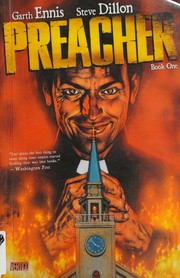
This is the first collected volume of the Vertigo/DC series, gathering the opening story material commonly identified as Preacher: Gone to Texas; the larger series was created by writer Garth Ennis and artist Steve Dillon. Jesse Custer, a small-town minister, is pushed out of ordinary pastoral life by a supernatural catastrophe and begins pursuing answers about God, destiny, and the forces shaping human lives. The book introduces the principal traveling trio—Jesse, his former girlfriend Tulip O’Hare, and the Irish vampire Cassidy—while establishing the series’ mixture of western iconography, religious critique, extreme violence, and deliberately offensive humor. It does not resolve the saga’s major questions; it functions as an aggressive opening statement and a promise of a much larger journey.
Core ideas
Faith versus religious authority
The story distinguishes spiritual conviction from institutional religion. Jesse’s anger is directed not simply at disbelief but at hypocrisy, coercion, and leaders who claim moral authority without accepting moral responsibility.
Freedom, choice, and responsibility
The supernatural premise creates a world where destiny and divine power may be real, but the characters are still judged by what they choose. Power does not automatically make a person righteous; loyalty and courage matter more than status.
The American West as moral ideal and myth
Jesse is framed through the language of the cowboy: self-reliant, direct, protective, and resistant to domination. The book both uses that ideal sincerely and exposes how violence, machismo, and national mythology can distort it.
Friendship as an alternative to institutions
Jesse, Tulip, and Cassidy form an unstable but compelling counter-community. Their bonds are built through history, danger, humor, and mutual recognition rather than shared respectability or official duty.
Shock as satire—and as a weakness
Ennis uses obscenity, grotesque bodies, blasphemy, and spectacular brutality to attack complacency and keep the reader off balance. The method can sharpen the satire, but it can also feel adolescent or excessive when provocation becomes the point.
A visual language of hard edges and spectacle
Steve Dillon’s clean, readable figures and controlled staging give the series a grounded, cinematic surface, making the outrageous events easier to follow and often more unsettling. The contrast between ordinary faces and extreme situations is central to the book’s effect.
Practical takeaways
- When a moral system claims unquestionable authority, ask who benefits from that authority and who is expected to bear its consequences.
- The book’s strongest relationships are not based on purity or agreement; they depend on loyalty that survives serious flaws without pretending those flaws do not exist.
- A rebellious identity can become its own kind of dogma. Jesse’s resistance is most persuasive when it is paired with responsibility rather than mere defiance.
- Notice where the book’s humor makes difficult subjects discussable—and where its shock tactics may substitute for deeper examination.
- Read the supernatural conflict as an argument about human agency: the presence of cosmic forces does not remove the need to choose.
Caveats and counterpoints
- The catalogue description appears to refer specifically to the first volume, Gone to Texas, rather than the complete Preacher series. DC identifies it as Volume 1 and describes the wider work as a modern American epic involving life, death, love, redemption, and deliberately adult material.
- The book contains graphic violence, sexual material, blasphemy, cruelty, grotesque imagery, and humor involving taboo subjects. Its treatment of religion is confrontational rather than even-handed, and some readers find the shock comedy dated or overextended.
- Interpretations of Jesse as an idealized American cowboy and of the series’ politics vary; the notes above separate recurring textual tensions from claims about Ennis’s intentions.
Questions worth revisiting
- Is Jesse rejecting God, or rejecting the institutions and expectations that speak in God’s name?
- Does the book’s celebration of personal freedom adequately account for the damage caused by violent individuals exercising that freedom?
- When does the trio’s loyalty become genuine ethical commitment, and when is it simply shared antagonism toward authority?
- Does the comic’s extreme humor deepen its critique of hypocrisy, or make certain characters and groups into disposable targets?
- What remains of the cowboy ideal once independence is separated from masculinity, violence, and control?
Return to this when…
Return to these notes before reading the later volumes, especially when comparing how Jesse’s ideas about faith, responsibility, friendship, and justice develop. Also revisit them if you want to assess whether the series’ provocative style serves its moral questions or overwhelms them.