
In one sentence
Organizations become more adaptable when they treat employees as capable adults: hire unusually strong people, explain the business context plainly, give them room to decide, and remove those whose skills no longer match the work. Freedom is not permissiveness; it is paired with unusually high standards and accountability.
Overview
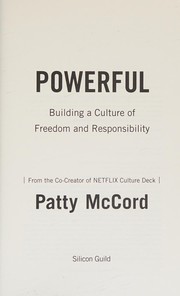
McCord presents a candid, experience-based critique of conventional HR and management practices, drawing heavily on her work as Netflix’s chief talent officer and on Silicon Valley organizations. The book is organized around practical questions: whom to hire, how to communicate, how to structure teams, how to handle performance and departure, and how to keep culture aligned with changing business needs.
Core ideas
Start with the business, not HR rituals
People practices should follow the company’s actual strategy and stage. McCord is skeptical of policies that exist mainly because they are customary—such as elaborate engagement programs, retention schemes, or formal annual reviews—when they do not improve the work.
Hire for the team you need now
Recruit for the capabilities required by the current business, rather than preserving roles because someone has been loyal or was once effective. As the company changes, a previously strong employee may no longer be the right fit; treating this directly is kinder and more honest than disguising it as a development exercise.
Context enables autonomy
Employees can make better decisions when leaders share business realities: objectives, constraints, trade-offs, competitive pressures, and what success looks like. Autonomy without context becomes arbitrary freedom; context turns judgment into a scalable management system.
Candor is a management responsibility
McCord advocates direct, timely feedback rather than relying on bureaucratic review cycles. Managers should address performance, disagreement, and changing expectations plainly, while making criticism specific to the work rather than personal.
Motivation comes from meaningful challenge
The book places greater weight on interesting, consequential work and capable colleagues than on perks, promises of promotion, or elaborate incentive programs. Compensation still matters, but it cannot substitute for a compelling task and a high-performing environment.
Teams should be designed, not sentimentalized
McCord rejects the idea that a company is primarily a family. A company is a team assembled to accomplish a purpose; leaders must continually assess whether its composition and skills match the next phase of work. Departures can be respectful without pretending that every role is permanent.
Freedom requires discipline
Minimal process is not the same as minimal accountability. The model depends on clear expectations, competent people, open information, strong judgment, and willingness to intervene when decisions or performance fall short.
Practical takeaways
- Translate strategy into a short list of capabilities the organization needs next; use it to guide hiring and team changes.
- Before adding a policy, identify the specific failure it is meant to prevent and whether clearer context or better judgment would solve the problem more simply.
- Replace vague feedback with frequent conversations about what is working, what is not, and what the role now requires.
- Give teams the information behind decisions, not merely the decisions themselves.
- Ask whether compensation, perks, or retention tactics are masking a weak role, poor management, or uninteresting work.
- When someone is no longer a fit, explain the business reason directly and handle the transition with dignity.
- Use autonomy selectively: it works best where people have the expertise, information, and incentives to exercise sound judgment.
Caveats and counterpoints
- The advice is strongly shaped by Netflix and Silicon Valley; a fast-changing, talent-dense technology company is not a universal organizational template.
- Abolishing or minimizing formal reviews and retention practices can fail where performance documentation, employment law, safety, equity, or coordination requirements demand more structure.
- “Radical honesty” can become an excuse for bluntness or unequal power unless leaders distinguish useful candor from humiliation, retaliation, or bias.
- The emphasis on replacing people whose skills no longer fit may underweight reskilling, internal mobility, institutional knowledge, and employees’ need for procedural fairness.
- The book is a perspective and set of operating principles, not a controlled comparison showing that Netflix-style practices caused Netflix’s performance; survivorship and selection effects remain relevant criticisms.
Questions worth revisiting
- Which parts of my organization’s process exist because they improve decisions, and which exist because they are familiar HR customs?
- Do employees understand the business context well enough to make independent trade-offs?
- Are managers giving feedback early, or storing up judgments for formal review moments?
- What capabilities will the organization need six to twelve months from now—not merely the skills that made it successful before?
- Where would greater autonomy improve speed, and where would it create unacceptable risk?
- Am I using “culture fit” to mean demonstrated behaviors and judgment, or merely similarity to current insiders?
Return to this when…
Return to the core distinction between freedom and responsibility when considering flatter structures, fewer rules, faster decisions, or changes to performance management. Revisit the caveats before applying the book’s hardest recommendations—especially replacing employees, reducing formal process, or treating the company as a non-family team.
References
- Powerful: Building a Culture of Freedom and Responsibility by Patty McCord | Goodreads
- bookember.com
- search.worldcat.org
- goodreads.com
- pattymccord.com
- goodreads.com
- “Powerful” (Book Review) – As I learn …
- vitalsource.com
- Powerful by Patty McCord (Ebook) - Read free for 30 days
- pattymccord.com
- content.img-gorod.ru
- bizjournals.com