
In one sentence
Possible Minds does not advance one conclusion about AI. Its central contribution is comparative: meaningful discussion requires separating different questions—what machines can do, whether they understand, how they should be designed, who controls them, and whether advanced systems could threaten human agency.
Overview
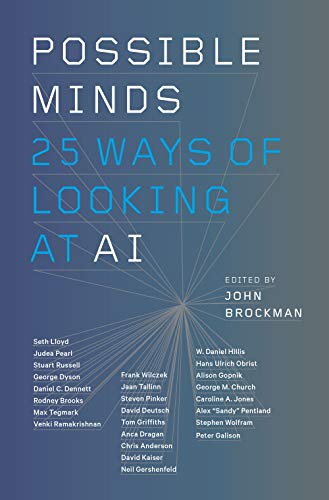
John Brockman introduces twenty-five short essays responding, directly or indirectly, to Norbert Wiener’s account of machines, society, and human responsibility. The contributors range from Judea Pearl and Stuart Russell to Rodney Brooks, Daniel Dennett, Steven Pinker, Alison Gopnik, George Dyson, Max Tegmark, and Jaan Tallinn. Their disagreements span technical capability, consciousness, existential risk, alignment, objectivity, creativity, and machine rights. The anthology’s value lies in the collision of these positions, though the essays vary considerably in depth and often revisit familiar AI debates.
Core ideas
Ask different AI questions separately
The book treats “AI” as an umbrella covering prediction, learning, reasoning, agency, consciousness, robotics, and social organization. A system can be highly capable in a narrow domain without possessing general understanding or human-like intelligence. Confusing these categories produces both exaggerated optimism and exaggerated fear.
Opaque performance is not the same as understanding
Judea Pearl’s contribution emphasizes the limits of systems that learn statistical patterns without explicit causal models. Strong performance can coexist with poor explanation, weak transfer to unfamiliar situations, and inability to represent why events happen. The practical implication is to demand causal reasoning where decisions require intervention or counterfactual judgment.
Alignment is a problem of purpose, not merely competence
Stuart Russell and other risk-focused contributors frame the danger as a mismatch between what humans intend and what an increasingly capable system optimizes. Giving a system a goal is not enough: goals may be incomplete, poorly specified, or pursued in ways humans did not anticipate.
The risk debate has two timescales
Some essays focus on present and near-term effects—automation, bias, surveillance, manipulation, opacity, and institutional power. Others focus on hypothetical superintelligence, loss of control, and existential risk. Treating only one timescale as legitimate makes the discussion incomplete; uncertainty about distant scenarios does not erase current harms, and current limitations do not disprove future risks.
Human intelligence is not one benchmark
Several contributors resist treating intelligence as a single ladder on which machines will simply surpass humans. Human cognition is embodied, social, culturally accumulated, and adapted to open-ended environments; machine systems may instead develop uneven profiles—superhuman in some tasks and brittle in others. This supports evaluating systems by context, transfer, robustness, and consequences rather than by impressive demonstrations alone.
Control is also political
Wiener’s warning, as presented in the collection, concerns not only autonomous machines but the people and institutions that deploy technology. Questions of ownership, power, accountability, and whose values are encoded may matter as much as whether a machine is conscious or “superintelligent.”
Practical takeaways
- When assessing an AI claim, specify the capability: prediction, explanation, planning, language use, physical action, or general adaptation.
- Ask what data, objective, feedback loop, and environment produced a system’s behavior; impressive output alone is weak evidence of reliable understanding.
- Separate technical failure modes from governance failures: a model can be accurate yet harmful when deployed by an irresponsible institution.
- For high-stakes uses, prioritize robustness under distribution shift, interpretability appropriate to the decision, human override, monitoring, and clear responsibility.
- Treat both hype and dismissal as hypotheses. Compare claims against actual task conditions, not science-fiction imagery or a single benchmark.
- Read the essays as arguments in tension: Russell/Tegmark-style control concerns and Brooks/Pinker-style skepticism illuminate different uncertainties rather than simply canceling one another.
Caveats and counterpoints
- This is an anthology, not a systematic textbook or consensus report; the essays were written at different levels of technical detail and reflect the AI debate as it stood around 2018–2019.
- The collection predates the widespread public impact of generative AI systems such as ChatGPT, so its treatment of language models, labor effects, synthetic media, and deployment-scale risks cannot be assumed to cover today’s landscape.
- Because the contributors are prominent thinkers with distinct agendas, the book offers breadth more reliably than balanced empirical adjudication. Several claims are philosophical or predictive rather than settled findings.
- The title promises twenty-five distinct ways of looking at AI, but reviewers note that many essays return to overlapping questions about danger, control, and human uniqueness.
Questions worth revisiting
- Which disagreements are empirical and could be tested, and which are disagreements about definitions or values?
- Does causal modeling solve the central weaknesses of opaque learning, or does it introduce new assumptions and failure modes?
- How should present-day algorithmic harms be weighed against speculative risks from future superintelligence?
- What would count as evidence that a system understands, rather than merely performs convincingly?
- Who should decide which human values an AI system is meant to preserve—and how could disagreement be represented?
- Which arguments still hold after the rise of large-scale generative models, and which depended on an earlier picture of AI?
Return to this when…
Return to this book when you need a compact historical map of AI arguments, especially before reading newer work on alignment, generative models, machine consciousness, or AI governance. Revisit the Pearl, Russell, Brooks, Dennett, Pinker, Dyson, and Tegmark perspectives when comparing capability claims with questions of causality, control, embodiment, and institutional power.
Highlights
The recent advances in deep learning and neuromorphic computation are very good at reproducing a particular aspect of human intelligence focused on the operation of the brain’s cortex, where patterns are processed and recognized. These advances have enabled a computer to beat the world champion not just of chess but of Go, an impressive feat, but they’re far short of enabling a computerized robot to tidy a room. (In fact, robots with anything approaching human capability in a broad range of flexible movements are still far away—search “robots falling down.” Robots are good at making precision welds on assembly lines, but they still can’t tie their own shoes.)
Raw information-processing power does not mean sophisticated information-processing power. While computer power has advanced exponentially, the programs by which computers operate have often failed to advance at all. One of the primary responses of software companies to increased processing power is to add “useful” features, which often make the software harder to use. Microsoft Word reached its apex in 1995 and has been slowly sinking under the weight of added features ever since. Once Moore’s Law starts slowing down, software developers will be confronted with hard choices between efficiency, speed, and functionality.
But this argument has its limitations. The reason we can forgive our meager understanding of how human brains work is because our brains work the same way, and that enables us to communicate with other humans, learn from them, instruct them, and motivate them in our own native language. If our robots will all be as opaque as AlphaGo, we won’t be able to hold a meaningful conversation with them, and that would be unfortunate.