
In one sentence
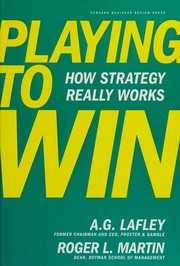
Strategy is an integrated, mutually reinforcing set of choices about where to play and how to win. The objective is not merely to participate or improve operations, but to create a coherent approach that gives the organization a favorable chance of winning.
Overview
The book’s central framework is the Strategic Choice Cascade: five linked questions that connect ambition to action. The authors use Procter & Gamble’s transformation and brand cases to show how explicit choices, trade-offs, capabilities, and management systems can turn broad aspirations into an actionable strategy.
Core ideas
1. Winning aspiration
Define what winning means for the organization—not just survival, growth, or being “the best,” but a specific ambition that guides choices. A mission or purpose can inspire, but it does not by itself determine how to compete.
2. Where to play
Choose the arenas in which to compete: customers, segments, geographies, product categories, channels, and stages of the value chain. Focus requires deciding where not to play; trying to serve everyone usually produces an unfocused strategy.
3. How to win
Specify the distinctive value proposition or advantage that will make the organization win in its chosen arenas. “High quality,” “great service,” or “innovation” are insufficient unless tied to a mechanism competitors cannot easily match.
4. Required capabilities
Work backward from the where-to-play and how-to-win choices to identify the mutually reinforcing activities and strengths required—such as brand building, consumer insight, innovation, supply-chain excellence, or go-to-market execution.
5. Management systems
Build the routines, measures, decision processes, resource-allocation mechanisms, and learning systems that support the choices. Strategy fails when operating systems reward behavior inconsistent with the stated direction.
Choices must reinforce one another
The cascade is not a checklist answered independently. Each choice constrains the next, and the answers should form a coherent system. A promising market choice without a credible advantage or supporting capabilities is not a strategy.
Strategy is an ongoing choice process
The authors emphasize iterative strategic thinking: generate alternatives, identify the assumptions behind them, ask what would have to be true, test those assumptions, and refine the choices. Analysis supports choice; it does not replace it.
Competition is central
Winning depends on how customers, competitors, substitutes, suppliers, and partners will respond. A strategy that describes only internal goals or capabilities ignores the competitive interaction that makes strategy necessary.
Practical takeaways
- Write a one-page cascade: winning aspiration; where to play; how to win; capabilities; management systems.
- Force explicit trade-offs. For every proposed priority, name the customers, markets, activities, or opportunities you will not prioritize.
- Separate aspiration from strategy: “be the leader” is an outcome; explain where leadership will be pursued and by what advantage.
- Use the question “What would have to be true?” to expose assumptions behind a strategic choice, then seek evidence rather than relying on confidence.
- Check vertical coherence: do the capabilities genuinely enable the chosen advantage, and do budgets, incentives, metrics, and review meetings reinforce them?
- Apply the framework at multiple levels—company, business, category, product, or team—but ensure lower-level choices support higher-level choices.
Caveats and counterpoints
- The evidence base is heavily shaped by Lafley’s experience at Procter & Gamble and therefore by consumer brands, large-company resources, and a relatively structured competitive context.
- The framework clarifies choices but does not eliminate uncertainty, politics, execution difficulty, or luck. A coherent strategy can still fail if its assumptions are wrong or competitors respond unexpectedly.
- “Winning” is treated primarily as competitive and organizational success. Nonprofits, public institutions, and mission-driven organizations may need a broader definition of success than market victory.
- The five questions can become a planning ritual if leaders avoid genuine trade-offs or fill the answers with generic language such as innovation, customer focus, and operational excellence.
- The book is more useful for structuring strategic dialogue than for providing a universal theory of competitive advantage; it should be paired with rigorous market, financial, and operational analysis.
Questions worth revisiting
- What does winning specifically mean for this organization, and over what time horizon?
- Which arenas should we deliberately avoid, even if they appear attractive?
- What is our actual mechanism for winning there, and why would it be difficult for competitors to copy?
- Which assumptions must be true for this strategy to work? Which can we test quickly?
- What capabilities are missing, and can we realistically build or acquire them?
- Do our budgets, incentives, metrics, and leadership routines reinforce the stated choices—or contradict them?
- What evidence would cause us to revise the strategy?
- Are we choosing a strategy, or merely describing an aspiration and listing initiatives?
Return to this when…
Return to this book when a strategy discussion becomes vague, overloaded with initiatives, or detached from competitive reality. The most useful refresher is the cascade itself: define winning, choose where to play, explain how to win, identify the required capabilities, and align management systems.