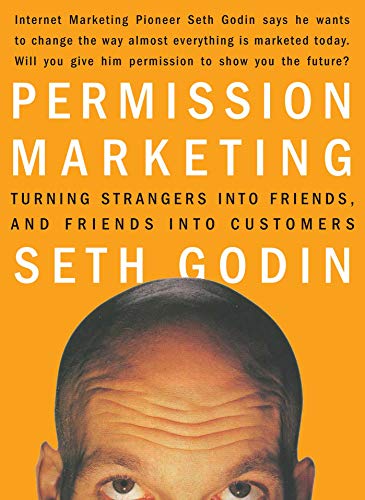

In one sentence
In an attention-saturated market, sustainable marketing comes from earning a prospect’s voluntary, ongoing permission to communicate—not from interrupting strangers with increasingly noisy messages. Permission becomes a business asset when it is used to deliver value, build trust, personalize interactions, and gradually increase customer commitment.
Overview
Godin contrasts “Interruption Marketing”—television ads, telemarketing, direct mail, and other messages that compete for attention—with a permission-based alternative. The book’s central process is: attract attention with an incentive, obtain explicit permission, provide useful and relevant communication, maintain trust, and progressively convert permission into profitable customer relationships. Godin presents the Internet as especially suited to this model because it enables interactive, individualized, measurable communication. The original book was published by Simon & Schuster in 1999.
Core ideas
Attention is scarce, so interruption gets weaker
Consumers face more messages, products, and media channels than they can process. As clutter rises, each unsolicited message becomes less effective, forcing marketers into a costly cycle of more exposure and diminishing returns. Godin’s point is economic as much as ethical: unwanted attention is an increasingly expensive resource.
Permission is anticipated, personal, and relevant
Permission marketing is not merely contacting someone who once supplied an email address. The recipient should expect the communication, recognize its relevance, and receive enough value to continue the relationship. Permission is therefore conditional and can be weakened or withdrawn when messages become excessive, generic, or self-serving.
Begin with an incentive, then earn the next interaction
A marketer may still need an interruption to make first contact, but the purpose is to invite a voluntary next step. A useful free trial, sample, tool, report, or other benefit gives the prospect a reason to opt in; subsequent communication must justify continued attention rather than immediately maximizing sales.
Treat permission as a permission asset
An opted-in audience is a compounding business asset: each interaction can improve knowledge of the customer, increase relevance, and make future offers more effective. The relationship gains value when the marketer can serve a customer repeatedly and predictably, not merely win a one-time transaction.
Move prospects through stages of commitment
Godin describes a progression from stranger to prospect, customer, and more valuable repeat customer. The practical logic is incremental: ask for a small commitment first, fulfill the promise, then earn permission for more information, more involvement, and eventually a purchase. Trust is built through consistent delivery, not declared through branding.
Personalization improves the economics
Because permission creates an interactive relationship, messages can become more specific to an individual’s interests and behavior. Better relevance reduces wasted communication and supports targeted offers, cross-selling, retention, and customer lifetime value—provided the data is used in ways the customer considers fair.
The marketer must keep paying for attention
Permission is not a blank check. The recipient is effectively compensated by receiving information, utility, entertainment, savings, or convenience. If the exchange stops being worthwhile, unsubscribing, ignoring, or distrust becomes rational. This makes permission marketing a discipline of continual value creation, not simply a compliance checkbox.
Practical takeaways
- Define the smallest audience for whom your offer is genuinely useful before designing the campaign.
- Use an initial, clearly stated value exchange to invite opt-in; do not disguise acquisition as permission.
- Tell subscribers what they will receive, how often, and why it will be useful.
- Design a sequence in which every message earns the right to send the next one.
- Measure progression and retention—not only clicks or immediate sales: opt-in quality, engagement, conversion, repeat purchase, and unsubscribe rates matter.
- Personalize only where it improves usefulness; excessive targeting can feel intrusive and damage the permission asset.
- Make opting out easy and treat declining permission as information, not as a problem to override.
Caveats and counterpoints
- The book’s examples and media assumptions come from the late 1990s, so some channel-specific claims are dated even though the permission-versus-interruption framework remains recognizable in email, content, CRM, and subscription marketing.
- Permission does not automatically produce trust or sales. A large opt-in list can still be low-intent, poorly segmented, over-messaged, or attracted mainly by incentives unrelated to the eventual product.
- Godin’s contrast can be too binary: interruption remains useful for discovery, reach, launches, and creating awareness, especially when the offer is difficult to search for. The strongest practical model combines selective interruption with permission-based follow-up.
- The approach assumes that ongoing communication is economically feasible and that the company can reliably deliver value. It is less persuasive for infrequent, low-consideration purchases where a long relationship may not justify its cost.
- The book is a strategic argument rather than a neutral empirical review; its recommendations should be tested against channel economics, privacy expectations, customer behavior, and the particular market.
Questions worth revisiting
- Where in my customer journey am I interrupting people instead of giving them a reason to opt in?
- What exact value does a subscriber receive before being asked to buy?
- What permission has the customer granted—and what permission am I merely assuming?
- Which messages could be made more anticipated, personal, or relevant?
- What evidence would show that my audience is becoming more valuable over time rather than merely larger?
- Where might a permission-based sequence fail because the purchase is too infrequent, urgent, or low-value?
Return to this when…
Return to this book when designing an email list, lead-nurture sequence, loyalty program, onboarding flow, or content strategy—or when a campaign is generating reach but not trust. Its most useful refresher is the question: “What value am I providing that makes the next message welcome?”
References
- pulserevops.com
- sumizeit.com
- 12min.com
- Permission Marketing Book Summary by Seth Godin
- goodreads.com
- supersummary.com
- Permission Marketing: Turning Strangers Into Friends and Friends Into Customers by Seth Godin
- Permission marketing : turning strangers into friends, and friends into customers | WorldCat.org
- litereads.app
- booksthatslay.com
- Permission Marketing | Book by Seth Godin | Official Publisher Page | Simon & Schuster
- Book Summary - Permission Marketing by Seth Godin - Gord Addison