
In one sentence
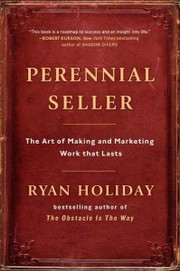
Durable success is not created by separating art from marketing or by relying on a spectacular launch. A perennial seller combines genuinely valuable work, deliberate positioning, a reachable audience, and persistent, relationship-based promotion over time.
Overview
The book is organized around the progression from creative mindset and making, through positioning and packaging, to marketing and platform-building. Holiday’s central contrast is between short-lived “hits” and work that accumulates value through word of mouth, repeated discovery, cultural relevance, and a growing base of supporters.
Core ideas
Make something worth sustaining
Marketing cannot permanently rescue work that lacks substance. Start with a clear purpose, a defined audience, and a real need or desire the work addresses. Holiday treats quality as partly objective craft and partly fit: the work must matter to someone specific, not merely express the creator’s intentions.
Think long-term from the start
The goal is not simply a successful launch but continued usefulness and discoverability. A weak initial response does not necessarily determine a work’s eventual life; perennial sellers can grow gradually through recommendations, reissues, renewed attention, and changing circumstances.
Integrate making and marketing
Audience awareness should influence creation, positioning, packaging, and distribution—not as cynical pandering, but as a way to make the work legible and findable to people who may value it. Holiday rejects the idea that marketing is an afterthought or beneath the creator.
Positioning creates access
Even strong work can disappear if people cannot quickly understand what it is, who it is for, or why it is distinctive. Refining the title, description, presentation, category, promise, and comparisons helps the right audience recognize the work.
Build a platform, not just a following
A platform is an owned or durable channel for reaching people: direct relationships, an email list, communities, repeat customers, collaborators, or regular venues. The aim is to turn temporary attention into ongoing access and trust.
Promotion is persistent and relational
Holiday emphasizes targeted outreach, reviews, interviews, partnerships, events, endorsements, and direct contact rather than one undifferentiated publicity blast. Marketing continues after release, with different messages and entry points for different audiences.
Use feedback without surrendering judgment
Testing and criticism can reveal confusion, weak presentation, or unmet audience expectations. But creators still need standards and conviction; optimizing every reaction can flatten the work or make it indistinguishable from competitors.
Luck matters, but preparation compounds it
No formula guarantees cultural longevity. Timing, distribution, gatekeepers, competition, and chance affect outcomes. Holiday’s practical response is to increase the number of opportunities for discovery while improving the work and staying active long enough for luck to matter.
Practical takeaways
- Define the work’s intended audience and the specific problem, desire, or experience it serves before finalizing it.
- Write a one-sentence explanation of what the work is, who it is for, and why it is different.
- Identify the work’s strongest entry points: the most useful chapter, memorable idea, visual hook, song, feature, or use case.
- Test the concept and presentation with real people before launch; distinguish confusion from disagreement.
- Create a promotion plan for before, during, and after release rather than treating launch day as the finish line.
- Prioritize channels you can maintain and relationships you can deepen over vanity metrics.
- Develop multiple audiences or communities that could discover the work for different reasons.
- Keep improving the packaging and distribution when the work deserves attention but is not being understood.
Caveats and counterpoints
- The book is practitioner-oriented and example-driven rather than a systematic study of marketing outcomes; its cases illustrate possibilities more than they establish universal rules.
- Its advice is most naturally suited to creators, entrepreneurs, authors, musicians, filmmakers, and other work with an identifiable audience; regulated, commoditized, or procurement-driven markets may require different methods.
- “Quality” and “lasting value” are treated as necessary but are difficult to define independently of audience, culture, distribution, and timing.
- Long-term thinking can become an excuse to ignore evidence. Some projects should be stopped, repositioned, or replaced rather than promoted indefinitely.
- The platform strategy can overemphasize personal visibility and owned audiences; dependence on email, social networks, or creator identity brings maintenance costs and concentration risk.
- Publishers Weekly found the framework logical and compelling but also noted repetition, buzzwords, and clichés—useful cautions when applying the book’s own advice about clarity and distinctiveness.
Questions worth revisiting
- What would make this work useful or memorable five years after release?
- Who is the smallest, clearest audience most likely to value it first?
- Can a stranger understand its promise and distinctiveness in one sentence?
- What part of the work is genuinely strong enough to earn recommendation?
- Which audience relationships or distribution channels will still exist after the launch campaign ends?
- What evidence would show that the problem is the work itself, its positioning, or its distribution?
- Am I building durable access to an audience, or merely renting attention from a platform?
Return to this when…
Return when planning a book, product, course, creative project, or relaunch—and especially when tempted to equate launch performance, virality, or immediate praise with lasting value.
Highlights
“If a book has been in print for forty years, I can expect it to be in print for another forty years. But, and that is the main difference, if it survives another decade, then it will be expected to be in print another fifty years. . . . Every year that passes without extinction doubles the additional life expectancy.”
In other words, classics stay classic and become more so over time. Think of it as compound interest for creative work. Brilliant financial minds have grasped
The more books we read, the clearer it becomes that the true function of a writer is to produce a masterpiece and that no other task is of any consequence. —Cyril Connolly
Even as someone who loves the challenge and creativity and rigor of marketing, I’m alarmed at how many creators gloss over creating. They fritter away their time on Twitter and Facebook—not killing time, but believing that they are building up followers to be the recipients of their unremarkable work.
Crappy products don’t survive. If you have phoned in the creative process, disrespected it, built a mediocre product, compromised, told yourself, “Hey, we’ll figure the rest out later,” then the project is likely doomed before it’s even finished. The battle will be futile—and expensive. Look at basically everything Microsoft has made in the last decade—from the Zune to Bing. That poor company seems resigned to spending billions on marketing products that inevitably lose money. Meanwhile, Microsoft Office is still a cash cow after two and a half decades. I’m editing this book with it.
As my mentor Robert Greene put it, “It starts by wanting to create a classic.”
Phil Libin, the cofounder of Evernote, has a quote I like to share with clients: “People [who are] thinking about things other than making the best product never make the best product.”
As legendary investor and Y Combinator founder Paul Graham explains, “The best way to increase a startup’s growth rate is to make the product so good people recommend it to their friends.”
Elon Musk has compared starting a company to “eating glass and staring into the abyss of death.”
Hunter S. Thompson once said that “the music business is a cruel and shallow money trench, a long plastic hallway where thieves and pimps run free and good men die like dogs.” And then he quipped, “There’s also a negative side.”
Matthew Weiner mused on the idea for Mad Men for years after first writing it down. Even finishing the first episode was not the end—or even the halfway point—because no one wanted the show. He called the show his mistress and carried it with him in a bag for years as he worked on other projects, watching it get critiqued and rejected time and again. From the time he started until production on the pilot began some seven long years later, very little visible progress occurred along the way (it was another year after that before he was able to film the second episode). Eventually there were immense rewards for his patience, but let’s not forget that even the momentous moment when Weiner got the green light to finally make his beloved show it was simply the beginning of seven more arduous years of writing, directing, and filming. Art is the kind of marathon where you cross the finish line and instead of getting a medal placed around your neck, the volunteers roughly grab you by the shoulders and walk you over to the starting line of another marathon.
If you’re not sure you have that kind of drive, or if this all sounds unpleasant (granted, to a degree it is), then it might make sense for you to just quit right now. You’ll be glad you did. There’s no shame in it. Zappos and Amazon offer to pay employees to walk away from their job at the end of a ninety-day trial period. They encourage them to take a onetime payout of $5,000. Why? Because not everyone is right for the job—and it’s better to realize that sooner than later.
It’s better to do as Hamilton did, as Seinfeld did, and as Jeff Bezos, the founder of Amazon, reminds his employees: “Focus on the things that don’t change.”
Like me, Zweig believed he had to write right now and that he didn’t have the time to wait—he was feeling the urgency of a first-time writer too. “Literature is a wonderful profession,” the friend explained patiently, “because haste is no part of it. Whether a really good book is finished a year earlier or a year later makes no difference.”
Peter Thiel, the founder of PayPal and the first investor in Facebook, warns that these are precisely the opportunities to avoid. First off, there’s too much competition. Second, the hype obscures whether there is the realistic long-term potential we’ve been pursuing in this book. “If you focus on near-term growth above everything else,” he has written, “you miss the most important question you should be asking: Will this business still be around a decade from now?” (See, ten years is a theme.)
more. I asked Scott Barry Kaufman, a leading psychologist at the University of Pennsylvania and an expert on creativity, about how ideas happen. “Insights rarely occur fully baked,” he explained. “The creative process is often nonlinear, with many detours along the way that inform the final product. The creator often starts with a hazy intuition of where he or she is going, but breakthrough innovations rarely resemble the seed idea or vision. This is because creative ideas, by their very nature, evolve over time, reflecting the colliding of seemingly disparate ideas. The best we can do is sit down and create something, anything, and let the process organically unfold. Tolerating ambiguity, frustration, and changes in the grand plan and being open to new experiences are essential to creative work. Indeed, they are what makes creativity work.”
The key is to catch them early. And the only way to do that is by doing the work at least partly in front of an audience. A book should be an article before it’s a book, and a dinner conversation before it’s an article. See how things go before going all in.
As Robert Evans, the movie producer behind films like Love Story and The Godfather, put it, “Getting into action generates inspiration. Don’t cop out waiting for inspiration to get you back into action. It won’t!”
Paul Graham of startup incubator Y Combinator, which has funded more than a thousand startups, including Dropbox, Airbnb, and Reddit, says that “having no specific user in mind” is one of the eighteen major mistakes that kills startups: “A surprising number of founders seem willing to assume that someone—they’re not sure exactly who—will want what they’re building. Do the founders want it? No, they’re not the target market. Who is? Teenagers. People interested in local events (that one is a perennial tar pit). Or ‘business’ users. What business users? Gas stations? Movie studios? Defense contractors?” Let’s be clear: You can’t afford to wait until after it’s finished to figure out who what you’re making is for. Why? Because too often the answer turns out to be: no one. You have to think about it now. Before you’ve made it. While you’re making it.
The best way I’ve found to avoid missing your target—any target—entirely is to identify a proxy from the outset, someone who represents your ideal audience, who you then think about constantly throughout the creative process. Stephen King believes that “every novelist has a single ideal reader” so that at various points in the process he can ask, “What will ______ think about this?” (For him, it’s his wife, Tabitha.) Kurt Vonnegut joked that you have to “write to please just one person. If you open a window and make love to the world, so to speak, your story will get pneumonia.” John Steinbeck once wrote in a letter to an actor turned writer, “Forget your generalized audience. In the first place, the nameless, faceless audience will scare you to death, and in the second place, unlike the theater, it doesn’t exist. In writing, your audience is one single reader. I have found that sometimes it helps to pick out one person—a real person you know, or an imagined person—and write to that one.”
You want what you’re making to do something for people, to help them do something—and have that be why they will talk about it and tell other people about it. That kind of purpose is not something that can be bolted on by an expert marketer or publicist down the road. Instead, it must be integrated into the creative process from the beginning (after all, this is the best marketing there is). Even if the purpose is simply that it provides a few minutes of satisfying entertainment, to ask a probing question or to speak to some part of the human experience. Even a pop song has a purpose. The ones that don’t? They don’t last—not longer
The bigger and more painful the problem you solve, the better its cultural hook, and the more important and more lucrative your attempt to address it can be. Imagine writing about a problem that solves itself or has a firm expiration date. Ask the people who made “solutions” for Y2K how that worked out for them. Instead, the timeless, recurring problems that make us human—those are ambitious problems to tackle.
So the creator of any project should try to answer some variant of these questions: What does this teach? What does this solve? How am I entertaining? What am I giving? What are we offering? What are we sharing?
As Goethe observed, the most original artworks “are not rated as such because they produce something new” but because they are saying something “as though it had never been said before.” They are blue oceans, providing something new or timeless. Pete Carroll, the Super Bowl–winning coach of the Seattle Seahawks, once told me a lesson he learned from the Grateful Dead. The Dead weren’t trying to be the best at anything, he said; they were trying to be the only ones doing what they were doing.
Instead, he helped them create their heaviest album ever—maybe one of the heaviest albums of all time: Reign in Blood. As he recounted later, “I didn’t want to water down. The idea of watering things down for a mainstream audience, I don’t think it applies. People want things that are really passionate. Often the best version is not for everybody. The best art divides the audience. If you put out a record and half the people who hear it absolutely love it and half the people who hear it absolutely hate it, you’ve done well. Because it is pushing that boundary.” Yes, in the short term, this choice almost certainly cost them some radio play. But when Rubin says that the best art divides the audience, he means that it divides the audience between people who don’t like it and people who really like it.
It’s interesting to think of how audacious this work is, but also how conventional it is. Blue Nude was provocative because of its use of color, of race, of ambiguity. It’s not also fifty feet wide and painted with a machine. Orson Welles’s broadcast was the length of his normal radio program; Truman Capote didn’t decide to publish his book anonymously and without a cover; Airbnb didn’t launch as a homesharing service that accepted only cryptocurrency. No, these groundbreaking innovations were unconventional in just a few particular, targeted ways, and that was enough.
The point is that you cannot violate every single convention simultaneously, nor should you do it simply for its own sake. In fact, to be properly controversial—as opposed to incomprehensible—you must have obsessively studied your genre or industry to a degree that you know which boundaries to push and which to respect.
I’ve come to realize that these are the tracking signs of a work that lasts. You want to provoke a reaction—it’s a sign you’re forging ahead. A famous scientist once warned his students not to worry about people stealing their ideas: “If it’s original, you will have to ram it down their throats.” Not only does that go back to our previous discussion of why mere ideas are not sufficient, but it connects to one of the realities of being provocative and new. Your work may shock people, they might not be willing to accept it right away—but that’s also a sign that you’ve created something fresh and truly original.
“The counterfeit innovator is wildly self-confident. The real one is scared to death.”
If the first step in the process is coming to terms with the fact that no one is coming to save you—there’s no one to take this thing off your hands and champion it the rest of the way home—then the second is realizing that the person who is going to need to step up is you. Many creatives want to be just the creator,
When it comes to feedback, I think Neil Gaiman’s advice captures the right attitude: “Remember: When people tell you something’s wrong or doesn’t work for them, they are almost always right. When they tell you exactly what they think is wrong and how to fix it, they are almost always wrong.” Only you know how to fix it—but you’ll only find out what’s wrong if you open yourself up to collaboration and input.
first articulated said target. You must be able to explicitly say who you are building your thing for. You must know
You must be able to explicitly say who you are building your thing for. You must know what you are aiming for—you’ll miss otherwise. You need to know this so you can make the decisions that go into properly positioning the project for them. You need to know this so you can edit and refine the work until it’s so utterly awesome that your target group cannot resist buying it. Marketing then becomes a matter of finding where those people are and figuring out the best way to reach them.
Regardless, you must start somewhere—ideally somewhere quantifiable. By which I mean: Who is buying the first one thousand copies of this thing? Who is coming in on the first day? Who is going to claim our first block of available dates? Who is buying our first production run?
Positioning is what your project is and who it is for. Packaging is what it looks like and what it’s called. The Pitch is the sell—how the project is described and what it offers to the audience.
It’s not easy to change your name or hire a new design firm midway through a project. But it’s far better to feel the pain now instead of later, when despite all your efforts the marketing just isn’t working. Consider how someone would describe your book, movie, restaurant, campaign, candidacy—whatever—at a party. Consider someone trying to tell someone else about it in just 140 characters. What would they say? Will they feel stupid saying it? It’s a ______ that does ______ for ______. Have you made filling in those blanks as easy and exciting as possible? Have you done the hard work for them?
Speak in short one-sentence answers and don’t go in with all the legalese. Talk about the movie as a movie and the effect it will have on the audience from an emotional point of view. If you continue to be boring, I will hire an actor in New York to pretend that he’s Errol Morris. . . . Keep it short and keep selling it because that’s what is going to work for you, your career and the film.
Nothing has sunk more creators and caused more unhappiness than this: our inherently human tendency to pursue a strategy aimed at accomplishing one goal while simultaneously expecting to achieve other goals entirely unrelated.
Likewise, if you’ve fallen into the sway of tracking your fellow creators on social media or you check the charts every week to see what other people are doing, you’re going to sap yourself of the discipline required to do what you are trying to do. Only idealists or masochists would think they can appeal to everyone and are entitled to everything. Only crazy people would compare themselves to people on totally different tracks.
“To begin with,” he said, your project “is a toy and an amusement. Then it becomes a mistress, then it becomes a master, then it becomes a tyrant. The last phase is that just as you are about to be reconciled to your servitude, you kill the monster and fling it to the public.”
You can cut back on a lot of things as a leader, but the last thing you can ever skimp on is marketing. Your product needs a champion. As Peter Drucker put it: “[Each project] needs somebody who says, ‘I am going to make this succeed,’ and then goes to work on it.”
Everything that follows in this chapter is a tactic in line with that strategy. As Seth Godin has written, creating successful word of mouth begins with a single customer. “Sell one,” he says. “Find one person who trusts you and sell him a copy. Does he love it? Is he excited about it? Excited enough to tell ten friends because it helps them, not because it helps you? Tribes grow when people recruit other people. That’s how ideas spread as well. They don’t do it for you, of course. They do it for each other.” So how do you find those first people? How do you bring them in? Well, that’s what marketing is about. You have to bring in those first customers, or there will be no friends to tell!
Other than the “when,” the most important part of a launch is the “what”—as in: What are we working with here? The first thing anyone planning a launch has to do is sit down and take inventory of everything they have at their disposal that might be used to get this product in people’s hands. Stuff like: Relationships (personal, professional, familial, or otherwise) Media contacts Research or information from past launches of similar products (what worked, what didn’t, what to do, what not to do) Favors they’re owed Potential advertising budget Resources or allies (“This blogger is really passionate about [insert some theme or connection related to what you’re launching].”)
“Although it’s hard to turn fame into money in the arts, it’s impossible to turn obscurity into money in the arts. It doesn’t matter how you plan on making your money—selling books or downloads, selling ads, getting sponsorship, getting crowdfunded, getting commissions, licensing to someone else who’s figured out how to make money—you won’t get the chance unless people have heard of your stuff.”
Yet there is another wrinkle in that story that gives it a somewhat happy ending. Because after fifty years of languishing in obscurity, Ask the Dust was discovered in the Los Angeles Public Library by the writer Charles Bukowski. Bukowski was blown away and began to rave about Fante to everyone he knew—including his editor. What ensued was a resurgence of Fante’s work. He spent his dying days finishing one last novel, and today there is a public square in downtown Los Angeles named after him, which isn’t bad for a man who was nearly forgotten by history.
A reality of our culture is that if you or your product has never been covered in the press, there is a risk that people will think you’re a nobody. Unless something is brand-new, it’s very rare that someone or something is both definitive and unknown. That’s why press matters and why it is part of most successful marketing plans.
But what makes something interesting? What makes for something newsworthy? Those are the essential questions for which I’ll give you an easy answer: The most newsworthy thing to do is usually the one you’re most afraid of. The thing you joke, “But of course, we can’t do that.” (One of my most famous stunts began with those exact words.) And then you have to actually do
There’s no reason to be intimidated by the big media machine. You can make it work for you. Don’t be afraid of pissing people off either. I’ve made a lot of people mad over the years—I’ve been through it all, and it’s not as bad as you’d think. It can actually be fun, as long as what you’re doing is consistent with the principles of your work. So create a stir. Make some noise. With the timeline we’re considering—years and years of relevance—in the end no one will remember being “offended” by something. The world will just remember having heard about it in the first place.
I’ve bought quite a lot of it over the years (at least $20 million worth on behalf of clients), but as an effective tool for the launch of a product, advertising almost never works. It’s far more effective when there is already a considerable audience or sales track record.
But maybe you do have some money to burn. In which case, here’s a crazy idea: Actually put it in a giant pile and burn it, then post the video online. Title it “Here’s What We Did with Our Advertising Budget.” Or give the money to an orphanage and track the impact of your donation on these children on your website for the next decade. Watch how much attention that gets. When you do something unexpected or surprising, it almost always does better than going dollar for dollar against advertisers, who spend millions of dollars a year like it’s nothing (because to them it is nothing—they’re not spending their own money the way you are).
In 2011, the outdoor clothing company Patagonia launched its “Common Threads Initiative” with a full-page print ad in the New York Times on Black Friday, featuring the headline “Don’t Buy This Jacket.” What do you think it was doing? Clearly it wasn’t trying to sell jackets on one of the busiest shopping weekends of the year in America. Patagonia was trying to make a point about the quality and durability of its products and show that it wasn’t just another fast-fashion company trying to sell you new products every single season—and thus sell more jackets—to the detriment of the environment. Yet, as a New Yorker profile on the company’s “anti-growth strategy” put it a few years later, in 2015, “‘Don’t Buy This Jacket’ translated, for many, into ‘Buy This Jacket’ in 2012.”
Creative advertising is probably the least competitive sector of advertising, because most brands either aren’t creative or are afraid to be. If you had a billboard in Times Square with a picture of the cover of your book, it might make you feel great, but it wouldn’t move the needle.
Another recent example from our friend Paulo Coelho: With the help of his Brazilian publisher, Coelho ran a series of print and outdoor ads that featured the entire text of his famous novel The Alchemist. It’s a giant block of text in 4.1-point font, so it’s basically impossible to read, but it’s still a stunningly clever and brazen move. The brilliant ad reads in part, “Thanks to the 70 million who read the book. If you are not one of them, read this ad.” The result was immediate coverage in outlets like Adweek and, of course, much love on social media. Even
It’s always better to focus on the bigger picture, on the things that don’t change. There’s a great exchange involving the philosopher Epictetus that encapsulates my approach to thinking about marketing. “Tell me what to do!” the student says. Epictetus corrects him, “It would be better to say, ‘Make my mind adaptable to any circumstances.’” It is true for marketing, just as it is for life. Principles are better than instructions and “hacks.” We can figure out the specifics later—but only if we learn the right way to approach them.
All of this is why publishers and investors increasingly ask questions geared toward this topic when they are considering working with a creator or entrepreneur. They want to know: What’s your platform? Who is your audience? What’s your long-term plan? They want to be confident that an author or entrepreneur can actually get his or her idea out into the world—that there are people actually interested in hearing about it. These creators represent much safer bets than brilliant unknowns.
It’s not that reputation is some long, hard slog. It’s just that, like your platform, it requires time, effort, and dedication to build. And time—again, lots of time. Audiences often need to hear about things multiple times and be exposed to them from multiple angles before they’re willing to give something a chance. The same logic applies to you as a creator, to giving you a chance. The momentum necessary to create that kind of lift takes time to build. You have to give yourself the runway to get airborne. To cut the engines halfway through? That’s the best way to ensure you never leave the ground.
It’s hard to put it better than Alexandre Dumas does in an exchange in The Count of Monte Cristo. In it, the pretentious Danglars is showing off his expensive art collection, specifically his paintings from the “old masters.” “I do not like the modern school,” he says, expressing his disdain for the popular work of the day (which, as it happens, was early-nineteenth-century Parisian art). To which the sarcastic Monte Cristo replies, “You are quite right, Monsieur. On the whole, they have one great shortcoming, which is that they have not yet had the time to become old masters.”
The launch is the launch. What happens after the launch, though, isn’t the result of momentum. It’s the result of a different kind of showing up, of word of mouth, of the book (or whatever tool you’re using to cause change) being part of something else, something bigger.
constrained by it. Some people are not your fans and never will be. But there is still something to be done there: Colonel Parker, the infamous manager of Elvis Presley, came up with the idea to sell “I Hate Elvis” memorabilia so that Elvis could profit from his haters too. Everyone should know who their detractors are and rile them up every once in a while just for fun.
Some questions to ask yourself: What are new areas that my expertise or audience would be valuable in? (Think of celebrities investing in companies or starting their own.) Is it possible to cut out the middleman like a label or a VC and invest in myself? (Like when musicians buy back their masters or authors get their rights reverted. Jay Z has a famous line that says if you don’t own your masters, you’re a slave—which is partly true.) Can I help other artists or creatives achieve what I have achieved? (Be a consultant, coach, or publisher/label head/producer.) What are other people in my field afraid to do? What do they look down on? (These are almost always great opportunities.) What can I do to make sure that I am not dependent on a single income stream? (You never know what can happen.) If I took a break from creating, what would I do instead? (Maybe there is some long-lost passion to rekindle.) What are parts of the experience or community surrounding my work that I can improve or grow? (Live events, conferences, memberships, personalized products, etc.)
When I asked Craig Newmark what it felt like to know that he had created something used by millions of people, something that’s still going strong after twenty years, his answer was the perfect note to end this book on: “It feels nice for a moment, then surreal, then back to work.”
Chatting with Judd Apatow about the trajectory of creative work after its release, Steve Martin once explained that there were three levels of “good” when it came to a movie: “One is when it comes out. Is it a hit? Then after five years. Where is it? Is it gone? Then again after ten [to] fifteen years if it’s still around. Are people still watching it? Does it have an afterlife?”
References
- Perennial seller : the art of making and marketing work that lasts | WorldCat.org
- goinswriter.com
- vitalsource.com
- "Perennial Seller" by Ryan Holiday
- goodreads.com
- Perennial Seller: The Art of Making and Marketing Work That Lasts by Ryan Holiday
- goodreads.com
- goodreads.com
- Details for Perennial seller : the art of making and marketing work that lasts / › College for Creative Studies catalog
- profilebooks.com
- overdrive.com
- nateshivar.com