
In one sentence
Team performance improves when leaders deliberately address five connected problems in sequence: absence of vulnerability-based trust, artificial harmony, lack of commitment, avoidance of accountability, and inattention to collective results. The book’s distinctive contribution is operational: it turns the model into a facilitation process rather than leaving it as a conceptual framework.
Overview
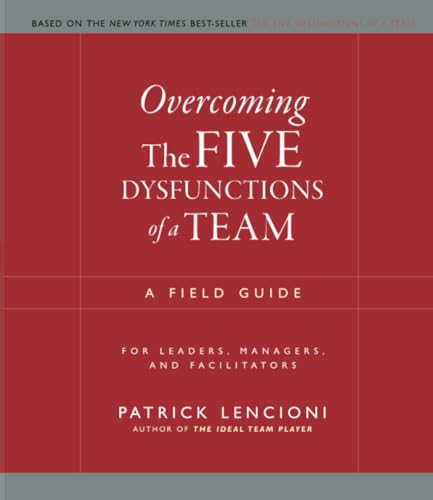
Published by Jossey-Bass in 2005, this 168-page field guide is organized around clarifying the model, addressing each dysfunction, answering implementation questions, and building the team. It includes assessments, exercises, facilitation advice, examples, a glossary, and resources. The book assumes a real team with shared responsibility—not merely a collection of people who report to one manager.
Core ideas
The dysfunctions form a pyramid
The sequence is: trust → productive conflict → commitment → accountability → results. Weakness near the foundation tends to impair the levels above it: without trust, people avoid candid disagreement; without debate, decisions remain ambiguous; without commitment, peer accountability feels presumptuous; without accountability, individuals protect their own priorities rather than shared outcomes. The model is presented as a practical diagnostic, not a claim that every team problem has only one cause.
Trust means vulnerability, not reliability alone
Lencioni uses trust to mean a willingness to acknowledge limitations, mistakes, needs, and uncertainty. The guide’s exercises include personal histories and behavioral profiling, intended to make colleagues more understandable and less defensive. The practical test is whether team members can ask for help, admit errors, and challenge one another without political self-protection.
Conflict should be made productive and visible
The target is disagreement about ideas, priorities, and decisions—not personal hostility. Suggested interventions include conflict profiling, explicit conflict norms, deliberately surfacing buried issues, granting permission to challenge, and examining how meetings suppress debate. Artificial harmony is treated as costly because unresolved disagreement reappears as delay, lobbying, or passive resistance.
Commitment requires clarity and buy-in, not unanimity
A team can commit to a decision without every member preferring it, provided the issue has been fully debated and the final direction is clear. The guide emphasizes commitment clarification, cascading communication, key principles, and thematic goals—tools for ensuring people know what was decided, why, and what matters most now.
Accountability is primarily peer-to-peer
Once standards and priorities are explicit, teammates should address missed commitments directly rather than depending entirely on the leader. The leader still models courage and intervenes when necessary, but a team that requires managerial enforcement for every lapse has not developed collective ownership.
Results must be collective
The final dysfunction is a drift toward individual status, departmental protection, or activity without shared outcomes. Lencioni’s remedy is a small set of visible team-level goals and a scoreboard that keeps attention on what the team—not merely its individual members—must accomplish.
The leader’s role is unusually hands-on
The guide is not a neutral toolkit. It expects leaders to create the conditions for candor, tolerate discomfort, insist on clarity, model accountability, and keep returning discussion to collective results. Facilitation is therefore behavioral and political, not just procedural.
Practical takeaways
- First determine whether the group is genuinely interdependent and whether members are willing to do the “heavy lifting”; the guide treats both as prerequisites for intervention.
- Use a team assessment to identify the most visible dysfunction, but work downward toward its likely foundation rather than treating symptoms independently.
- At the next meeting, distinguish debate from decision-making: allow vigorous discussion, then record the decision, owner, rationale, and implications for people who were not present.
- Create explicit norms for disagreement—for example, challenge ideas directly, do not reopen settled decisions without new evidence, and ask quiet members for their view.
- End important meetings with commitment clarification: What exactly did we decide? Who will communicate it? What will each person do differently?
- Make accountability observable through a short list of commitments and regular peer follow-up; avoid vague expectations that cannot be challenged fairly.
- Track one or two team-level outcomes visibly. If the scoreboard contains only individual or departmental metrics, it may reinforce the problem the book is trying to solve.
- Treat personality instruments as conversation aids, not explanations of behavior or substitutes for direct feedback; the guide specifically includes behavioral profiling among its tools.
Caveats and counterpoints
- The pyramid is memorable but deliberately reductive. Team dysfunction can also arise from incentives, power differences, unclear authority, workload, organizational structure, or psychological unsafety—factors that exercises alone cannot repair.
- The book’s advice is best suited to intact teams with a meaningful shared goal. Applying it to loosely connected specialists, temporary project groups, or teams whose goals are imposed and contradictory may produce artificial “buy-in” rather than real commitment.
- Vulnerability exercises can backfire if leaders demand personal disclosure, misuse confidential information, or have not established basic safety. Trust cannot be manufactured by a single off-site.
- A strong emphasis on peer accountability may be inappropriate where formal authority, labor rules, cultural norms, or retaliation risks make direct challenge unsafe; leaders must adapt the method to the power structure.
- The guide is practical rather than a comprehensive evidence review. Its examples and frameworks are useful for diagnosis and discussion, but they should not be mistaken for a validated guarantee that teams will improve.
Questions worth revisiting
- Is our group actually a team, or are we a set of specialists coordinated by a manager?
- Which disagreement are we currently avoiding because candor feels politically expensive?
- What decision remains ambiguous even though everyone appears to have agreed?
- What behavior would a teammate need to confront me about?
- Are our goals genuinely collective, and can we show progress with a simple scoreboard?
- Which intervention fits our current level of trust, rather than the level we wish we had?
Return to this when…
Return to the book before launching a team off-site, after a major reorganization, when meetings feel polite but decisions do not stick, or when accountability repeatedly escalates to the leader. Revisit the trust–conflict–commitment–accountability–results sequence as a diagnostic checklist, but test it against structural and power-related causes before prescribing an exercise.
References
- Overcoming the Five Dysfunctions of a Team: A Field Guide for Leaders ... - Patrick M. Lencioni - Google Books
- books.google.com
- search.worldcat.org
- catalog.library.tamu.edu
- Overcoming the Five Dysfunctions of a Team: A Field Guide for Leaders, Managers, and Facilitators Book
- Overcoming the five dysfunctions of a team : a field guide for leaders, managers, and facilitators | WorldCat.org
- books.google.co.tz
- books.google.co.tz
- oreilly.com
- overdrive.com
- tablegroup.com
- books.google.com