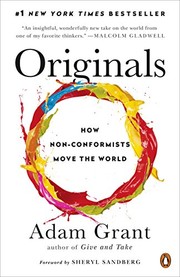

In one sentence
Originality is not reckless individualism. It is the disciplined process of generating and championing better alternatives while managing the social, emotional, and organizational risks of nonconformity. Progress depends not only on original thinkers, but also on leaders, parents, colleagues, and institutions that make dissent safer and useful.
Overview
Grant organizes the book around a practical question: how can people challenge conventions without unnecessarily risking their careers, relationships, or causes? He discusses recognizing promising ideas, testing them before committing, presenting them persuasively, recruiting allies, choosing when to act, and creating cultures where disagreement improves decisions. The book’s examples range across companies, social movements, politics, technology, and entertainment.
Core ideas
Originals are made, not born
Originality means producing and acting on ideas that are both novel and useful. Grant presents it as a behavioral capacity: question defaults, look for alternatives, and develop enough conviction to move an idea beyond private thought.
Generate many options before judging
Creative quality improves when people produce multiple possibilities rather than protecting their first idea. Broad exploration helps separate genuinely promising alternatives from merely unfamiliar ones.
Take calculated risks, not total risks
Successful originals often hedge: they maintain stable income, test ideas cheaply, build transferable skills, or keep fallback options. Security can make principled experimentation more feasible than all-or-nothing commitment.
Procrastination can support creativity
A moderate delay between starting and finishing can leave room for incubation and revision. The point is not to glorify avoidance: delay helps when it preserves exploration and hurts when it prevents execution.
Pitch weaknesses as well as strengths
Acknowledging limitations can increase credibility because it signals realism and invites useful discussion. A proposal becomes more persuasive when its advocate shows awareness of risks and explains how they will be managed.
Coalitions beat lone heroics
People challenging a norm need allies, supportive relationships, and social proof. Coalition-building reduces the appearance that the idea is merely one person’s eccentric preference and distributes the cost of dissent.
Timing and framing matter
The same challenge can succeed or fail depending on the audience’s readiness, the language used, and the amount of change proposed. Grant favors presenting departures from tradition as ways to preserve underlying values while improving outdated practices.
Leaders should institutionalize disagreement
Organizations reduce groupthink by inviting criticism, assigning dissenting roles, separating idea generation from evaluation, and rewarding people who identify problems early. Psychological safety is useful only when dissent is specific and evidence-based.
Practical takeaways
- Before committing to one solution, generate several alternatives and ask what each would make possible.
- Run low-cost tests before making a high-cost bet; preserve a fallback when practical.
- Ask trusted critics to identify the strongest objection to your idea, then revise rather than defensively rebutting it.
- When presenting change, connect it to values the audience already respects instead of treating tradition as stupidity.
- Build support privately before making a public challenge; identify people who gain from the proposed improvement.
- Use a deliberate pause after an initial idea to allow incubation, but set a firm deadline for deciding and acting.
- In meetings, appoint a genuine critic or ask, “What would make this fail?” Do not confuse ritual disagreement with serious evaluation.
- As a parent or teacher, encourage children to explain reasons, question rules respectfully, and develop models beyond the immediate authority figure.
Caveats and counterpoints
- The book is persuasive popular psychology rather than a systematic review. It relies heavily on memorable case studies, and successful examples may not represent the many original ideas that failed or were never pursued.
- Grant’s advice is conditional: procrastination, risk-taking, dissent, and nonconformity are not automatically beneficial. Their value depends on execution, domain knowledge, timing, power relationships, and the quality of the alternative.
- Some claims—especially around birth order, personality, and creativity—are presented more confidently than a cautious reader may find warranted; the birth-order discussion has attracted skepticism because those effects are difficult to generalize.
- Psychological safety does not eliminate structural risk. Junior employees, minorities, whistleblowers, and people in precarious jobs may face real penalties for dissent that better framing alone cannot solve.
- The book’s emphasis on individual agency can understate material conditions: access to money, education, networks, status, and institutional protection strongly affects who can afford to challenge norms.
Questions worth revisiting
- Which convention in my work is genuinely serving a purpose, and which survives mainly because nobody has proposed a credible alternative?
- What is the smallest experiment that could test my idea without requiring irreversible commitment?
- Am I defending my first idea, or comparing several options against evidence?
- Who would be affected by this change, and whose criticism am I currently not hearing?
- Would my proposal sound less threatening if I framed it as protecting a shared value?
- Where would dissent improve decisions in my organization, and what incentives currently punish it?
- Which parts of Grant’s argument depend on unusual success stories rather than strong general evidence?
Return to this when…
Return to these notes when preparing a proposal, deciding whether to challenge an established practice, designing an innovation process, or diagnosing groupthink. The most useful reminder is that originality is usually a social process: generate alternatives, test them, recruit allies, frame them carefully, and build conditions where criticism can improve the idea.