
In one sentence
Design creates durable organizational value only when it is treated as a managed capability—not merely as a collection of talented practitioners. The design leader’s job is therefore to shape the conditions in which good work can happen: purpose, structure, people systems, culture, quality practices, and productive relationships with other disciplines.
Overview
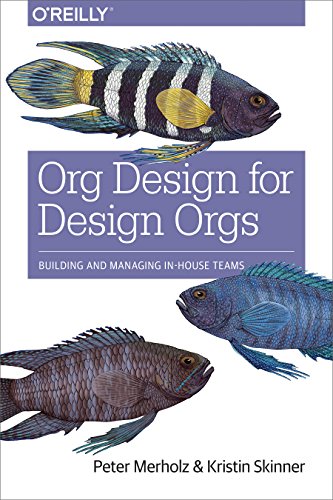
The book moves from the strategic case for design to the practical mechanics of running a design organization. It presents twelve qualities of effective design organizations, recommends a “centralized partnership” model as a useful hybrid between centralized and embedded teams, then addresses team composition, recruiting, career levels, management, culture, and collaboration. The final chapters frame organizational maturity as a progression from merely achievable work toward sustainable and impactful work.
Core ideas
Design is a business capability, not just a craft
The authors connect design’s growing importance to software, service complexity, and user empowerment. Design should help define and make strategy concrete, shape the whole customer journey, and improve experiences—not simply solve isolated interface problems. This broad framing is the justification for building an in-house function.
Start with organizational conditions
The twelve qualities include shared purpose; focused, empowered leadership; authentic user empathy; value creation; support for the entire journey; scalability; quality standards; delivery over perfection; humane treatment of people; diversity; collaboration; and effective operations. The memorable point is that weak context can neutralize strong individual designers.
Use structure deliberately
Centralized teams offer consistency, community, and easier management; embedded teams offer proximity and responsiveness but can fragment practice and identity. The proposed centralized partnership combines a coherent design home with close, durable relationships to product or business units. It requires explicit commitments, team leads, and design operations rather than assuming the structure will work automatically.
Design the organization for its stage of growth
The book describes an evolution from an initial designer pair, to a full team, to a design organization, then to coordination mechanisms for complexity and finally distributed leadership. Each stage creates different problems; copying the structure of a much larger organization too early—or retaining an informal structure too long—can both be costly.
Make roles and career paths explicit
The organization may need product designers, communication designers, researchers, program managers, content strategists, service designers, creative technologists, and several forms of leadership. A levels framework distinguishes craft, soft skills, responsibilities, and leadership, while preserving both individual-contributor and management paths.
Recruiting is a system and a team responsibility
Hiring extends beyond writing a job description: establish headcount, source deliberately, build school and community relationships, review portfolios consistently, coordinate interviews and feedback, check references, and treat hiring as a sustained practice rather than a short sprint. The emphasis is on process quality and shared ownership.
Manage designers by enabling judgment
The management guidance emphasizes clear expectations, support rather than control, obstacle removal, advocacy when necessary, frequent feedback, and knowing people as individuals. Managers are not expected to prescribe every design decision; they create clarity, protection, growth, and accountability.
Culture is built through repeated practices
Culture is not reduced to values statements or office aesthetics. It is reinforced through onboarding, meetings, critique, customer exposure, cross-team collaboration, community participation, and the ways work is discussed and decided. A charter helps make the intended culture legible, but activities make it real.
Practical takeaways
- Write a design-team charter covering purpose, scope, customers, decision rights, and how success will be recognized.
- Diagnose your current organization against the twelve qualities; look for system failures before blaming individual performance.
- Choose centralized, embedded, or hybrid structure based on the work, coordination needs, and maturity of the organization—not design fashion.
- Define roles and levels before scaling headcount, and support both specialist/individual-contributor and management growth.
- Treat recruiting as ongoing infrastructure: maintain sourcing channels, interview calibration, feedback discipline, and realistic role definitions.
- Protect designers’ maker time while making operating agreements with product, engineering, research, marketing, and leadership.
- Create shared quality practices through critique, standards, customer contact, and clear decision-making—not through final-stage design policing.
- Revisit structure as the team grows; the problems of a two-person team are not the problems of a distributed design organization.
Caveats and counterpoints
- The book was published in August 2016, so its examples and assumptions reflect the rapid expansion of digital product design and the organizational debates of that period. Its principles remain useful, but contemporary readers may need to adapt them to remote or globally distributed work, design systems, AI-assisted production, and newer research or operations practices.
- The centralized partnership is presented as a strong general-purpose model, but it is not a universal answer. Highly regulated environments, brand-led organizations, agency-like internal studios, or businesses requiring extreme local autonomy may need different arrangements.
- The framework is principally practitioner guidance rather than a comparative empirical study. It offers experienced recommendations and organizing concepts, but readers should validate proposed structures against their own decision latency, staffing economics, product model, and power relationships.
- The advice assumes design has, or can earn, meaningful access to strategy and leadership. Where executives do not value user-centered work or where incentives reward only short-term delivery, reorganizing the design team alone may not produce the promised impact.
Questions worth revisiting
- Which of the twelve qualities is currently weakest in my organization, and what evidence supports that diagnosis?
- Is our structure failing because of its formal design, or because partnerships, decision rights, and operating agreements are unclear?
- What work belongs in a shared design capability, and what work genuinely benefits from embedding?
- Do our career levels describe observable contribution and influence, or merely seniority and craft excellence?
- Where does design have authority to uphold quality, and where are designers acting as a late-stage gating function?
- What would “impactful,” rather than merely “achievable” or “sustainable,” design work look like in our organization?
- Which cultural practices expose designers to customers and help non-designers participate constructively in quality?
- What organizational problem are we trying to solve with the next hire, team, or reporting-line change?
Return to this when…
Return to this book when creating or restructuring an in-house design team, defining a design-leadership role, building career levels, improving hiring, or diagnosing why a capable design team is not influencing product and business outcomes. For current methods and updated organizational patterns, pair it with Peter Merholz’s later Design Org Dimensions material, which explicitly extends and updates the book’s framework.
Highlights
Org Design for Design Orgs is for those business and design leaders. This is the book we wish we had as we began our careers building and managing design teams. Like so many others, we figured it out as we went along, stumbling toward a set of approaches that work pretty well. We share what we’ve learned not because we have it all figured out (far from it!), but because it’s time to elevate the dialogue around design operations and management.
Enterprise software design remained terrible for a few reasons: the person buying the software was usually not the person using it; the people using it had no alternative; a belief that bad design could be overcome through training; and a sense that work shouldn’t be fun or pleasant, and that software should reflect such seriousness.
Most people make the mistake of thinking design is what it looks like. People think it’s this veneer—that the designers are handed this box and told, “Make it look good!” That’s not what we think design is. It’s not just what it looks like and feels like. Design is how it works.[
We’re using the phrase “focused leadership” to mean one or two people are running design and are from within the design organization—these leaders are not also overseeing other functions. While design leaders must be attentive to issues of quality, a common mistake made by many companies is that they place in this role a design visionary, a creative director with big ideas and an obsessive attention to detail. A design organization is an entity that needs care, nurturing, diplomacy, and leadership. The skills that made someone a great designer or creative director are almost wholly unrelated to the skills that make them a great manager and team leader. Instead, this design leader’s primary responsibilities will prove organizational, working with other executives to clear the path for design, and serving as a manager, mentor, team builder, and operator for the team itself, creating both a figurative and literal space where design can thrive.
A design organization is ultimately judged by the quality of its output. What’s tricky is that there’s no universal definition of design quality. So while “high-quality engineering” is typically considered through quantifiable metrics such as reduction of bugs shipped, speed of performance, and service uptime, “high-quality design” is understood through subjective measures rooted in personal preference and taste. Sure, design solutions can have quantitative performance measures such as conversion rates and task completion, but they are insufficient in establishing quality. The ultimate assessment of quality often exists in the eyes of the beholders. To overcome this, the design organization must be empowered to define quality standards for their team and their organization. Those standards then must be externalized so that others know what is being upheld. The goal is to take as much subjectivity as possible out of the equation, shifting design critique from a stance of personal preferences (“I really love this shade of blue”) or a desire to stand out (the infamous “make the logo bigger”) to an agreed-upon set of principles and guidelines that explain the team’s definition of quality, supported by numerous examples of design work that demonstrate good quality with callouts as to why.
Once the design org has established such quality standards, they must hold themselves up to those standards, and not sacrifice. The rest of the organization will likely act in a way that unintentionally discourages quality. People outside of the design team don’t understand what it takes to maintain a high quality bar, and design teams are asked to do too many things with too few people in too little time.
A design organization is only as good as what it delivers, and if it is producing crap because it’s trying to do too many things, then the rest of the organization will associate design with crap. Design leaders need to wield the power of “No.” Design work should only be done when adequately prioritized and staffed, and when there is time to develop quality solutions. This should not mean excessively long schedules for rumination and exploration. Good leaders know that there are points where design practice realizes diminishing returns, where further effort no longer leads to improved results. What it does mean is empowering the design organization to uphold what it takes to deliver quality, and to decline work that doesn’t fit.
Many design organizations rely on process as a proxy for quality. This is a false connection. Critical thinking is essential for delivering great work, and an over-adherence to a methodology leads to teams making unthinking decisions.
Actualized design teams overcome such practices by treating team members as individuals, with all the messiness implied. They recognize job titles are imperfect, and two people with the same title may have different skills. That’s OK, though, because everyone knows those people’s strengths and weaknesses, and makes sure that they’re set up to succeed. Seniority levels are seen as guidelines, not strict containers. Reporting structures are there for communication and mentorship, and do not limit anyone’s ability to share ideas and have an impact.
While maintaining this individualistic perspective is challenging as the design organization grows, it’s worth the effort. Designers, perhaps more than other professionals, are a sensitive, empathetic, expressive, and quirky bunch. Reducing them to labels and levels removes their individuality, blunting their engagement and, in turn, their work. Instead, celebrate their individuality. Let their freak flags fly.
Overly long work weeks deliver a double whammy to designers—along with the obvious struggle with work/life balance, designers, as creative professionals, need to disconnect in order to recharge. Constant production and overlong hours stagnates work quality, as designers rely on what is basic and safe. Productivity can even go backward—poor decisions designers make while fatigued have to then be undone before the team can move on.
Every member of the team must demonstrate respect to every other member, or the openness required for successful collaboration will not emerge. Dismissiveness, insults, cattiness, and behind-the-back gossip lead to people feeling shamed and shut down, and cannot be tolerated. Instead, train the team to give authentic feedback and to deal with disagreements constructively. Earning one another’s respect is necessary in order for the team to “get real,” because frank and candid critique and feedback are essential for upholding the quality standards. Greatness comes from the tension and collision of different perspectives (a concept known as “creative abrasion”), addressed openly and honestly. Design teams that favor politeness over candor will rarely produce great work.
Great design work takes space—places to collaborate, whiteboards for sketching and ideation, walls to show work. And those spaces should be permanent, places where the team works and sees their work all around them. Not only does this encourage continual engagement from the team itself, such spaces enable people outside the team to quickly connect with the work. It literally demonstrates openness and transparency. And instead of having occasional big share-outs (that require preparation that takes time away from productivity), these spaces support frequent lightweight check-ins. This keeps the work on track, because if it begins to veer off-course, it is quickly corrected.
The most underappreciated aspect of running a design organization is the importance of smooth operations (cue Sade). Just because design is “creative,” it shouldn’t get a pass in terms of running effectively. Much of what causes designers to stress in their work is the result of flawed operations. Symptoms include: Trouble coordinating internally, particularly around process, communications, and file management Difficulty collaborating with other parts of the organization Inappropriate staffing on projects and programs Lack of visibility into related workstreams or duplicate efforts Non-existent measurement
The gravest issue for designers is that they find themselves fundamentally disempowered. By the time designers are brought in to the project, the important decisions have already been made. Their concerns about assumptions underlying a brief are easily dismissed, because those designers will be gone when their part of the work is over. It’s the people in the business who are held accountable, and with that accountability comes authority.
When a company realizes that its centralized, function-based organization is leading to delays, subpar work, and unsatisfying outcomes, a common solution is to reorganize into wholly staffed, independent teams, with all the capabilities necessary for delivery. This reduces overhead by giving these teams autonomy to make decisions that benefit themselves, with the expectation that if everyone is looking out for their best interests, that will bubble up and serve the interests of the company as a whole. Design teams follow suit. Instead of a single design organization, designers embed within these decentralized teams.
This disempowerment leads to designers developing an “us versus them” attitude. They become disenchanted, nodding during meetings, but rolling their eyes afterward at the requirements they’ve been handed. They put in the bare minimum to get the work done, because their effort isn’t going to be appreciated. And such attitude and behavior only reinforces the business’s treatment of designers, leading to a vicious cycle of diminished expectations. The business units requesting design get frustrated because they have no real control over this function. They have pressing and important needs, but they have to wait for the design organization to be able to staff a team. Other projects are given priority, and they don’t understand why. When they finally do get design resources, the deadlines are such that there’s not enough time for any creativity. They have to wait for internal design team reviews before work gets approved. And so the business feels that they had to wait a long time, only to get substandard work.
Because these decentralized business and product teams have been wholly staffed, they have freedom and speed that they couldn’t achieve before. They no longer have to sit in someone else’s queue. They no longer have to wait for approvals. They are in control of their own destiny, and design is part of that. For the designers, instead of being brought in only after all the important decisions are made, they are now full team members. They participate throughout the product lifecycle, including the agenda-setting requirements development. They contribute to the strategy, and their perspective helps ensure superior product delivery.
Teams range in size from 2 to 7 members. Seven people can take on a large program—consider a generous designer-to-developer ratio of 1 to 5, we’re talking about a program that requires 35 engineers! If it seems the team should be bigger than 7, it’s likely its mandate has gotten too big. Split the team into two, each with a sharper focus.
This role can get confused for another such connection, the Frontend Developer. While frontend developers work closely with design and can be quite design savvy, the role is fundamentally an engineering role oriented on delivery. The Creative Technologist is less concerned about delivery than possibility. They can be fast and loose with their code in a way that frontend developers cannot. Frontend developers ultimately serve the purpose of the engineering team, focused on performance matters of stability, speed, and working-as-it-should at scale. Creative technologists align with the mission of the design organization, using engineering as a tool to uncover opportunities for a clear, coherent, and satisfying user experience.
Head of Design focuses on: Recruiting and hiring There may be nothing more important in the organization than identifying talent and getting them to join the team. Living the culture Addressed in depth in Chapter 8, the culture of a design team is essential to its long-term success. A Head of Design not only establishes the team’s cultural values, but demonstrates them every day through his or her actions. Process and practices Working with Design Managers and Creative Directors, establish a methodological toolkit, and make sure it is shared, understood, and used throughout the team. Vision Developing a “north star” for the company is not a one-time act, but an ongoing process of refinement and evolution. Represent design for the organization The Head is the primary voice of design inside and outside the company, sharing its work, evangelizing its success, and articulating its vision. Sometimes this representation means fighting for design in the face of policies, procedures, and bureaucracy that limits the team’s potential.
DESIGN TESTS? A topic of some controversy within product design circles is whether candidate interviews should involve some kind of design test or challenge akin to what happens in engineering interviews. Our firm, resolute response to this is “no.” Design tests set up an unhealthy power dynamic in the interview environment, when instead you should be fostering collegiality. The context in which the challenge is given (typically narrowly time-boxed and with only a little information and little support) is wholly artificial—and so whether a candidate succeeds or fails is not a meaningful indicator of actual practice. There is nothing you will find out in such a test that you couldn’t better learn through probing the candidate about their portfolio.
References
- petermerholz.com
- orgdesignfordesignorgs.com
- Org Design for Design Orgs: Building and Managing In-House Design Teams - Org Design for Design Orgs Book
- lib.ccsdetroit.edu
- books.apple.com
- play.google.com
- vitalsource.com
- Design Org Dimensions: The Hidden Architecture...
- campusbooks.com
- petermerholz.com
- indigo.ca
- 1. Why Design? Why Now? - Org Design for Design Orgs Book