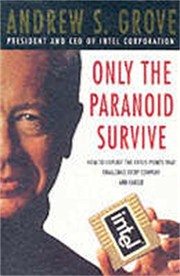

In one sentence
A successful organization must treat major environmental change as a possible strategic inflection point: a period when its competitive fundamentals are being reshaped. Survival depends less on predicting the future perfectly than on noticing contradictions early, debating them honestly, and moving decisively while the old business still provides resources.
Overview
Grove combines management advice with Intel case history. The central episode is Intel’s painful recognition that Japanese semiconductor producers had undermined its memory-chip business, requiring a shift toward microprocessors. He also discusses the Pentium crisis, the Internet’s disruptive potential, organizational behavior during uncertainty, and— in later editions or versions—career inflection points. The book’s contents include “A 10X Change,” “Signal or Noise?,” “Let Chaos Reign,” “Rein in Chaos,” and “Career Inflection Points.”
Core ideas
Strategic inflection points
A strategic inflection point occurs when a large change—often a roughly tenfold shift in an external force—alters the industry’s operating assumptions. The trigger may be competition, technology, customers, suppliers, complementary businesses, or regulation. The danger is that the change initially looks like ordinary noise.
The signal is often visible before it is accepted
Organizations rarely lack all warning; they often discount inconvenient evidence because existing incentives, expertise, and success reinforce the old strategy. Leaders should actively seek anomalies, dissatisfied customers, unexpected competitors, and facts that the current model explains poorly.
Intel’s memory-to-microprocessor transition
Grove presents Intel’s move away from memory chips as a defining example: Japanese competitors changed the economics and quality expectations of the memory market, but Intel took time to acknowledge that incremental improvement would not restore its position. The eventual response was to redirect the company toward microprocessors.
Let chaos expose the new reality
During a major transition, premature demands for certainty can suppress the information needed to choose a new direction. Grove favors allowing vigorous debate and experimentation, then imposing discipline once a viable strategic path becomes clear.
Middle managers are strategic sensors
Front-line and middle managers often encounter market changes before senior executives do. A leader’s job is to create channels where bad news travels upward, challenge filtered reports, and make it safe—but not consequence-free—to surface uncomfortable interpretations.
Act before the crisis is undeniable
Waiting for complete proof is dangerous because, by the time the new reality is obvious, competitors may have claimed the opportunity and the organization may lack the resources or credibility to respond. The practical goal is not certainty but a sufficiently strong case for reallocating attention and resources.
Change requires both bottom-up debate and top-down commitment
Exploration benefits from competing hypotheses, dissent, and local experimentation. Execution eventually requires a clear choice, concentrated resources, and management mechanisms that prevent the organization from quietly reverting to the old strategy.
The title means vigilance, not anxiety
“Paranoia” is Grove’s shorthand for assuming that success is temporary and that external conditions can change. It is useful as institutional alertness; taken literally, it could encourage indiscriminate fear, constant reorganizing, or short-term reactions to every apparent threat.
Practical takeaways
- Map the forces that define your current business model: customers, competitors, technologies, suppliers, complements, regulation, and distribution.
- Keep a running list of anomalies: lost deals, changing customer behavior, new substitutes, margin pressure, quality surprises, and competitors succeeding with a different model.
- Ask: “What would have to become true for our current strategy to stop working?” Then identify observable indicators.
- Separate ordinary fluctuations from structural changes by looking for multiple independent signals and changes in industry economics, not just isolated anecdotes.
- Give people closest to customers and operations a formal route to challenge the prevailing strategy.
- When evidence accumulates, run small experiments that test the emerging alternative rather than defending the incumbent model through incremental improvements alone.
- Once a direction is chosen, align budgets, incentives, staffing, product priorities, and communication around it; strategic change fails when only the slogan changes.
- For careers, watch for shifts in the skills, technologies, and organizational positions that create opportunity—and build capability before the transition is obvious.
Caveats and counterpoints
- The book is rooted in the semiconductor and personal-computer industries of the 1970s–1990s, so some examples and its discussion of the Internet are historically bounded rather than current analysis.
- Grove’s Intel-centered narrative gives a powerful insider account, but it is also a retrospective managerial interpretation of events, not a neutral history of the semiconductor industry.
- “10X change” is a memorable heuristic, not a reliable measurement rule. Important disruptions can be gradual, local, or cumulative rather than tenfold and sudden.
- Paranoia alone does not produce good strategy. Vigilance must be paired with customer evidence, economic analysis, experimentation, and the ability to distinguish a real structural shift from temporary volatility.
- The advice assumes leaders can redirect resources. Highly regulated, capital-intensive, or politically constrained organizations may need slower transitions, coalition-building, or risk controls that Grove’s decisive Intel examples understate.
Questions worth revisiting
- Which part of my organization’s current success would become a liability if the industry’s economics changed?
- What evidence am I discounting because it conflicts with our established strategy?
- Who sees the earliest customer, technology, or competitor signals—and do they have influence with decision-makers?
- What small, reversible experiment could test the alternative business model?
- Am I preserving a legacy business for sound strategic reasons, or because its identity and metrics dominate decision-making?
- What resources, incentives, and skills would have to move if the emerging strategy became our priority?
Return to this when…
Return to this book when a previously successful strategy begins producing contradictory signals, when a new technology or competitor changes customer economics, or when an organization is debating whether to protect its core business or redirect it. It is especially useful before a major strategic review; pair it with a more current industry analysis rather than treating Grove’s historical examples as forecasts.
Highlights
But these worries pale in comparison to how I feel about what I call strategic inflection points. I’ll describe what a strategic inflection point is a bit later in this book. For now, let me just say that a strategic inflection point is a time in the life of a business when its fundamentals are about to change. That change can mean an opportunity to rise to new heights. But it may just as likely signal the beginning of the end.
Let’s not mince words: A strategic inflection point can be deadly when unattended to. Companies that begin a decline as a result of its changes rarely recover their previous greatness.
I wasn’t having a wonderful time either. I’ve been around this industry for thirty years and at Intel since its inception, and I have survived some very difficult business situations, but this was different. It was much harsher than the others. In fact, it was unlike any of the others at every step. It was unfamiliar and rough territory. I worked hard during the day but when I headed home I got instantly depressed. I felt we were under siege—under unrelenting bombardment. Why was this happening?! Conference
What happened to us in the course of this event is something that happens to many businesses. All businesses operate by some set of unstated rules and sometimes these rules change—often in very significant ways. Yet there is no flashing sign that heralds these rule changes. They creep up on you as they crept up on us, without warning.
It’s like sailing a boat when the wind shifts on you but for some reason, maybe because you are down below, you don’t even sense that the wind has changed until the boat suddenly heels over. What worked before doesn’t work anymore; you need to steer the boat in a different direction quickly before you are in trouble, yet you have to get a feel of the new direction and the strength of the wind before you can hope to right the boat and set a new course.
When a change in how some element of one’s business is conducted becomes an order of magnitude larger than what that business is accustomed to, then all bets are off. There’s wind and then there’s a typhoon, there are waves and then there’s a tsunami. There are competitive forces and then there are supercompetitive forces. I’ll call such a very large change in one of these six forces a “10X” change, suggesting that the force has become ten times what it was just recently.
In the face of such “10X” forces, you can lose control of your destiny. Things happen to your business that didn’t before, your business no longer responds to your actions as it used to.
An inflection point occurs where the old strategic picture dissolves and gives way to the new, allowing the business to ascend to new heights. However, if you don’t navigate your way through an inflection point, you go through a peak and after the peak the business declines. It is around such inflection points that managers puzzle and observe, “Things are different. Something has changed.” Put another way, a strategic inflection point is when the balance of forces shifts from the old structure, from the old ways of doing business and the old ways of competing, to the new.
When exactly does a strategic inflection point take place? It’s hard to pinpoint, even in retrospect. Picture yourself going on a hike with a group of friends and getting lost. Some worrywart in the group will be the first one to ask the leader, “Are you sure you know where we’re going? Aren’t we lost?” The leader will wave him away and march on. But then the uneasiness over lack of trail markers or other familiar signs will grow and at some point the leader will reluctantly stop in his tracks, scratch his head and admit, not too happily, “Hey, guys, I think we are lost.” The business equivalent of that moment is the strategic inflection point.
Perhaps more than getting lost on a hike, working your way through a strategic inflection point is like venturing into what I call the valley of death, the perilous transition between the old and the new ways of doing business. You march in, knowing full well that some of your colleagues will not make it across to the other side. Yet the senior manager’s task is to force that march to a vaguely perceived goal in spite of the casualties, and the middle managers’ responsibility is to support that decision. There is no other choice.
Given the amorphous nature of an inflection point, how do you know the right moment to take appropriate action, to make the changes that will save your company or your career? Unfortunately, you don’t. But you can’t wait until you do know: Timing is everything. If you undertake these changes while your company is still healthy, while your ongoing business forms a protective bubble in which you can experiment with the new ways of doing business, you can save much more of your company’s strength, your employees and your strategic position. But that means acting when not everything is known, when the data aren’t yet in. Even those who believe in a scientific approach to management will have to rely on instinct and personal judgment. When you’re caught in the turbulence of a strategic inflection point, the sad fact is that instinct and judgment are all you’ve got to guide you through.
In the early eighties, Michael Dell started supplying his friends with computers he assembled out of parts in his dorm room at the University of Texas. Basically, he tapped into the desire of customers of the horizontal PC industry for low-cost standard computer systems. Later, Dell built on his experience and started a company based on the premise that people other than his college friends would also be interested in purchasing computers customized to their specific needs and supplied through direct means—in this case, through orders taken over the phone, with computers delivered by parcel post. No member of the old computer industry would have given a chance to a proposition that said that people would buy computers through the mail. It would simply have been seen as an unnatural act: just as dogs don’t fly, people don’t buy mail-order computers. At least, they didn’t in the old world order. Today, Dell Computer Corporation of Austin, Texas, is doing about $5 billion worth of business a year, still true to its original premise—selling personal computers custom-assembled to the individual buyer’s specifications, through the mail.
There is an important lesson to be learned from Novell’s experience. Whereas as a hardware producer Novell had lack of scale working against them, by being the first to popularize networking software that runs on PCs and capturing a large share of the emerging networking market, they made scale work for them. They turned from losers to winners.
In fact, there are two more lessons here. First, when a strategic inflection point sweeps through the industry, the more successful a participant was in the old industry structure, the more threatened it is by change and the more reluctant it is to adapt to it. Second, whereas the cost to enter a given industry in the face of well-entrenched participants can be very high, when the structure breaks, the cost to enter may become trivially small, giving rise to Compaqs, Dells and Novells, each of which emerged from practically nothing to become major corporations. What’s common among these companies is that they all instinctively followed the rules for success in a horizontal industry.
Horizontal industries live and die by mass production and mass marketing. They have their own rules. The companies that have done well in the brutally competitive horizontal computer industry have learned these implicit rules. By following them, a company has the opportunity to compete and prosper. By defying them, no matter how good its products are, no matter how well they execute their plans, a company is slogging uphill.
One, don’t differentiate without a difference. Don’t introduce improvements whose only purpose is to give you an advantage over your competitor without giving your customer a substantial advantage. The personal computer industry is characterized by well-chronicled failures when manufacturers, ostensibly motivated by a desire to make “a better PC,” departed from the mainstream standard. But goodness in a PC was inseparable from compatibility, so “a better PC” that was different turned out to be a technological oxymoron.
Two, in this hypercompetitive horizontal world, opportunity knocks when a technology break or other fundamental change comes your way. Grab it. The first mover and only the first mover, the company that acts while the others dither, has a true opportunity to gain time over its competitors—and time advantage, in this business, is the surest way to gain market share. Conversely, people who try to fight the wave of a new technology lose in spite of their best efforts because they waste valuable time.
Three, price for what the market will bear, price for volume, then work like the devil on your costs so that you can make money at that price. This will lead you to achieve economies of scale in which the large investments that are necessary can be effective and productive and will make sense because, by being a large-volume supplier, you can spread and recoup those costs. By contrast, cost-based pricing will often lead you into a niche position, which in a mass-production-based industry is not very lucrative.
When a Wal-Mart moves into a small town, the environment changes for every retailer in that town. A “10X” factor has arrived. When the technology for sound in movies became popular, every silent actor and actress personally experienced the “10X” factor of technological change. When container shipping revolutionized sea transportation, a “10X” factor reordered the major ports around the world. Reading the daily newspapers through a “10X” lens constantly exposes potential strategic inflection points.
Can travel agencies continue as before in the face of a significant loss of income? Within days of the airlines’ decision, two of the country’s largest agencies instituted a policy of charging customers for low-cost purchases. Will such a charge stick? What should the travel agencies do if the caps on commissions remain a fact of life and if their customers won’t absorb any of their changes? One industry association predicted that 40 percent of all agencies might go out of business. It is possible that this single act by the suppliers can precipitate a strategic inflection point that might in time alter the entire travel industry.
But beyond experiencing this crisis personally, the incident that I’m about to describe is how I learned with every fiber of my being what a strategic inflection point is about and what it takes to claw your way through one, inch by excruciating inch. It takes objectivity, the willingness to act on your convictions and the passion to mobilize people into supporting those convictions. This sounds like a tall order, and it is.
Meanwhile, as the debates raged, we just went on losing more and more money. It was a grim and frustrating year. During that time we worked hard without a clear notion of how things were ever going to get better. We had lost our bearings. We were wandering in the valley of death. I remember a time in the middle of 1985, after this aimless wandering had been going on for almost a year. I was in my office with Intel’s chairman and CEO, Gordon Moore, and we were discussing our quandary. Our mood was downbeat. I looked out the window at the Ferris wheel of the Great America amusement park revolving in the distance, then I turned back to Gordon and I asked, “If we got kicked out and the board brought in a new CEO, what do you think he would do?” Gordon answered without hesitation, “He would get us out of memories.” I stared at him, numb, then said, “Why shouldn’t you and I walk out the door, come back and do it ourselves?”
The way IBM and Intel responded to the x-ray technology threat showed that one company deemed it “signal,” while the other classified it “noise.” We decided not to pursue the x-ray approach. (Ten years later, it appears that we were right. As of this time of writing, to my knowledge, neither IBM nor the Japanese manufacturers are planning to use x-ray technology in manufacturing any time soon.) In
Contemporary management doctrine suggests that you should approach any debate and argument with data in hand. It’s good advice. Altogether too often, people substitute opinions for facts and emotions for analysis. But data are about the past, and strategic inflection points are about the future. By the time the data showed that the Japanese memory producers were becoming a major factor, we were in the midst of a fight for our survival. At the risk of sounding frivolous, you have to know when to hold your data and when to fold ‘em. You have to know when to argue with data. Yet you have to be able to argue with the data when your experience and judgment suggest the emergence of a force that may be too small to show up in the analysis but has the potential to grow so big as to change the rules your business operates by.
The point is, when dealing with emerging trends, you may very well have to go against rational extrapolation of data and rely instead on anecdotal observations and your instincts.
Simply put, fear can be the opposite of complacency. Complacency often afflicts precisely those who have been the most successful. It is often found in companies that have honed the sort of skills that are perfect for their environment. But when their environment changes, these companies may be the slowest to respond properly. A good dose of fear of losing may help sharpen their survival instincts.
How a company handles the process of getting through a strategic inflection point depends predominantly on a very “soft,” almost touchy-feely issue: how management reacts emotionally to the crisis. This is not so strange. Businesspeople are not just managers; they are also human. They have emotions, and a lot of their emotions are tied up in the identity and well-being of their business.
A manager in a business that’s undergoing a strategic inflection point is likely to experience a variation of the well-known stages of what individuals go through when dealing with a serious loss. This is not surprising, because the early stages of a strategic inflection point are fraught with loss—loss of your company’s preeminence in the industry, of its identity, of a sense of control of your company’s destiny, of job security and, perhaps the most wrenching, the loss of being affiliated with a winner.
However, unlike the accepted model of the sequence of emotions associated with grief (i.e., denial, anger, bargaining, depression and, ultimately, acceptance), in the case of a strategic inflection point, the sequence goes more as follows: denial, escape or diversion and, finally, acceptance and pertinent action.
By “early” I mean acting while the momentum of your existing business is strong, while the cash flow is there and while the organization is intact. The momentum of a still healthy business provides you with a benign bubble within which you can work on repositioning the company.
In other words, it is best when senior management recognizes and accepts the inevitability of a strategic inflection point early on and acts before the vitality of the business has been sapped by the “10X” forces affecting it. The necessary transformation of the business will likely be a lot less wrenching and more successful if proper action is taken early and enforced decisively.
Looking back over my own career, I have never made a tough change, whether it involved resource shifts or personnel moves, that I haven’t wished I had made a year or so earlier.
When I think about what it’s like to get through a strategic inflection point, I’m reminded of a classic scene in old western movies in which a bedraggled group of riders is traveling through a hostile landscape. They don’t know exactly where they are going; they only know that they can’t turn back and must trust that they will eventually reach a place where things are better.
To make it through the valley of death successfully, your first task is to form a mental image of what the company should look like when you get to the other side. This image not only needs to be clear enough for you to visualize but it also has to be crisp enough so you can communicate it simply to your tired, demoralized and confused staff.
You need to answer these questions in a single phrase that everybody can remember and, over time, can understand to mean exactly what you intended. In 1986, when we came up with the slogan “Intel, the microcomputer company,” that was exactly what we were trying to achieve. The phrase didn’t say anything about semiconductors, it didn’t say anything about memories. It was meant to project our mental image of the company as we would emerge from the valley of death that the 1985–86 memory debacle/strategic inflection point represented for us.
Doing this should actually be a little easier at this point because, as you’re coming out of a very bad period, you’re likely to have extremely strong feelings about what you don’t want to be. By 1986 we knew we did not want to be in the memory business any longer. We knew it with a passion that only comes after struggling with a business and finding that we were no better off for those struggles.
Getting through strategic inflection points represents a fundamental transformation of your company from what you were to what you will be. The reason such a transformation is so hard is that all parts of the company were shaped by what you had been in the past. If you and your staff got your experience managing a computer company, how can you even imagine managing a software company? If you got your experience managing a broad-based semiconductor company, how can you even imagine what a microcomputer company might be like? Not surprisingly, the transformation implicit in surviving a strategic inflection point involves changing members of management one way or another.
The discipline of redeployment is needed in spades when it comes to your personal time. When I started on this software study, I had to take the time I spent on it away from other things. In other words, I had to be the “production planner” of my own time and had to reallocate the way I spent time at work.
A strategic transformation requires discipline and redeployment of all resources; without them, it turns out to be nothing more than an empty cliché. One more word about your own time: if you’re in a leadership position, how you spend your time has enormous symbolic value. It will communicate what’s important or what isn’t far more powerfully than all the speeches you can give. Strategic change doesn’t just start at the top. It starts with your calendar.
Strategic plans are statements of what we intend to do. Strategic actions are steps we have already taken or are taking which suggest our longer-term intent. Strategic plans sound like a political speech. Strategic actions are concrete steps.
Strategic plans deal with events that are so far in the future that they have little relevance to what you actually have to do today. So they don’t command true attention. Strategic actions, however, take place in the present. Consequently, they command immediate attention. Their power comes from this very aspect. Even if any one strategic action changes the trajectory on which the corporation moves by only a few degrees, if those actions are consistent with the image of what the company should look like when it gets to the other side of the inflection point, every one of them will reinforce every other. That’s why I think the most effective way to transform a company is through a series of incremental changes that are consistent with a clearly articulated end result.
When is the time right? When the momentum of your existing strategy is still positive, your business is still growing, your customers and complementors still think highly of you yet there’s enough evidence of blips on your radar screen to warrant, at a minimum, exploring their significance. If your exploration confirms that they are real and are gaining, shift more resources on to them. Your tendency will almost always be to wait too long. Yet the consequences of being early are less onerous than the consequences of being late.
Your tendency will almost always be to wait too long. Yet the consequences of being early are less onerous than the consequences of being late. If you act too early, chances are the momentum of your previous business is still healthy. Therefore even if you’re wrong, you’re in a better position to course-correct. For instance, you can even pull back to their old jobs people whom you’ve reassigned to other areas. Since they come from those tasks, they can pick up the pieces again in no time and help out. But management’s tendency is to hang on to the old, so their strategic actions are more likely to happen later rather than earlier. The risk is that if you are late you may already be in an irreversible decline.
Simply put, in times of change, managers almost always know which direction they should go in, but usually act too late and do too little. Correct for this tendency: Advance the pace of your actions and increase their magnitude. You’ll find that you’re more likely to be close to right.
If competition is chasing you (and they always are—this is why “only the paranoid survive”), you only get out of the valley of death by outrunning the people who are after you. And you can only outrun them if you commit yourself to a particular direction and go as fast as you can. You could argue that, since they are chasing you, you should give yourself all sorts of alternative directions—in other words, hedge. I say, “No.” Hedging is expensive and dilutes commitment. Without exquisite focus, the resources and energy of the organization will be spread a mile wide—and they will be an inch deep.
If you’re wrong, you will die. But most companies don’t die because they are wrong; most die because they don’t commit themselves. They fritter away their momentum and their valuable resources while attempting to make a decision. The greatest danger is in standing still.
When a company is meandering, its management staff is demoralized. When the management staff is demoralized, nothing works: Every employee feels paralyzed. This is exactly when you need to have a strong leader setting a direction. And it doesn’t even have to be the best direction—just a strong, clear one. Organizations in the valley of death have a natural tendency to drift back into the morass of confusion. They are very sensitive to obscure or ambiguous signals from their management. Heads of companies often inadvertently contribute to this confusion.
At times like this, your calendar becomes your most important strategic tool. Most executives’ schedules are shaped by the inertia of prior actions. You are likely to accept appointments, attend meetings and schedule activities that are similar to what you had been doing in the past. Break the mold now. Resist the tacit temptation to accept invitations or make appointments because you have done so in the past. Ask yourself the questions, “Will going to this meeting teach me about the new technology or the new market that I think is very important now? Will it introduce me to people who can help me in the new direction? Will it send a message about the importance of the new direction?” If so, go to it. If not, resist it.
The other side of the valley of death represents a new industry order that was hard to visualize before the transition. Management did not have a mental map of the new landscape before they encountered it. Getting through the strategic inflection point required enduring a period of confusion, experimentation and chaos, followed by a period of single-minded determination to pursue a new direction toward an initially nebulous goal. It required listening to Cassandras, deliberately fostering debates and constantly articulating the new direction, at first tentatively but more clearly with each repetition. It required casualties and personal transformation; it required accepting the fact that not all would survive and that those who did would not be the same as they had been before. Beyond a doubt, going through the valley of death that a strategic inflection point represents is one of the most daunting tasks an organization has to endure. But when “10X” forces are upon us, the choice is taking on these changes or accepting an inevitable decline, which is no choice at all.
I have long held that each person, whether he is an employee or self-employed, is like an individual business. Your career is literally your business, and you are its CEO.
References
- Only the Paranoid Survive: How to Exploit the Crisis Points That Challenge ... - Andrew S. Grove - Google Books
- books.google.com
- Only the Paranoid Survive: How to Exploit the Crisis Points that Challenge ... - Andrew S. Grove - Google Books
- books.google.com
- books.google.com
- books.google.co.uk
- thekeypoint.org
- briansnotes.io
- marcabraham.com
- rlaexp.com
- goodreads.com
- emerald.com