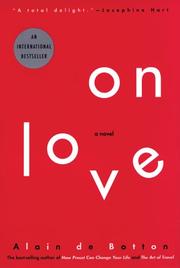

In one sentence
Love is not simply discovered in another person: it is partly constructed from prior longings, fantasies, fears, and cultural stories. De Botton’s novel suggests that the mind’s effort to understand love can illuminate it, but can also become a way of possessing, misreading, or avoiding the beloved.
Overview
The American edition, On Love, was first published in 1993; the British edition is titled Essays in Love. The narrator meets Chloe on a Paris–London flight, and the novel traces the affair through attraction, intimacy, jealousy, disappointment, and emotional aftermath without treating romance as a conventional plot-driven story. Its form resembles a philosophical case study: titled chapters, numbered paragraphs, diagrams, literary references, and analyses of seemingly ordinary details.
Core ideas
The beloved as an answer to a prior need
The narrator’s attraction is presented as more than recognition of Chloe’s actual qualities. He has already developed a desire to love, then interprets her as the person who can satisfy it. The novel repeatedly questions whether we love individuals or the meanings we attach to them.
Romantic fatalism versus contingency
The opening encounter feels destined, yet de Botton playfully examines the mundane probabilities behind it—seating arrangements, timing, geography, and social circumstance. The tension is between the grand story lovers tell about fate and the accidents that make the story possible.
Analysis as both insight and defense
The narrator’s intelligence helps him notice emotional patterns, but his relentless interpretation also distances him from Chloe. Thinking about intimacy can become a substitute for participating in it, and explanation can shade into surveillance or control.
Idealization and the limits of knowledge
Early love turns fragments into a whole person. The narrator fills gaps in what he knows about Chloe with imagination, then experiences the collision between his mental portrait and her independent reality as betrayal or inexplicable change.
Romantic communication as indirect conflict
The book depicts lovers who often conceal their needs, test one another, or communicate through silence and strategically casual remarks. What it calls romantic ‘terrorism’ grows from the fear that direct vulnerability would surrender power.
A comic-philosophical novel of emotional narcissism
The narrator’s self-consciousness is funny, but the comedy exposes a serious problem: even apparent devotion may remain centered on one’s own feelings, wounds, and self-image. Critics have differed on whether the intellectual playfulness deepens the novel or becomes pretentious; both responses reflect its deliberately unstable balance between sincerity and parody.
Stendhal and the tradition of dissecting passion
De Botton consciously treats romantic feeling as something that can be catalogued, classified, and examined. The book’s numbered sections and aphoristic style recall a philosophical treatise while preserving the emotional vulnerability of a novel; one contemporary reviewer specifically situated it in relation to Stendhal’s analytical tradition.
Practical takeaways
- When a relationship feels destined, separate the facts of the encounter from the story you have built around it.
- Ask which qualities belong to the other person and which have been supplied by your hopes, fears, or cultural expectations.
- Notice when analysis is clarifying an emotion and when it is protecting you from honestly expressing it.
- A partner’s opacity is not necessarily a defect to solve; another person remains partly independent of your interpretation.
- Early intensity may reveal a powerful capacity for longing without proving that two people are well matched.
- The book’s narrator is not a neutral guide: his intelligence, self-absorption, and unreliability are part of what must be assessed.
Caveats and counterpoints
- This is a highly stylized literary novel, not a psychological handbook or a balanced account of relationships.
- The narrator’s perspective dominates, so Chloe is understood largely through his projections; readers may find the treatment insightful, comic, objectifying, or all three.
- The novel’s deliberately intellectual form—diagrams, abstractions, references, and numbered sections—can feel either fresh and illuminating or mannered and overextended. Contemporary reviews split along those lines.
- These notes avoid the final developments of the plot and should not be treated as a substitute for the particular wording, arrangement, or revisions of any edition.
Questions worth revisiting
- What does the narrator actually know about Chloe, and what does he merely infer?
- Does analysis make his love more truthful, or does it turn Chloe into a subject of study?
- Which parts of romantic disappointment come from another person’s actions, and which come from inflated expectations?
- Why does the novel need to present itself as both a love story and a series of essays?
- When does wit make emotional pain more bearable, and when does it prevent genuine sympathy?
Return to this when…
Return to these notes when thinking about first impressions, idealization, anxious interpretation, or the gap between loving someone and loving an imagined future with them.
Highlights
I had to find out more about Chloe, for how could I abandon my true self unless I knew what false self to adopt?
When we look at someone (an angel) from a position of unrequited love and imagine the pleasures that being in heaven with them might bring us, we are prone to overlook a significant danger: how soon their attractions might pale if they began to love us back. We fall in love because we long to escape from ourselves with someone as ideal as we are corrupt. But what if such a being were one day to turn around and love us back? We can only be shocked.
How could they be divine as we had hoped when they have the bad taste to approve of someone like us? If in order to love, we must believe that the beloved surpasses us in some way, does not a cruel paradox emerge when we witness this love returned? 'If s/he really is so wonderful, how could s/he could love someone like me?'
If one is not wholly convinced of one's own lovability, receiving affection can appear like being bestowed an honour for a feat one feels no connection with. Lovers unfortunate enough to prepare breakfast for such types must brace themselves for the recriminations due to all false flatterers.
'Don't worry, I'm not angry with you, I'm glad you kept the old horror on, I would have thought you were so weak if you'd done what I told you.'
Therefore, in the mature account of love, we should never fall at first glance. We should reserve our leap until we have completed a clear-eyed investigation of the depths
Later in the afternoon, I took a walk in the garden with her father, a donnish man to whom thirty years of marriage had imparted some distinctive views on the subject. 'I know my daughter and you are fond of one another. I'm no expert on love, but I'll tell you something. In the end, I've found that it doesn't really matter who you marry. If you like them at the beginning, you probably won't like them at the end. And if you start off hating them, there's always the chance you'll end up thinking they're all right.'
It may be a sign that two people have stopped loving one another (or at least stopped wishing to make the effort that constitutes ninety per cent of love) when they are no longer able to spin differences into jokes. Humour lined the walls of irritation between our ideals and the reality: behind every joke, there was a warning of difference, of disappointment even, but it was a difference that had been defused - and could therefore be passed over without the need for a pogrom.
As Proust once said, classically beautiful women should be left to men without imagination.
love is today kept alive by modern capitalism only in order to: . . . motivate individuals – where there is no other means of motivating them – to occupy the positions husband-father and wife-mother and form nuclear families that are essential not only for reproduction and socialization but also to maintain the existing arrangements for distributing and consuming goods and services and, in general, to keep the social system in proper working order and thus maintain it as a going concern.
For a moment, I fantasized I might transform myself into a carton of yogurt so as to undergo the same process of being gently and thoughtfully accommodated by her into a shopping bag between a tin of tuna and a bottle of olive oil. It was only the incongruously unsentimental atmosphere of the supermarket ('Liver Promotion Week') that alerted me to how far I might have been sliding into romantic pathology. 6. On the
Love reveals its insanity by its refusal to acknowledge the inherent normality of the loved one. Hence the boredom of lovers for those standing on the sidelines. What do they see in the beloved save simply another human being?
'By forty, everyone has the face they deserve,' wrote George Orwell,
Desperate needs bring about a hallucination of their solution: thirst hallucinates water, the need for love hallucinates a prince or princess.
To love someone is to take a deep interest in them, and by such concern to bring them to a richer sense of what they are doing and saying.
However happy we may be with our partner, our love for them necessarily hinders us from pursuing alternatives. Why should this constrain us if we love them? Why should we feel this as a loss unless our love for them has already begun to wane? Because in resolving our need to love, we do not always succeed in resolving our need to long.
We might define maturity as the ability to give everyone what they deserve when they deserve it, to separate the emotions that belong and should be restricted to oneself from those that should at once be expressed to their initiators rather than passed on to later and more innocent arrivals. We were often not mature.
Why don't you love me? is as impossible a question (though a far less pleasant one) to ask as Why do you love me? In both cases, we come up against our lack of conscious control in the amorous structure, the fact that love has been brought to us as a gift for reasons we never wholly determine or deserve. To ask such questions, we are forced to veer on one side towards complete arrogance, on the other to complete humility: What have I done to deserve love? asks the humble lover; I can have done nothing. What have 1 done to be denied love? protests the betrayed one, arrogantly claiming possession of a gift that is never one's due. To both questions, the one who hands out love can only reply: Because you are you – an answer that leaves the beloved dangerously and unpredictably strung between grandiosity and depression.
Her apathy embodied the hope that by doing nothing, another might take the decision for her, that by displaying her indecision and frustration while not acting on it I would ultimately perform the move that she had needed (but been too scared) to make herself.
Once a partner has begun to lose interest, there is apparently little the other can do to arrest the process. Like seduction, withdrawal suffers under a blanket of reticence. The very breakdown of communication is hard to discuss, unless both parties have a desire to see it restored. This leaves the lover in a desperate situation. Honest dialogue seems to produce only irritation and smothers love in the attempt to revive it. Desperate to woo the partner back at any cost, the lover might at this point be tempted to turn to romantic terrorism, the product of irredeemable situations, a gamut of tricks (sulking, jealousy, guilt) that attempt to force the partner to return love, by blowing up (in fits of tears, rage or otherwise) in front of the loved one. The terroristic partner knows he cannot realistically hope to see his love reciprocated, but the futility of something is not always (in love or in politics) a sufficient argument against it. Certain things are said not because they will be heard, but because it is important to speak.
The sulker is a complicated creature, giving off messages of deep ambivalence, crying out for help and attention, while at the same time rejecting it should it be offered, wanting to be understood without needing to speak.
According to Immanuel Kant, a moral action is to be distinguished from an amoral one by the fact that it is performed out of duty and regardless of the pain or pleasure involved. I am behaving morally only when I do something without consideration of what I may get in return for it, when I am guided solely by duty:
The essence of Kant's theory is that morality is to be found exclusively in the motive from which an act is performed. To love someone is moral only when that love is given free of any expected return, if that love is given simply for the sake of giving love.
Whenever something calamitous happens to us, we are led to look beyond everyday causal explanations in order to understand why we have been singled out to receive such terrible, intolerable punishment. And the more devastating the event, the more inclined we are to imbue it with a significance it does not objectively have, the more likely we are to slip into a brand of psychological fatalism. Bewildered and exhausted by grief, I suffocated on question marks: 'Why me? Why this? Why now?' I scoured the past to look for origins, omens, offences, anything that might count as an explanation for the wound I had sustained.
A notorious inability to express emotions makes human beings the only animals capable of suicide. An angry dog does not commit suicide, it bites the person or thing that made it angry, but an angry human sulks in its room and later shoots itself leaving a silent note.
It is hard to imagine Christianity having achieved such success without a martyr at its head. If Jesus had simply led a quiet life in Galilee making commodes and dining tables and at the end of his life published a slim volume entitled My Philosophy of life before dying of a heart attack, he would not have acquired the status he did.
The difference could be grouped into categories of mature and immature love. Preferable in almost every way, the philosophy of mature love is marked by an active awareness of the good and bad within each person, it is full of temperance, it resists idealization, it is free of jealousy, masochism, or obsession, it is a form of friendship with a sexual dimension, it is pleasant, peaceful, and reciprocated (and perhaps explains why most people who have known the wilder shores of desire would refuse its painlessness the title of love). Immature love on the other hand (though it has little to do with age) is a story of chaotic lurching between idealization and disappointment, an unstable state where feelings of ecstasy and beatitude combine with impressions of drowning and fatal nausea, where the sense that one has finally found the answer comes together with the feeling that one has never been so lost. The logical climax of immature (because absolute) love comes in death, symbolic or real. The climax of mature love comes in marriage, and the attempt to avoid death via routine (the Sunday papers, trouser presses, remote-controlled appliances). For immature love accepts no compromise, and once we refuse compromise, we are on the road to some kind of cataclysm.
But sitting at a dinner party one evening, lost in Rachel's eyes while she outlined the course of her office life for me, I was shocked to realize how easily I might abandon a stoic philosophy in order to repeat all the mistakes I had lived through with Chloe. If I continued to look at Rachel's hair tied elegantly in a bun, or at the grace with which she used her knife and fork or the richness of her blue eyes, I knew I would not survive the evening intact.
If I wanted to be courageous, were there not greater opportunities for heroism in love? Moreover, for all the sacrifices demanded by the stoic life, was there not something cowardly within it? At the heart of stoicism lay the desire to disappoint oneself before someone else had the chance to do so. Stoicism was a crude defence against the dangers of the affections of others, a danger that it would take more endurance than a life in the desert to be able to face. In calling for a monastic existence free of emotional turmoil, stoicism was simply trying to deny the legitimacy of certain potentially painful yet fundamental human needs. However brave, the stoic was in the end a coward at the point of perhaps the highest reality, at the moment of love. 17.
I realized that a more complex lesson needed to be drawn, one that could play with the incompatibilities of love, juggling the need for wisdom with its likely impotence, juggling the idiocy of infatuation with its inevitability. Love had to be appreciated without flight into dogmatic optimism or pessimism, without constructing a philosophy of one's fears, or a morality of one's disappointments. Love taught the analytic mind a certain humility, the lesson that however hard it struggled to reach immobile certainties (numbering its conclusions and embedding them in neat series), analysis could never be anything but flawed – and therefore never stray far from the ironic.
Such lessons appeared all the more relevant when Rachel accepted my invitation for dinner the following week, and the very thought of her began sending tremors through the region the poets have called the heart, tremors that I knew could have meant one thing only – that I had once more begun to fall.