
In one sentence
Positioning is the deliberate act of defining how a product is the best option for a specific group of customers who care deeply about a particular outcome. It is not merely messaging or branding: positioning supplies the context that makes marketing, sales, product strategy, and perceived value work.
Overview
Dunford’s process begins by examining how customers solve the problem today, rather than starting with the product’s features or the category the company wants to claim. From there, teams identify what is genuinely different, translate those differences into customer value, locate the customers who care most, and choose a market category that makes the product’s strengths obvious. Relevant market trends can strengthen the position, but should not substitute for durable value.
Core ideas
Positioning is context, not a slogan
The same product can appear valuable, ordinary, or irrelevant depending on the comparison set and market context. A product’s capabilities do not explain themselves; buyers interpret them through familiar categories, alternatives, and expectations.
Start with competitive alternatives
Ask what customers would use or do instead—including manual work, spreadsheets, internal projects, or doing nothing. These real alternatives reveal what buyers are comparing, which makes differentiation more concrete than simply listing named competitors.
Separate attributes, value, and proof
A differentiated feature is not automatically valuable. Connect each unique attribute to the customer outcome it enables, then support the claimed value with evidence such as customer results, demonstrations, data, or credible references.
Choose the best-fit customers
Do not target the broadest possible audience. Look for customers whose problems, constraints, priorities, and existing alternatives make the product’s distinctive strengths especially important. Positioning is strongest where the product’s advantages solve an urgent, well-defined problem.
Select a market category strategically
A category supplies assumptions about buyers, competitors, use cases, pricing, and required capabilities. Choose the category—or, where appropriate, a narrower or alternative category—that makes the product’s advantages easiest for the target customer to understand.
Positioning is upstream of messaging
Messaging should express an already-decided position. If a team begins with taglines, feature lists, or website copy before agreeing on the product’s alternatives, value, customers, and category, it is likely polishing strategic confusion.
Positioning is a cross-functional decision
The work depends on evidence held by product, sales, customer success, leadership, and marketing. Dunford’s method is best treated as a collaborative alignment exercise rather than a marketing department’s isolated copywriting task.
Trends are leverage, not foundations
A timely trend can make an existing advantage more urgent or understandable. But a trend-based position is fragile if the product lacks meaningful differentiation or if the trend fades; use trends to amplify a good position, not to manufacture one.
Practical takeaways
- Run a positioning workshop around five questions: What are customers using instead? What makes us genuinely different? Why do those differences matter? Which customers care most? What category makes the advantage obvious?
- Interview recent wins, best-fit customers, lost deals, and prospects who chose an alternative. Listen for the comparison they made—not just the words your company uses.
- Translate every important feature into a chain: capability → customer impact → business value → proof.
- Treat “doing nothing” and existing internal processes as serious competitors; they often explain stalled deals better than a named vendor does.
- Create one shared positioning document before rewriting the website, sales deck, or product pitch. Use it as the strategic source for those materials.
- Revisit positioning when the product, customer mix, competitive alternatives, or market context changes. Positioning is a choice that may need updating, not a permanent identity.
Caveats and counterpoints
- The book is especially oriented toward startups and B2B technology companies; consumer brands, regulated categories, and mature mass markets may require additional research, segmentation, brand, pricing, and channel frameworks. The official description emphasizes growing B2B technology companies.
- The framework provides disciplined questions, but it cannot replace customer evidence or judgment. A weak understanding of buyers, alternatives, or value will produce a neatly organized but inaccurate position.
- Choosing a category can clarify value, but an unfamiliar category may also create education costs, credibility problems, or expectations the product cannot meet.
- A favorable position does not guarantee product-market fit, demand, distribution, or retention. It can make value easier to recognize; it cannot create value that customers do not experience.
- One serious review finds the book unusually actionable but relatively light on nuance and detailed examples, so complex positioning work may require supplementary research and testing.
- Bibliographic listings identify the commonly referenced edition as Ambient Press, 2019, 189 pages; the author’s site also advertises a newly updated and expanded edition, so exercises and wording may differ by edition.
Questions worth revisiting
- What would our best customers replace if our product disappeared tomorrow?
- Which product capability is both unusual and important—not merely interesting?
- What measurable customer or business outcome does that capability enable?
- Which customer segment experiences the problem most acutely and has authority or budget to act?
- Which market category gives buyers the most useful expectations while highlighting our strengths?
- What evidence would make our claimed value believable to a skeptical buyer?
- Are we describing the product we intended to build, or the product customers actually use and value?
Return to this when…
Return to these notes when preparing a positioning workshop, revising a go-to-market strategy, onboarding a product-marketing or sales team, or diagnosing why a product is being misunderstood despite having strong capabilities.
Highlights
“How do you beat Bobby Fischer? You play him at any game but chess.” WARREN BUFFETT
Even a world-class product, poorly positioned, can fail. In the context of a concert hall, Bell is perceived as producing something that is very valuable. He’s dressed to perform. He’s surrounded by an orchestra on a beautiful stage. The program tells people what awards he has won. Whereas, when he’s playing outside a subway station, everything around him has changed. He’s dressed like a street performer and standing beside a garbage can, playing for tips. His product—the music—hasn’t changed, but in this context, few people recognize its value.
These are the Five (Plus One) Components of Effective Positioning: Competitive alternatives. What customers would do if your solution didn’t exist. Unique attributes. The features and capabilities that you have and the alternatives lack. Value (and proof). The benefit that those features enable for customers. Target market characteristics. The characteristics of a group of buyers that lead them to really care a lot about the value you deliver. Market category. The market you describe yourself as being part of, to help customers understand your value. (Bonus) Relevant trends. Trends that your target customers understand and/or are interested in that can help make your product more relevant right now.
References
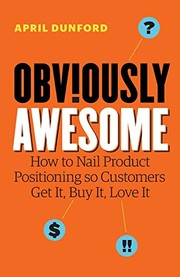
- Obviously Awesome - How to Nail Product Positioning so Customers Get it, Buy it, Love it
- Obviously Awesome: How to Nail Product Positioning So Customers Get It, Buy ... - April Dunford - Google Books
- goodreads.com
- themarketingjuice.com
- glasp.co
- Obviously Awesome: How to Nail Product Positioning so Customers Get It, Buy It, Love It by April Dunford | Goodreads
- lightdrop.com
- April Dunford: Positioning Is Not Branding, And It's Not Just Marketing's Job
- mindleap.app
- Review: Obviously Awesome by April Dunford
- mindtheproduct.com
- guptadeepak.com