
In one sentence
Business success often comes less from producing clever ideas than from seeing the relevant facts clearly, identifying the simplest effective action, and persisting when others dismiss it as too ordinary.
Overview
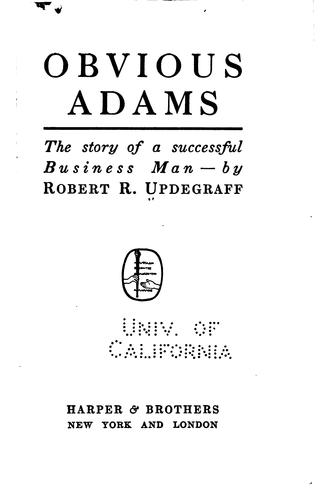
Oliver Adams begins as a grocery clerk and seeks work with the Oswald Advertising Agency. Although he lacks the conspicuous ambition and cleverness expected in advertising, he observes people, products, stores, and sales situations closely. His practical recommendations repeatedly succeed because they address the real problem directly. Adams eventually becomes influential not through dramatic genius, but through reliable judgment and execution. The 1980 revised edition adds the author’s later notes on applying the “obvious” approach.
Core ideas
The obvious is usually hidden by complication
People often search for novelty, sophistication, or impressive language before asking what the situation plainly calls for. Adams cuts through this tendency by starting with direct observation and common sense.
Observation precedes creativity
The book’s advertising examples suggest that useful ideas emerge from examining customers, products, retail conditions, and actual behavior—not from inventing concepts in isolation. The relevant facts constrain and improve the creative answer.
Simplicity must be actionable
An insight matters only when someone converts it into a concrete change: clearer copy, better presentation, more appropriate targeting, or a direct response to the buyer’s need. Adams’s advantage is practical translation, not merely noticing.
Persistence is part of obviousness
Seeing the right answer is insufficient. Adams continues with an idea after initial skepticism and follows it through without theatrical self-promotion. The author links sound judgment to the resolve to act on it.
Unflashy competence compounds
Adams is deliberately portrayed as ordinary. His reputation grows because repeated, dependable decisions create results over time. The parable challenges the assumption that leadership requires charisma, novelty, or visible “genius.”
A useful test for decisions
Before adding complexity, ask: What facts are directly in front of me? What does the customer or user actually need? What would I recommend if I had to explain the answer plainly? What simple action can I take now?
Practical takeaways
- Describe the customer’s problem in everyday language before brainstorming campaigns or solutions.
- Inspect the real environment—stores, interfaces, conversations, usage, complaints, and buying behavior—rather than relying only on internal opinions.
- Separate the core action from decorative strategy. If the proposal cannot be stated simply, the problem may not yet be understood.
- Treat “too obvious” as a prompt to test the idea, not as evidence that it is wrong.
- Pair every insight with an owner, a next step, and a way to observe whether it worked.
- When presenting an idea, explain the underlying fact and the direct implication; avoid using complexity to make a modest idea sound important.
Caveats and counterpoints
- The book is a persuasive parable, not a modern marketing textbook or an empirical study. Its lessons are conveyed through a success story rather than comparative evidence.
- “Obvious” is context-dependent. What seems straightforward after the fact may require expertise, research, experimentation, or technical investment to discover.
- The emphasis on common sense can understate structural constraints, organizational politics, unequal resources, and situations where customers cannot clearly articulate their needs.
- Its early-twentieth-century advertising setting and male professional culture limit how directly some examples transfer to contemporary organizations.
- The narrative risks hindsight bias: successful outcomes make Adams’s judgment appear inevitable, while failed “obvious” ideas receive little analytical attention.
Questions worth revisiting
- What facts am I ignoring because a more complicated answer feels more professional?
- Is this genuinely obvious to the customer, or only obvious to me after learning the domain?
- What would direct observation reveal that meetings, dashboards, or assumptions conceal?
- Am I resisting a simple answer because it is weak—or because it is difficult to defend as original?
- What small, reversible test could distinguish a clear insight from a merely appealing story?
Return to this when…
Return to this book when a marketing, sales, or management problem is becoming overengineered; when a team is seeking novelty before understanding the customer; or when a plainly sensible idea needs the confidence and persistence to be implemented. The 1916 original is a very short work, while the 1980 edition includes additional author notes on applying the principle.