
In one sentence
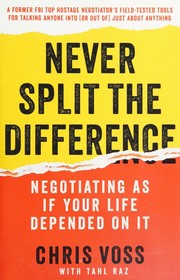
Negotiation is primarily an emotional and informational process, not a contest of logic. The negotiator who listens closely, makes the other person feel understood, exposes unspoken concerns, and preserves the other person’s sense of control can often achieve better outcomes than someone who argues, rushes toward agreement, or automatically splits the difference.
Overview
Voss adapts lessons from FBI crisis and hostage negotiations to work, sales, family, and everyday disputes. The book’s memorable stories make the techniques accessible, but its evidence base is largely experiential rather than a systematic review of negotiation research. Its strongest contribution is practical communication: slow down, listen for emotion, test assumptions, and use questions to make the other party solve part of the problem.
Core ideas
Tactical empathy
Empathy here means accurately recognizing and articulating the other person’s feelings, motives, and viewpoint—not agreeing with them. Labeling perceived emotions and summarizing concerns can reduce defensiveness and reveal information.
Listen before influencing
Voss treats negotiation as a process of discovery. Mirroring—briefly repeating a few of the other person’s last words—encourages them to elaborate; deliberate silence gives them room to continue.
Aim for ‘that’s right,’ not merely ‘yes’
A superficial yes may be politeness, evasion, or an attempt to end the conversation. A well-built summary that the other person recognizes as accurate creates a more meaningful form of alignment.
Use calibrated questions
Open-ended questions beginning with how or what—such as asking how a proposal could work—make constraints visible and invite the counterpart to participate in solving the problem. They are especially useful for resisting unreasonable demands without blunt confrontation.
‘No’ can create safety
Instead of treating no as failure, Voss presents it as a way for people to establish boundaries and regain control. Questions that allow a safe no can lower pressure and make honest discussion easier.
Prepare an accusation audit
Before making an ask, anticipate the negative thoughts the other person may have about you or the proposal and address them openly. This can reduce the emotional force of objections rather than allowing them to remain implicit.
Do not compromise mechanically
The title challenges the assumption that the midpoint is automatically fair or wise. Splitting the difference can preserve a bad premise, conceal unequal value, or produce an outcome neither side actually wants. The point is not to reject every compromise, but to understand what is being traded before compromising.
Look for black swans
Important, unexpected pieces of information may radically change the negotiation. Stay alert for hidden constraints, emotional stakes, deadlines, or relationships that are not obvious from the stated position.
Practical takeaways
- Before proposing anything, write down the other person’s likely concerns, constraints, and emotional state.
- Use labels such as “It sounds like…” or “It seems…” to test your understanding without claiming certainty.
- After an important statement, pause instead of filling the silence.
- Turn resistance into information with questions such as “What makes that difficult?” or “How would you suggest we handle it?”
- Summarize the other person’s position in a way they can correct; listen for recognition rather than rushing to agreement.
- Separate stated positions from underlying needs: price may represent risk, status, fairness, urgency, or fear of loss.
- Prepare a realistic alternative and a walk-away point; empathy does not replace leverage or preparation.
- Use the techniques to clarify and influence, not to perform artificial empathy or manipulate trust.
Caveats and counterpoints
- The book generalizes from high-stakes hostage and crisis negotiations to ordinary commercial and personal situations. Those settings differ in power, reversibility, relationship value, and the cost of prolonged conflict.
- Its anecdotes are vivid but do not by themselves establish that every technique works reliably across cultures, industries, or personality types. Critics also find the book repetitive and more dismissive of collaborative ‘win-win’ approaches than the evidence warrants.
- A strongly tactical style can damage trust when the relationship is long-term, the parties need genuine joint problem-solving, or the other person experiences labeling and calibrated questions as evasive.
- “Never split the difference” is a corrective against automatic compromise, not a universal ban on compromise. Sometimes a fair midpoint is efficient, relationship-preserving, and preferable to extended bargaining.
Questions worth revisiting
- Am I trying to understand the other party’s reality, or merely waiting for my turn to argue?
- What emotion, constraint, or hidden stake might explain the stated position?
- Would the other person say my summary is accurate?
- What information would change my judgment about the deal?
- Do I have enough leverage, time, and preparation to refuse a bad agreement?
- Is this a negotiation where tactical pressure helps, or one where collaboration and relationship preservation matter more?
Return to this when…
Return to the notes before salary discussions, purchases, vendor or client disputes, difficult feedback, boundary-setting, or any conversation where the visible disagreement may conceal fear, status concerns, uncertainty, or a need for control.
References
- Never Split the Difference - Book Summary - MindBooks
- Chris Voss: Never Split The Difference | TED Talk
- Never Split the Difference by Chris Voss - Book Review | DadReader
- Never Split the Difference: Book Review (Chris Voss) - Shortform Books
- summary.com
- app.thestorygraph.com
- reiprime.com
- rationalgames.com
- catherinecheek.com
- Never Split the Difference
- flowstatesales.com
- repository.law.umich.edu