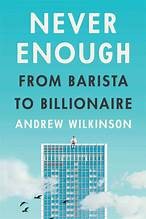

In one sentence
Building wealth can solve material problems without solving insecurity, anxiety, status competition, or dissatisfaction. Wilkinson’s eventual shift is from maximizing money and prestige toward maximizing freedom, relationships, contribution, and a life he actually wants.
Overview
The book is primarily a memoir, not a systematic startup manual. Wilkinson recounts teaching himself web design, founding MetaLab, making costly mistakes, and helping build Tiny as a long-term holding company modeled partly on Berkshire Hathaway. The entrepreneurial story gradually becomes an examination of what happens after extraordinary financial success: escalating consumption, comparison with even-richer peers, damaged relationships, and the realization that “enough” must be defined deliberately.
Core ideas
Ambition is useful but self-renewing
The drive that helps an entrepreneur tolerate uncertainty and repeated failure can become a permanent feeling of insufficiency. Each financial milestone risks resetting the comparison group rather than producing lasting satisfaction.
Ownership and leverage change the game
Wilkinson’s path moves from selling personal labor through an agency to owning stakes in businesses. Tiny’s holding-company model emphasizes acquiring durable companies, allocating capital, and allowing good operators substantial autonomy rather than constantly rebuilding from zero.
Business lessons come through failure
The memoir treats failed ventures, bad deals, interpersonal mistakes, and expensive experiments as more instructive than a polished success narrative. A recurring implication is to notice incentives, protect downside, and avoid confusing cleverness with sound judgment.
More money can intensify comparison
Wealth changes the reference group: a successful person may stop comparing themselves with ordinary earners and begin comparing themselves with billionaires. Luxury can therefore become a treadmill—temporary pleasure followed by a higher baseline of expectation.
Money is a tool, not a complete life strategy
The book’s central correction is that money can buy convenience, safety, and optionality, but not automatically happiness, emotional stability, intimacy, or purpose. Freedom—control over time and commitments—is presented as more valuable than an ever-larger net worth.
Relationships are part of the balance sheet
The costs of relentless work and status-seeking are not merely emotional side effects; they can undermine marriages, friendships, family ties, and trust. Financial success is therefore incomplete if it is purchased by damaging the relationships that make freedom worthwhile.
Giving can redefine success
Wilkinson’s later reflection turns toward contribution and redistribution rather than accumulation for its own sake. The important mental shift is from asking “How much more can I acquire?” to asking “What obligations or opportunities follow from having more than enough?”
Practical takeaways
- Define a personal “enough” before your goals keep escalating; include time, health, relationships, and autonomy—not only money.
- Prefer businesses with durable economics, understandable operations, and room for patient ownership; avoid treating constant novelty as progress.
- Separate financial freedom from conspicuous consumption. After basic security, ask whether a purchase buys meaningful utility or merely status.
- Track the opportunity cost of work: missed relationships, reduced health, attention fragmentation, and dependence on an identity built around achievement.
- Use failures as operating data: examine incentives, downside protection, partner quality, and whether the project deserves continued capital.
- Create explicit rules for generosity, employee recognition, and wealth distribution rather than waiting for a crisis to decide what your money means.
- When envy appears, identify the comparison group. Moving into a richer circle may change the target without improving the underlying life.
Caveats and counterpoints
- This is a first-person memoir built around Wilkinson’s recollections and business records, so its lessons are selective and shaped by hindsight; it should not be read as a representative account of entrepreneurship.
- The “barista to billionaire” framing is rhetorically powerful, but the barista period was brief; the more consequential story is his early access to internet entrepreneurship, agency work, ownership, and later acquisitions.
- The book’s business advice is embedded in unusual circumstances—technology markets, personal talent, timing, access to capital, and a very high-risk tolerance. Most readers cannot reproduce the outcome by copying the tactics.
- The book’s conclusions about wealth and happiness are persuasive as autobiography but not a controlled test of what money does for people. Readers should distinguish Wilkinson’s interpretation of his life from general evidence about income, wellbeing, and philanthropy.
- Some readers may find the candid self-criticism illuminating; others may see the narrative as self-mythologizing or insufficiently attentive to the structural advantages and social costs associated with extreme wealth.
Questions worth revisiting
- What would “enough” mean in my own life if status comparisons were removed?
- Am I optimizing for money, freedom, recognition, mastery, or contribution—and do my current actions match that answer?
- Which current ambition would still matter if success were guaranteed but nobody else knew about it?
- What relationships or health costs am I quietly treating as acceptable business expenses?
- Do I want to build one enduring company, own a portfolio, or simply gain more control over my time?
- What would responsible wealth distribution look like before I become wealthy enough to rationalize postponing it?
Return to this when…
Return to these notes when a career or financial goal keeps moving the finish line, when considering a high-risk acquisition or venture, or when success begins to crowd out relationships and autonomy. The key reminder is simple: wealth can expand options, but it cannot decide what those options are for.