
In one sentence
How people interpret ability and failure shapes the goals they choose, the risks they take, their response to criticism, and their persistence. Treating ability as developable generally supports learning-oriented behavior; treating it as fixed encourages performance-protection and avoidance. The book’s practical message is valuable, but mindset is one influence among many—not a substitute for instruction, resources, opportunity, or effective strategy.
Overview
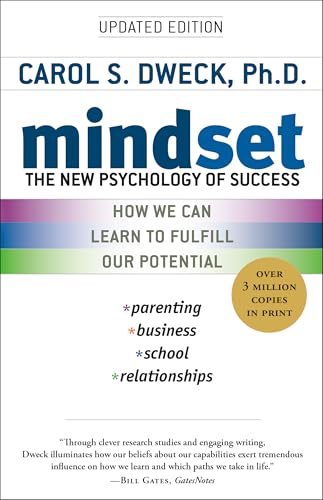
First published in 2006, the book develops the fixed/growth distinction and then extends it across achievement, sport, business leadership, relationships, parenting, teaching, and coaching. Its recurring contrast is between proving that one is talented and improving through challenge. The final section presents a “mindset workshop” approach for noticing and changing fixed responses. The 2016 updated edition is catalogued as an updated Ballantine trade-paperback edition.
Core ideas
Fixed and growth mindsets
A fixed mindset treats intelligence, talent, or character as relatively permanent; a growth mindset treats them as capacities that can be developed. Dweck presents these as patterns of belief and behavior, not permanent personality types. People can hold different mindsets in different domains or shift between them.
The meaning assigned to difficulty
With a fixed mindset, difficulty can feel like evidence of inadequate ability, so people may avoid challenge, conceal mistakes, or give up to protect their self-image. With a growth mindset, difficulty is more likely to be interpreted as information about what still needs learning.
Goals: proving versus improving
Performance goals aim to demonstrate competence; learning goals aim to build competence. The book argues that improvement-oriented goals make setbacks more usable because the central question becomes “What can I learn or try next?” rather than “What does this failure say about me?”
Effort is not enough
The book does not reduce growth to trying harder. Productive effort is paired with better strategies, practice, help-seeking, feedback, and persistence when appropriate. Repeating an ineffective method is not the same as learning.
Praise can shape beliefs
Dweck warns that praising supposedly innate brilliance can make people more concerned with appearing smart, whereas acknowledging process, choices, strategies, and progress can reinforce learning. Process praise should still be specific and honest; indiscriminate praise can become empty or manipulative.
Setbacks reveal the operating mindset
Pay attention to automatic reactions after criticism, rejection, poor performance, or comparison. A fixed response seeks excuses, blame, or withdrawal; a growth response looks for causes, feedback, alternatives, and the next manageable action.
Organizations and relationships
In leadership, the framework favors cultures that recruit, develop, and listen to people rather than worshiping star talent. In relationships, it encourages seeing conflict and personal shortcomings as workable—without confusing willingness to change with tolerating harmful behavior.
Evidence is more conditional than the popular slogan
A large 2019 national experiment found that a brief intervention improved grades mainly among lower-achieving students and modestly increased advanced-math enrollment, suggesting context matters. However, a 2023 systematic review reported major design and reporting problems and concluded that apparent academic effects may be inflated by bias.
Practical takeaways
- When you hear “I’m not a math person,” “I’m bad at this,” or “I’ll never change,” rewrite it as a current description plus a possible learning path: “I do not understand this yet; what prerequisite, explanation, practice, or feedback is missing?”
- After a setback, separate four questions: What happened? What was under my control? What strategy did I use? What is the next experiment? This converts self-judgment into diagnosis.
- Give feedback on observable process: preparation, strategy, revision, persistence, questions asked, and response to feedback—not merely intelligence or effort.
- Use challenge with support. A growth message is unlikely to help if the person lacks time, instruction, safety, tools, or a realistic route to improvement.
- Treat persistence as conditional. Change tactics, seek help, or stop when evidence shows that the current goal or method is unproductive.
- In teaching or management, pair belief in people’s capacity with concrete scaffolding, high standards, useful feedback, and opportunities to practice.
Caveats and counterpoints
- The fixed/growth binary is a memorable teaching device, but real beliefs are mixed, domain-specific, and context-sensitive; nobody reliably has a growth mindset about everything.
- The book’s anecdotes about athletes, executives, teachers, and relationships illustrate the framework but should not be treated as controlled evidence that mindset alone caused success or failure.
- Growth mindset is not positive thinking, limitless potential, or a guarantee that effort produces success. Prior knowledge, health, discrimination, money, institutional quality, teaching, and opportunity also matter.
- Research support is mixed and effects appear small and heterogeneous. The 2019 national experiment offers qualified support, while later reviews criticize study quality and publication bias; read the book as a useful lens, not a settled universal law.
- A harmful application is to tell struggling people simply to “adopt a growth mindset,” shifting responsibility onto them while ignoring inadequate teaching, unsafe conditions, or structural barriers.
Questions worth revisiting
- Where do I most strongly protect an image of being naturally capable?
- Which recent failure did I interpret as a verdict rather than as information?
- What specific strategy, feedback, or prerequisite would make improvement more likely?
- Am I praising talent when I really want to encourage learning?
- Where would persistence be wise, and where would changing goals or methods be wiser?
- What environmental change—not just belief change—would support the improvement I want?
Return to this when…
Return to the distinction before starting a difficult skill, responding to criticism, giving feedback, or deciding whether a setback means “stop.” Also revisit the caveats when someone uses growth-mindset language to explain away poor instruction, unequal opportunity, or the need for a better strategy.