
In one sentence
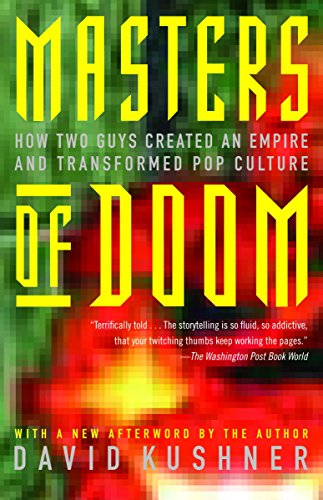
The book’s central argument is that id Software transformed games by combining Carmack’s relentless technical innovation with Romero’s design instincts, ambition, and showmanship. Their success was not simply the product of genius: it depended on emerging PC capabilities, shareware distribution, small-team autonomy, and a culture willing to work obsessively. The same creative imbalance and extreme work culture that produced landmark games ultimately damaged the partnership.
Overview
Kushner presents the story as a rise-and-fall partnership. Carmack and Romero meet through the early PC-software scene, collaborate on increasingly ambitious games, and help establish id Software. Commander Keen demonstrates their commercial potential; Wolfenstein 3D makes first-person action visible; Doom turns the format into a cultural event; and Quake pushes the technology toward fully 3D multiplayer worlds. The narrative then follows Romero’s departure, the troubled launch of Ion Storm’s Daikatana, and the consequences of trying to reproduce id’s success elsewhere. The book’s chapter structure moves from personal background to technical breakthroughs, business decisions, cultural controversy, and organizational conflict.
Core ideas
Complementary strengths beat uniform talent
Kushner frames Carmack and Romero as opposites whose abilities initially reinforced one another: Carmack pursued code, engines, speed, and technical possibility; Romero emphasized play, level design, presentation, and the player’s experience. The partnership worked because the product required both kinds of judgment—not because either person could do everything alone. This is the book’s “Lennon and McCartney” model, though the analogy is an interpretive framing rather than a literal business theory.
Constraints can create a strategic advantage
Early id operated with limited money, hardware, and formal infrastructure. Those constraints encouraged reusable technology, rapid experimentation, direct feedback from players, and unconventional distribution. Shareware let the team reach a large audience without relying entirely on traditional retail publishing, helping a small studio compete through product quality and audience enthusiasm.
Technology matters when it changes the experience
The book does not treat programming sophistication as valuable in isolation. Carmack’s technical advances mattered because they enabled experiences that felt impossible on ordinary PCs: smoother scrolling, immersive first-person spaces, faster action, networked play, and eventually more fully 3D environments. The strategic lesson is to connect engineering breakthroughs to a visible change in what users can do or feel.
Distribution and community amplify innovation
id’s games spread through demos, shareware, enthusiasts, magazines, online communities, multiplayer sessions, and user excitement. The product was partly the game and partly the surrounding system of trial, sharing, discussion, and competition. That made Doom and Quake cultural phenomena rather than merely successful software.
A founder culture can become a liability
The intense, informal, highly autonomous culture that accelerated id’s early work also made coordination, accountability, and disagreement harder. As the company grew, the team’s methods did not scale cleanly. The Carmack–Romero conflict illustrates how unclear authority, incompatible priorities, and accumulated resentment can turn productive creative tension into organizational fracture.
Success can expose incompatible definitions of the mission
Carmack increasingly prioritized technical progress and disciplined execution; Romero was associated with design ambition, status, spectacle, and a more socially oriented creative culture. Their conflict was therefore more than a personality clash: it reflected disagreement about what id should become after it had already won. The book presents Romero’s departure as the decisive rupture in the original partnership.
The book’s business lesson is conditional, not universal
Extreme commitment and loose structure can be powerful during a breakthrough phase, especially for a small expert team pursuing a difficult technical goal. They are less reliable once products, staff, deadlines, and leadership responsibilities become more complex. The story cautions against mistaking a founding-era culture for a permanent operating model.
Practical takeaways
- Pair technical excellence with someone who can shape the user experience, product direction, or market narrative.
- Treat constraints as design inputs: limited resources can encourage focus, reuse, speed, and unconventional distribution.
- Test innovations through the audience’s actual experience, not through technical novelty alone.
- Build distribution and community into the product strategy; demos, sharing, feedback, and multiplayer can compound adoption.
- Define decision rights before success makes disagreements expensive—especially when founders have different standards for quality and progress.
- Separate productive intensity from unsustainable work habits. A culture that creates a breakthrough may still damage people and coordination over time.
- When a company grows, deliberately redesign communication, authority, and incentives rather than preserving founder mythology.
Caveats and counterpoints
- This is a narrative account, not a neutral organizational case study. Kushner emphasizes drama, archetypal personalities, and the rise-and-fall shape of the story; some scenes and motivations are therefore presented through journalistic reconstruction rather than a fully documented analytical framework.
- The book is heavily centered on Carmack and Romero. Other contributors and broader industry forces appear, but the “two geniuses” structure can understate the importance of artists, designers, producers, publishers, testers, and the surrounding shareware ecosystem.
- Kirkus praised the cultural and technological coverage but found the account repetitive in its recurring descriptions of all-night development, releases, and interpersonal conflict.
- The book’s endpoint is the early-2000s aftermath of the id era, so it should not be treated as a complete history of later game development, modern live-service economics, or contemporary studio management. The edition catalogued here was published in 2003, with a 2004 trade-paperback edition.
- Later first-person accounts by people involved may emphasize different interpretations of the Carmack–Romero split. This is a reason to treat the book’s dramatic balance of blame as Kushner’s reconstruction, not as the uncontested final account.
Questions worth revisiting
- Which part of id Software’s success was most transferable: the technology, the shareware model, the small-team structure, or the founders’ unusual abilities?
- At what point should a startup replace informal founder culture with explicit process and authority?
- Would the partnership have survived if id had formalized creative and technical decision-making earlier?
- How much does a breakthrough product depend on the surrounding community and distribution system rather than the core invention?
- Where is relentless commitment genuinely useful, and where does it become a warning sign for organizational failure?
Return to this when…
Return to the sections on id’s early distribution model, the transition from Wolfenstein 3D to Doom and Quake, and the breakdown of the two-Johns partnership when thinking about founder dynamics, technical-product collaboration, platform shifts, or the limits of “heroic” startup culture.
References
- Masters of Doom: How Two Guys Created an Empire and Transformed Pop Culture - David Kushner - Google Books
- MASTERS OF DOOM | Kirkus Reviews
- publishersweekly.com
- graphic-engine.swarthmore.edu
- goodreads.com
- en.wikipedia.org
- penguinrandomhouse.com
- gamesfirst.com
- goodreads.com
- muratbuffalo.blogspot.com
- books.google.com
- thedeadpixels.squarespace.com