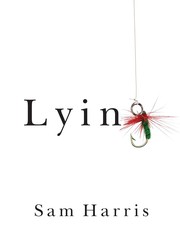

In one sentence
We should tell the truth whenever possible because lying predictably damages trust, autonomy, self-understanding, and social cooperation, while the supposed benefits of “white lies” are usually short-term and avoidable. Harris’s stronger practical claim is that candid truth-telling often produces better outcomes than people expect.
Overview
Lying is a short philosophical essay, first published in 2011 and revised and expanded in 2013; the commonly catalogued edition is 108 pages from Four Elephants Press. Harris is not mainly offering a taxonomy of deception or a survey of ethical theory. Instead, he presents a deliberately forceful challenge to ordinary excuses for lying, then considers objections involving privacy, politeness, danger, and social convention.
Core ideas
Lying is a violation of another person’s access to reality
Harris treats lying as more than inaccurate speech: it intentionally causes another person to form a false belief where honest communication is expected. The moral problem is therefore not only the false statement but the manipulation of another person’s ability to decide and act.
“White lies” are the central test case
The book concentrates on lies told to spare embarrassment, avoid conflict, or protect someone’s feelings—the forms of dishonesty that decent people often regard as harmless. Harris argues that these cases matter because they are habitual, socially normalized, and often replace a more respectful response: tactful honesty, silence, or refusal to answer.
Short-term comfort can create larger long-term costs
A lie may reduce immediate discomfort, but it can deprive someone of information they need, force the liar to maintain a false story, and weaken mutual trust. At a social level, Harris connects normalized dishonesty with corruption, betrayal, and collective failures of judgment.
Honesty need not mean indiscriminate disclosure
The practical alternative to lying is not blurting out every private thought. Harris’s position leaves room for silence, privacy, tact, and declining to participate in a conversation. The key distinction is between withholding information one is not obliged to provide and actively misleading someone who reasonably expects honesty.
The argument is consequentialist in spirit, though phrased as a strong norm
Harris emphasizes the effects of lying on well-being, trust, freedom, and relationships rather than grounding the case solely in a rule such as “lying is intrinsically wrong.” He presents truthfulness as a policy that generally improves outcomes, while still treating the ideal of not lying as unusually demanding.
Exceptions expose the limits of the slogan
Harris acknowledges life-or-death situations in which lying may appear necessary, but maintains that such cases should not be used to excuse routine dishonesty. A serious criticism is that the book’s confidence can understate cases involving coercion, abuse, privacy, unequal power, or duties to protect vulnerable people.
Practical takeaways
- Before telling a “kind” lie, ask whether you are protecting the other person or mainly avoiding your own discomfort.
- Use truthful alternatives: say less, decline to answer, describe your uncertainty, or frame criticism around observable facts and choices.
- Treat trust as cumulative: a small lie can matter because it changes what the other person can safely infer from your words.
- Separate honesty from cruelty. Truthful communication still requires timing, relevance, compassion, and respect.
- When honesty could expose someone to serious harm, analyze the power relationship and competing duties rather than applying a simple absolute rule.
Caveats and counterpoints
- The book is intentionally provocative and brief, so it does not fully develop a general theory distinguishing lying, deception, misleading omission, confidentiality, politeness, and justified concealment.
- Its argument is strongest against convenience lies and self-protective social smoothing; it is less decisive in cases where truth-telling would enable violence, abuse, persecution, or exploitation.
- Harris often assumes that candid communication can replace a lie. That is plausible in many relationships but less so in workplaces, hierarchical institutions, diplomacy, or situations where one party cannot safely negotiate boundaries.
- The revised 2013 edition includes responses to reader criticisms, so notes based on the original essay alone may omit part of the author’s later clarification.
Questions worth revisiting
- Which “white lies” do I tell to help another person, and which primarily help me avoid awkwardness?
- When I cannot or should not disclose the truth, can I remain truthful by saying that I will not answer?
- Does Harris’s case depend more on consequences, respect for autonomy, or cultivation of character?
- What obligations to privacy or protection could justify deception, and who gets to decide?
- Would greater honesty improve this relationship, or would I first need to establish safety and trust?
Return to this when…
Return to this book when you notice yourself calling a lie “kind” without examining whose discomfort it relieves, what information it withholds, and what more honest alternative is available.
Highlights
To lie is to intentionally mislead others when they expect honest communication.^
People lie so that others will form beliefs that are not true. The more consequential the beliefs—that is, the more a person's well-being depends upon a correct understanding of the world—the more consequential the lie.