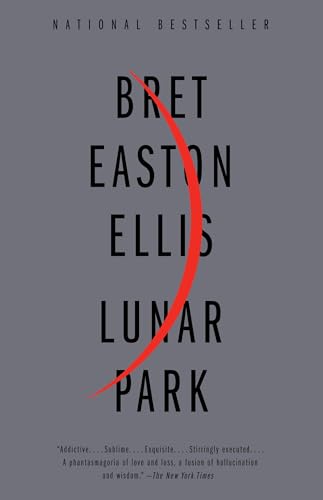

In one sentence
Lunar Park turns the author’s public persona and earlier fiction into a haunted house: Ellis uses horror to examine inheritance, parental failure, self-invention, and the possibility that a writer cannot escape the emotional consequences of the world he has created.
Overview
The narrator is a fictionalized version of Bret Easton Ellis: a notorious novelist whose drug use, celebrity, and evasive relationships have left him poorly prepared for marriage and fatherhood. After entering domestic life in the suburbs, he encounters increasingly disturbing events connected to his family, his childhood, and his books. The novel deliberately blurs autobiography and invention; its “truth” is psychological and metafictional rather than documentary. Ellis has described the project as originating in a desire to write a haunted-house story influenced by Stephen King.
Core ideas
The father-son inheritance
The central emotional tension is between the narrator and his son Robby. Fatherhood is not presented as automatic redemption: the narrator’s self-absorption, resentment, and absence make him fear that he has transmitted the very damage he received from his own father. The supernatural plot gives this inheritance a literal, threatening shape.
The author as a haunted construction
“Bret Easton Ellis” is both character and performance. The book exploits the gap between public author-image, private self-understanding, and fictional invention, suggesting that celebrity can become a prison populated by earlier versions of oneself.
Fiction feeding reality
Ellis’s earlier novels—especially American Psycho—return as cultural artifacts, accusations, and possible blueprints. The book questions whether fiction merely represents violence or helps circulate, glamorize, and reproduce it. This is less a straightforward sequel than a self-critical confrontation with the author’s catalogue.
Domesticity versus spectacle
The suburban home is set against the narrator’s former life of drugs, sexual excess, and literary celebrity. Domestic routines promise stability but also expose his inability to perform ordinary care. The horror emerges where family intimacy meets the theatricality of fame.
Unstable truth and self-justification
The mock-memoir form makes every confession suspect. The narrator’s claims to honesty coexist with manipulation, irony, and self-pity. A key question is not simply “What really happened?” but “What kind of story does this narrator need to tell about what happened?”
A serious but contested act of self-revision
Some reviewers found the novel an effective, elegiac ghost story and a meaningful meditation on fathers and sons; others saw it as convoluted, celebrity-obsessed, and overly dependent on familiarity with Ellis’s reputation. Its ambition is clearest when its emotional stakes outweigh its metafictional games.
Practical takeaways
- When a narrator insists on authenticity, examine what the performance of honesty allows him to avoid.
- Artistic self-awareness does not automatically equal moral accountability; the novel keeps those achievements separate.
- Family inheritance can be emotional and behavioral, not only biological: absence, fear, cruelty, and silence may all be passed down.
- A past work can return as a burden rather than a legacy—especially when its creator has become inseparable from its public image.
- The novel’s horror is most productive when read as an externalization of guilt, grief, and fear of repetition, not merely as a puzzle about supernatural events.
Caveats and counterpoints
- This is a deliberately spoiler-sensitive summary; the novel’s later revelations and ending substantially reshape the meaning of earlier events.
- The “Bret Easton Ellis” in the novel should not be treated as a factual memoir of the author. The book advertises autobiographical resemblance while repeatedly making clear that it is fiction.
- The book’s reception is divided: its formal hybridity and emotional ambition appeal to some readers, while its self-reference, tonal shifts, and reliance on Ellis’s public persona frustrate others.
- Familiarity with Ellis’s earlier novels—particularly Less Than Zero and American Psycho—deepens the metafictional effect, but is not required to follow the family and horror plot.
Questions worth revisiting
- Is the narrator genuinely seeking forgiveness, or mainly seeking a more flattering version of himself?
- Does the novel condemn its earlier violence, reinterpret it, or turn self-condemnation into another form of spectacle?
- What does the haunted house represent that ordinary psychological realism could not express?
- Can a parent break an inherited pattern without first understanding how much of it has already been reproduced?
- Where does the book’s emotional seriousness overcome—or fail to overcome—its authorial performance?
Return to this when…
Return to it when thinking about metafiction, unreliable autobiography, literary celebrity, or the relationship between horror and family guilt. It is especially useful alongside American Psycho and Less Than Zero, not as a conventional continuation, but as a self-conscious reckoning with the persona and imaginative violence associated with them.
Highlights
published and became a success. His negative, disapproving attitude about me then metamorphosed, by the popularity of the novel, into a curiously glowing acceptance that intensified my loathing for him even more. My father created me, criticized me, destroyed me and, then, after I reinvented myself and lurched back into being, became a proud,