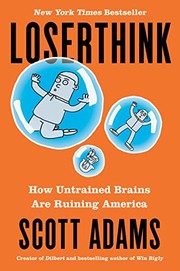

In one sentence
People often reason badly not because they lack intelligence, but because they lack training across different domains of thought. Adams argues that learning how psychologists, scientists, engineers, historians, entrepreneurs, and artists approach problems can help people escape their “mental prisons” and argue more productively.
Overview
The book is less a rigorous psychology treatise than a practical, humorous set of heuristics for thinking and arguing. Adams defines loserthink as a pattern of thought—not a permanent type of person—and focuses especially on political and media controversies. His recurring remedy is to widen the frame: separate evidence from interpretation, look for alternative explanations, identify hidden variables, and reduce certainty before trying to persuade someone else.
Core ideas
“Loserthink” is a mental habit, not an identity
The label is meant to describe unproductive reasoning rather than declare someone inherently unintelligent. This framing makes self-correction possible, although the book’s title and combative political examples sometimes work against that charitable distinction.
Think across disciplines
A central claim is that specialists—and ordinary people—often import the habits of one domain into another. Useful thinking improves when you borrow multiple lenses: scientific testing, engineering trade-offs, historical comparison, psychological awareness, and entrepreneurial experimentation.
Do not confuse words with reasons
Labels, slogans, accusations, and emotionally loaded descriptions can substitute for explaining mechanisms. Ask what specifically happened, what evidence supports the claim, and what causal process would connect the evidence to the conclusion.
Avoid mind-reading
Inferring another person’s hidden motives—especially from ambiguous statements—is presented as a frequent reasoning error. Respond to what was actually said or done, not to an imagined intention. This is particularly relevant to political arguments and accusations of prejudice.
Search for alternative explanations and missing variables
A visible correlation rarely settles causation. Adams repeatedly encourages testing competing explanations and noticing variables that a convenient story leaves out; the practical goal is to prevent coincidence, selective evidence, and one-factor explanations from becoming certainty.
Argue to reduce certainty, not to force conversion
Adams’s persuasion strategy is incremental: establish shared ground, address the other side’s strongest argument, and lower confidence in weak claims rather than expecting an opponent to reverse position immediately. One suggested prompt is to identify a belief one person holds that the other does not.
Use ego as information, not as identity
The book treats ego-investment as an obstacle to updating beliefs. Track predictions, notice when embarrassment or status is driving a decision, and cultivate situations in which being wrong is survivable.
Practical takeaways
- Before accepting a confident claim, ask: What is the evidence? What else could explain it? Which variables are missing?
- Rewrite emotionally charged statements into neutral, testable propositions.
- Separate a person’s observable behavior from claims about their motives.
- In disagreement, first state the strongest version of the other person’s position and find genuine common ground.
- Treat political and media narratives as arguments assembled from selected facts, not as transparent descriptions of reality.
- Keep a record of predictions and outcomes; use misses to calibrate confidence rather than merely inventing explanations afterward.
- When a problem seems blocked, change disciplinary lenses: ask how an engineer, scientist, historian, negotiator, or entrepreneur would frame it.
Caveats and counterpoints
- The book presents broad heuristics and examples rather than a systematic, experimentally validated theory of cognition; “loserthink” is Adams’s own organizing term, not a standard psychological diagnosis.
- Its advice to consider alternative explanations is valuable, but alternatives are not automatically equally plausible; evidence, base rates, and domain expertise still matter.
- The political examples are designed to challenge partisan reflexes, yet the author’s own highly confident political style can make the book feel less even-handed than its method recommends. This is a limitation of presentation, not a claim that every heuristic fails.
- Persuasion techniques can improve dialogue, but lowering someone’s confidence is not the same as establishing truth. Productive debate still requires reliable evidence and willingness to revise one’s own view.
- The book’s accessible, provocative style may encourage readers to use “loserthink” as a dismissive label—the very tribal shortcut the book says to avoid.
Questions worth revisiting
- Which of my beliefs depend mainly on labels, assumed motives, or a single favored explanation?
- What prediction would my current view make, and what result would change my mind?
- Am I applying a useful cross-disciplinary model, or merely borrowing an analogy that sounds persuasive?
- When I argue, am I trying to discover what is true, lower unjustified certainty, or simply win status?
- Where does Adams’s method need stronger evidence, expertise, or attention to moral consequences?
Return to this when…
Return to this book before difficult online or political conversations, especially when you notice mind-reading, certainty from correlation, identity-protective reasoning, or an urge to defeat rather than understand the other side.