
In one sentence
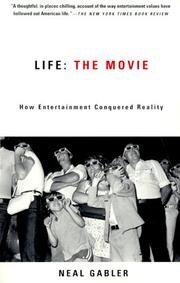
Entertainment has become not merely an industry or distraction but a dominant way of organizing public reality. Modern institutions and individuals increasingly shape events as performances because visibility, attention, and emotional impact determine what gets noticed and remembered. Gabler’s concern is not simply that reality is fake, but that entertainment supplies the standards by which reality is judged.
Overview
Originally published by Knopf in 1998, the book follows the historical rise of what Gabler calls the “Republic of Entertainment,” beginning with nineteenth-century popular theater and sensational journalism and intensifying through movies, television, celebrity culture, and newer information technologies. Its central examples are large-scale media spectacles—“lifies”—such as the O. J. Simpson trial, Princess Diana’s death, and the Clinton–Starr conflict. The book is organized into five main chapters: “The Republic of Entertainment,” “The Two-Dimensional Society,” “The Secondary Effect,” “The Human Entertainment,” and “The Mediated Self.”
Core ideas
Entertainment becomes a governing logic
Gabler’s claim is broader than “the media are sensational.” Politics, journalism, religion, high culture, and commerce increasingly borrow entertainment’s methods: dramatic conflict, recognizable characters, visual novelty, suspense, personalization, and emotional payoff. Activities that cannot be made compelling risk becoming culturally invisible.
“Lifies” turn real events into mass narratives
A “lify” is a major story written in the medium of life: an event that becomes a continuing public drama with protagonists, antagonists, plot turns, moral judgments, and a large audience. The event matters partly because it can be narrated and serialized, not only because of its underlying social or political importance.
The boundary between high culture and popular entertainment is historical and political
Gabler does not treat entertainment as a recent corruption of an otherwise pure culture. He argues that popular sensation has long challenged elite authority, while movies and television greatly expanded its reach. This makes entertainment both democratizing and potentially flattening: it can weaken cultural gatekeepers while also making spectacle the common measure of value.
Public figures become characters before they become representatives
Politicians, journalists, celebrities, and even criminals are increasingly understood through roles and images. A person’s ability to produce a compelling public persona can matter as much as competence or institutional position. Public conflict is therefore recast as a contest between personalities, performances, and competing stories.
The audience becomes a performer
The transformation is not confined to mass media. Ordinary people learn to manage their lives as presentations: selecting images, dramatizing experience, seeking attention, and treating identity as something staged for an audience. Gabler’s “mediated self” describes a culture in which being seen can become evidence of being significant.
Visibility creates a feedback loop
People and institutions produce spectacles to gain attention; media amplify the spectacles; the resulting attention encourages further performance. This loop makes the distinction between event and publicity increasingly unstable. Entertainment does not merely represent reality—it helps determine which events occur, how they unfold, and what consequences they have.
Entertainment can empower as well as anesthetize
The book’s position is deliberately ambivalent. Entertainment can make institutions more accessible, give outsiders a way to challenge elites, and broaden participation. Its danger is that accessibility becomes the only criterion, replacing sustained thought, expertise, privacy, and seriousness with novelty and emotional stimulation. A serious review praised this complexity but found Gabler’s conclusion somewhat inconclusive.
Practical takeaways
- When evaluating a public controversy, separate the underlying issue from its narrative packaging: Who are the assigned heroes and villains? What emotional arc is being supplied? What facts disappear because they are not dramatic?
- Treat attention as an incentive, not a neutral resource. Ask who benefits when an institution, politician, brand, or individual converts a problem into a spectacle.
- Distinguish visibility from importance. Events that dominate conversation may be highly narratable rather than proportionately significant.
- Notice “performance pressure” in personal life: the impulse to document, dramatize, or optimize an experience for an imagined audience can alter the experience itself.
- For serious decisions, deliberately use formats entertainment tends to suppress: slow reading, comparison of primary evidence, uncertainty, privacy, and attention to systems rather than personalities.
Caveats and counterpoints
- The book was published in 1998, so its examples predate social media, smartphones, algorithmic feeds, influencer culture, and streaming platforms. Its framework may illuminate those developments, but applying it to them is an inference rather than a claim Gabler could have directly analyzed.
- Gabler’s historical argument is wide-ranging and interpretive. The central pattern is persuasive as a cultural diagnosis, but it can understate institutions, audiences, and forms of public life that resist entertainment logic.
- The book sometimes treats “entertainment” as a broad cultural force, which risks blurring important differences among amusement, narrative, journalism, propaganda, art, and democratic communication.
- The critique can sound culturally pessimistic even though Gabler acknowledges that entertainment may democratize culture and empower people against elites. The strongest reading preserves both sides rather than reducing the book to an anti-television argument.
Questions worth revisiting
- Which parts of public life genuinely require entertainment-like narrative in order to reach a mass audience—and which are merely being distorted by it?
- Does the book’s argument describe a permanent change in reality, or a recurring cycle in which new media temporarily intensify spectacle?
- When people perform themselves publicly, are they losing an authentic self, gaining agency, or doing both at once?
- What kinds of expertise, privacy, and collective action remain valuable even when they are difficult to dramatize?
- How would Gabler’s argument change if attention were shaped less by centralized television and more by participatory, algorithmic media?
Return to this when…
Return to these notes when a news story, political campaign, celebrity controversy, brand, or personal social-media habit feels unusually theatrical. The useful test is: what is the event, what is the performance built around it, and what does the performance make harder to see?
Highlights
But because television had become the primary means through which people appropriated the world, it promulgated an epistemology in which all information, whatever the source, was forced to become entertainment, the age of typography giving way to the age of television and transforming our way of thinking in the process.
What the movies provided, early critics like Jane Addams realized, was a tangible model to which one could conform life and a standard against which one could measure it, both in seemingly trivial ways, like fashion or behavior, and in more serious ways, like the movie-induced expectations one had about the course of one’s own life or the value of one’s own deeds. Why can’t life be more like the movies? viewers asked, and then answered that it could.
At the same time, the tabloid had learned something else from the movies. It had learned that photos could be used as publicity stills for sustained narratives—serials really. Tabloids told stories and told them in such a hyperdramatized manner that already in the late 1920s Robert Park could say that the “news story” and the “fiction story” are “now so much alike that it is sometimes difficult to distinguish them” and adding that the “daily press writes fiction in the form of news.”
It had to do with the media. Though the press had embellished other trials and heightened their drama, this time it had actively collaborated with the prosecution to create an event that would heighten itself. Since there was no credible evidence against the defendants, it almost seemed as if the trial had been staged by and for the media, which is exactly what Mrs. Hall said upon her acquittal.
But if Hall-Mills muddled the lines between entertainment and life yet again, the tabloids still hadn’t finished the process. At roughly the same time as Hall-Mills, the New York Graphic editor Emile Gauvreau, with an insight not unlike Hearst’s when he decided star reporters could make stories, realized that the papers could create characters from real people and then “star” them in adventures that could be featured on the front page—a kind of news repertory company. Once they were created, anything these individuals did would be news simply by dint of their recognizability.
The Gulf War of 1991 may have been even more bizarre a series. Apparently thinking of the war as it thought of its conventional entertainment programming, each of the television networks introduced its coverage with a title card: ABC’s and CNN’s was “Crisis in the Gulf”; CBS’s was “Showdown in the Gulf” before the war and “War in the Gulf” during; NBC’s, the more dramatic “America at War.” Each network also had a logo and a musical signature, undoubtedly making this the first war introduced by a theme song. As if that weren’t enough, on-site reporters like CNN’s Peter Arnett and NBC’s Arthur Kent were instantly transformed into stars. The handsome, youthful Kent, flinching and wincing at the detonations of the Russian Scud missiles Iraq fired at Israel, even won the moniker “Scud stud.” As the Nation quipped, “General Sherman had it all wrong. War ain’t hell—it’s entertainment.”
“In Los Angeles, we’ve got a movie in which the lead speaks no lines, a blonde bombshell turns out to be a man and the $5-a-day extras in the jury box keep walking off the set,” wrote television producer Don Hewitt during the trial, which he accurately called “TV’s longest running entertainment special.” When the verdict was announced, nine national television networks, including the cable sports channels ESPN and ESPN2, covered it live. ABC revised its prime-time schedule for a two-hour special. NBC and CBS offered continuous coverage from 7:00 A.M. to 5:00 P.M., and all three major broadcast networks had their anchormen hosting the reports. All this, again, not because the trial was an intrinsically important event in American life but because it was an astonishingly entertaining one: part thriller, part murder mystery, part pornography, part courtroom drama.
Television journalists have usually been quick to disassociate themselves from the idea of the “new news” even as many of them have necessarily served it. “[W]e should all be ashamed of what we have and have not done,” CBS news anchor Dan Rather once lectured a group of news directors. “They’ve got us putting more and more fuzz and wuzz on the air, cop-shop stuff, so as to compete not with other news programs but with entertainment programs, including those posing as news programs, for dead bodies, mayhem and lurid tales. ‘Action Jackson’ is the cry. Hire lookers, not writers. Do powder puff, not probing interviews.”
The result was to make of modern society one giant Heisenberg effect, in which the media were not really reporting what people did; they were reporting what people did to get media attention. In other words, as life was increasingly being lived for the media, so the media were increasingly covering themselves and their impact on life.
Professor Kiku Adatto of Harvard found that the average length of an uninterrupted sound bite declined from 42.3 seconds in 1968 to 9.8 seconds by 1988, with none in the latter election exceeding a minute. And if government itself was a series of bloodless policy decisions, the media simply shifted their focus to politics, so that everything a president did was seen not in terms of its effect on the public, which was boring, but in terms of its effect on his candidacy, which lent government the drama of an ongoing contest.
Each debate was followed by a media postmortem to determine which candidate had most impressed the press, since that is what the analysts were really talking about (who impressed them); and because the sense of “who won” was all anyone seemed to care about, the media’s postmortem became the real story, regardless of what actually happened during the debate or even how the public itself felt. Which is to say that, in a Pirandellian twist, the media reaction to the debate always supplanted the debate.
What Warhol realized and what he promoted in both his work and his life, if it is even possible to separate them, was that the most important art movement of the twentieth century wasn’t cubism or surrealism or fauvism or minimalism or op or pop, to which he himself nominally belonged. No, the most important art movement was celebrity. Eventually, no matter who the artist was and no matter what school he belonged to, the entertainment society made his fame his achievement and not his achievement his fame. The visual art, like so much else in American life, was a macguffin for the artist. It was just a means to celebrity, which was the real artwork.
But because entertainment had become America’s cosmology, the world as show, and the movies had become a metaphor for the new life movie, movie stars were more than embodiments of fame. They were also living, breathing tropes who demonstrated that what was true for one entertainment medium (film) was equally true for another (life)—namely, that entertainment needed identifiable and magnetic personalities to maximize the audience response to sensation. Movies had stars. Life had celebrities.
Movies had stars. Life had celebrities.
The idea that celebrities were the stars of the life movie necessitated an amendment to Boorstin’s definition. Celebrities weren’t only known for their well-knownness. In what was an entirely new concept, celebrities were self-contained entertainment, a form of entertainment that was rapidly exceeding film and television in popularity. Every celebrity was a member of a class of people who functioned to capture and hold the public’s attention no matter what they did or even if they did nothing at all. The public didn’t really seem to care.
Nesbit’s transformation would be repeated thousands of times by thousands of others in the succeeding decades as the media sifted life to determine whom to anoint with publicity. But having both exploited celebrity and created it, the media would soon find themselves in servitude to it. Celebrity was the force to which nearly everything deferred because human entertainment seemed to interest people more than any other entertainment.
People editor Richard Stolley even devised a set of rules for a successful cover; Young is better than old. Pretty is better than ugly. Rich is better than poor. TV is better than music. Music is better than movies. Movies are better than sports. Anything is better than politics. And nothing is better than a celebrity who has just died. It was a bracing description not only of what sold magazines but of what values the media now sold to the country.
Trump understood that in an entertainment-driven society celebrity was among the most effective tools of salesmanship and that consequently a businessman’s job was not only the management of assets but the management of image. By the same token, the media didn’t care that Trump wasn’t in the same financial league with other business superstars; his life was a good act for them to exhibit, as Trump ensured it would be.
There were also celebrities who actively resisted celebrity by declining publicity, as reclusive authors J. D. Salinger and Thomas Pynchon did. Rather than void their celebrity, however, their abnegation practically voided Boorstins definition of it: They became famous for not wanting to be famous.
Indeed, the profusion of celebrity was so overwhelming that it also seemed to void another oft-quoted dictum. In the future everyone would not be famous for fifteen minutes, as Andy Warhol had prophesied. In the future, it seemed, everyone would be anonymous for fifteen minutes.
What the profile of Saatchi really demonstrated, then, was not his genius—though he may very well be one—but the fact that celebrity was like a bank reserve upon which one could draw and spend on anything one did. Or to paraphrase artist Jenny Holzer’s maxim that “Money creates taste,” one might say that “Celebrity creates value.” Thus the artist Julian Schnabel can draw upon his celebrity to record an album of lovelorn country-and-western songs he has composed, while singer Tony Bennett can draw upon his celebrity to exhibit paintings he has done. And actor Ethan Hawke can draw on his celebrity to write a novel, while novelist Norman Mailer can draw on his celebrity to appear in films.
IT IS WITH criminality, perhaps, that one can best see just how the values of human entertainment usurped other, more traditional values. Judged by traditional values, criminals are objects of reproach and scorn. But judged by the values of entertainment, which is how the media now judged everything, the perpetrator of a major, or even a minor but dramatic, crime, was as much a celebrity as any other human entertainer. Timothy McVeigh, later convicted of setting off a bomb outside the Alfred P. Murrah Federal Building in Oklahoma City, Oklahoma, and killing 168 people, received the kind of glamour treatment from Newsweek magazine that was usually only accorded movie stars.
Among members of the upper or “superior pecuniary class” this led to “conspicuous leisure,” a kind of performance art in which one showed how little one had to work by showing how much time one had to cultivate one’s aesthetic sensibility. But because, in Veblen’s words, the “norm of reputability imposed by the upper class extends its coercive influence with but slight hindrance down through the social structure to the lowest strata,” even the middle class and the poor felt the need to consume conspicuously to assert their social worth. This led to Veblen’s famous “conspicuous consumption,” in which everyone acquired primarily to show everyone else what he or she had acquired.
In effect, this reversed the traditional assumption about the relationship between consumption and entertainment. The assumption was that entertainment was a form of consumption, the commodification of leisure in an industrialized capitalist society. In truth, since the act of buying and then displaying goods was often the most efficient and effective way to create a convincing role for oneself in the life movie, consumption really seemed to be a form of entertainment. It was a means of preparing oneself to put on a show. This in fact
It was no wonder, then, that more and more architectural spaces, not only theme parks and vacation resorts, had souvenir stands, and at places like the Hard Rock Cafe or Planet Hollywood, two notable theme restaurants, the merchandise sold there reportedly grossed far more money than the food. But since many visitors apparently bought Hard Rock souvenirs without even eating there, what exactly did the souvenirs memorialize? The answer, one had to assume, is that they memorialized their own purchase. The Hard Rock had been so celebritized that some people went there to buy a souvenir to commemorate the time they went to the Hard Rock to buy a souvenir which, in turn, broadcast to others that they had been to the Hard Rock to buy a souvenir. Which, needless to say, made for yet another convoluted scene in the life movie.
At what may have seemed its most extreme manifestation, one wasn’t even reduced to one’s image but to the symbols of that image, making what Boorstin had said of movie stars true of all public figures. The self became synecdoche: a cane and bowler for Charlie Chaplin, a ski-nose profile for Bob Hope, a wild mane of hair for Albert Einstein, a bristle of beard for Ernest Hemingway, the “Air Jordan” logo for Michael Jordan. Every celebrity worth the designation had to have some ready referent, whether a physical characteristic or a signature expression or a distinctive vocal inflection or a style of dress, in order to claim his space in the crowded celebrity universe. Asked why he started wearing round black-framed glasses, the architect Philip Johnson admitted, “I needed a trademark.”
To an inner-directed individual—say, a nineteenth-century American farmer—the idea of creating an image for the benefit of others would have had absolutely no meaning. He didn’t dress to be a farmer or design his home to look like a farmhouse, and he didn’t self-consciously perform in ways that would have signified to others that he was a farmer. He dressed like a farmer and acted like a farmer not for effect but simply because he was a farmer.
But what really seemed to illustrate how rapidly personal life was advancing toward theater was the advent of a new profession: self-described “life coaches,” reportedly fifteen hundred of them in 1997, who advised clients on how to reorient their lives to reach what one coach called fulfillment but what someone else might have called a happy ending. What the coaches really did, along with routine ego boosting, was replot the client’s life.
Whether this was just a form of playacting or a new variant of the life movie was open to interpretation. One could certainly think of this as a kind of game for one’s own entertainment. Devout users, however, argued, legitimately, that if they spend more time on the Internet than in so-called real life, if they interact with more people on the Internet than in real life, if they engage in more activities on the Internet than in real life, if they feel more fully themselves on the Internet than in real life, who is to say that this virtual life of theirs isn’t as real as, if not more real than, the physical existence outside it? Which may have made the computer, in this function at least, yet another ingenious technological instrument of the large, implacable force of entertainment, yet another tool of Homo scaenicus, and the Internet itself not an information superhighway but an entertainment superhighway.
This suggested something terribly important. It suggested that the mind had begun processing life the way it processed the movies and consequently that if the movies were a metaphor for the condition of modern existence, the moviegoer was a metaphor for how one could cope with that existence.
References
- LIFE THE MOVIE | Kirkus Reviews
- Life the Movie: How Entertainment Conquered Reality - Neal Gabler - Google Books
- openlibrary.org
- Life: The Movie: How Entertainment Conquered Reality - Neal Gabler - Google Books
- Life: The Movie by Neal Gabler: 9780375706530 | PenguinRandomHouse.com: Books
- goodreads.com
- books.apple.com
- indigo.ca
- penguin.com.au
- openlibrary.org
- publishersweekly.com
- vitalsource.com