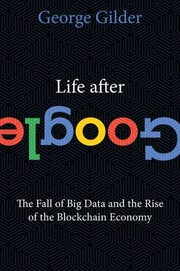

In one sentence
Gilder argues that the “Age of Google”—centralized data centers, machine intelligence, surveillance-based advertising, and supposedly free digital services—is reaching a structural limit. He predicts a “cryptocosm” built on blockchain, cryptocurrency, decentralized storage, and direct payments: a “great unbundling” that redistributes power from platform monopolies to users and entrepreneurs.
Overview
The book is part technology forecast, part economic manifesto, and part philosophical defense of human creativity against statistical prediction. Gilder’s central contrast is between Google’s attempt to infer the future from accumulated data and a blockchain economy that uses cryptographic identity, property rights, scarcity, and prices to coordinate independent human action. Its chapter sequence moves through Google’s origins, AI, data centers, monetary theory, Bitcoin, Ethereum, Hashgraph, Blockstack, Brave, and the prospects for a decentralized internet.
Core ideas
“Aggregate and advertise” is an unstable business model
Google gives users services at no apparent monetary price, then monetizes attention and behavioral data through advertising. Gilder’s objection is economic as much as ethical: when transactions lack explicit prices, entrepreneurs receive weaker signals about what users actually value, while platforms gain excessive control over distribution and information.
Big Data is not the same as knowledge
The book treats data accumulation and pattern recognition as fundamentally backward-looking. Algorithms can extrapolate regularities, but they cannot originate purposes, discover genuinely new categories, or replace entrepreneurial judgment. Human action matters because the future is created, not merely predicted. This is also the conceptual point highlighted in Peter Thiel’s endorsement.
Centralization creates a security and power problem
A small number of platforms concentrate identity, personal information, computing infrastructure, and economic access. That concentration makes breaches and surveillance especially consequential. Gilder therefore presents decentralization not merely as an efficiency improvement but as a redesign of who controls digital assets and credentials.
The “cryptocosm” supplies missing digital property rights
Blockchain-based systems, in Gilder’s model, let users transact, authenticate ownership, and compensate one another without routing every interaction through a central platform. Cryptocurrencies and tokens provide a payment layer for online activity, including small or machine-to-machine transactions. The intended result is an internet less dependent on advertising and platform intermediation.
Prices are information
A recurring economic premise is that prices coordinate dispersed knowledge better than centralized command or free-service distribution. Direct payment would reveal demand, support specialized businesses, and make online services accountable to customers rather than advertisers. This extends Gilder’s broader information-theoretic view of capitalism.
“Great unbundling” reverses platform consolidation
The mature internet bundled search, identity, storage, publishing, payments, and distribution inside a few giant firms. Gilder expects cryptographic protocols and decentralized infrastructure to separate those functions again, enabling smaller firms and individuals to compete over specific services.
Technology arguments are embedded in a worldview
Gilder links decentralization to a broader belief that creativity, consciousness, faith, and human freedom cannot be reduced to computation. Consequently, the book’s blockchain thesis is inseparable from its opposition to materialist and deterministic accounts of mind and society.
Practical takeaways
- When evaluating a digital business, ask who pays, who owns the data, who controls identity, and where the economic value is actually captured.
- Treat “free” platforms as exchange systems with hidden prices—usually attention, data, dependence, or reduced bargaining power.
- Distinguish a technology’s architectural promise from the business model and governance required to make it useful.
- For investing, separate durable infrastructure ideas—cryptographic verification, digital ownership, programmable settlement—from speculative claims about particular tokens or companies.
- Use the book as a framework for thinking about platform concentration and digital property rights, not as a current asset-allocation guide.
- When judging decentralization, examine actual tradeoffs: usability, governance, throughput, energy use, legal compliance, recovery from lost credentials, and concentration among validators, exchanges, or developers.
Caveats and counterpoints
- The book was published in 2018, and many forecasts are intentionally bold. Its claim that blockchain would soon displace Google’s dominant architecture should be read as a thesis to test, not an established outcome.
- Gilder’s treatment is enthusiastic and wide-ranging rather than a systematic comparison of competing blockchain designs. A critical review describes the blockchain argument as rambling and unconvincing, especially where technical, monetary, and metaphysical claims are joined together.
- The critique of Google’s model can be valuable even if the proposed replacement fails. Centralized platforms may have serious privacy and power problems, but decentralization does not automatically produce security, fairness, privacy, or broad adoption.
- The book’s monetary preferences and favorable treatment of cryptocurrency reflect Gilder’s broader ideological commitments. Readers should independently assess claims about sound money, Bitcoin, gold, and the economic effects of tokenized systems.
- The publisher’s framing and endorsements emphasize the book’s forecast; they are useful for identifying the author’s position but should not be mistaken for independent validation.
Questions worth revisiting
- Which parts of Google’s model truly depend on centralization, and which could be decentralized without sacrificing speed or convenience?
- Does a blockchain create meaningful ownership if users cannot easily control keys, understand protocols, or exit dominant intermediaries?
- Are prices always superior information signals for digital goods, especially where marginal costs are near zero or benefits are social rather than private?
- What evidence would show that the predicted “great unbundling” is occurring rather than merely producing new intermediaries?
- Which of Gilder’s forecasts still look insightful, and which were products of the 2017–2018 cryptocurrency boom?
Return to this when…
Return to this book when thinking about platform economics, digital identity, blockchain investment narratives, or the tension between prediction and human creativity. Revisit the caveats alongside the core ideas: its lasting value is most likely as a provocative diagnosis of centralized internet economics, not as a reliable timetable for blockchain replacing Big Tech.
References
- Life After Google eBook by George Gilder | Official Publisher Page | Simon & Schuster
- Life After Google: The Fall of Big Data and the Rise of the Blockchain Economy by George Gilder - Books on Google Play
- openlibrary.org
- openlibrary.org
- goodreads.com
- About | George Gilder
- Details for: Life after Google : the fall of big data and the rise of the blockchain economy / › MyCC Library catalog
- catalog.cclsny.org
- befreed.ai
- Life after Google : the fall of Big Data and the rise of the Blockchain economy | WorldCat.org
- goodreads.com
- goodreads.com
- boundary2.org