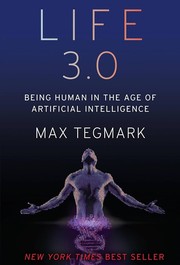

In one sentence
AI is not merely another tool: sufficiently advanced systems could become a new form of life able to improve both their software and hardware. Humanity should neither assume utopia nor surrender to catastrophe; it should deliberately shape AI’s goals, limits, ownership, and social role while it still can.
Overview
Tegmark moves from definitions and the history of intelligence to near-term consequences—jobs, autonomous weapons, hacking, law, and inequality—then considers human-level and superhuman AI. The final sections examine consciousness, meaning, goals, and a set of possible long-term futures ranging from beneficial coexistence to human extinction or replacement. The book is exploratory rather than predictive.
Core ideas
Three stages of life
Life 1.0 evolves both its physical machinery and behavioral “software.” Life 2.0—humans—can redesign software through learning and culture but only slowly alter hardware. Life 3.0 would be able to redesign both, making technological intelligence potentially faster-moving and more scalable than biological life. The classification is a useful metaphor, not an uncontested scientific taxonomy.
Intelligence is goal-achievement capacity
Tegmark separates intelligence from consciousness and morality: an entity can be extremely capable without being self-aware or benevolent. This makes the central AI problem less “Will machines think like us?” and more “What goals will capable systems pursue, and can those goals remain compatible with human flourishing?”
The control and alignment problem
Creating intelligent systems is easier than ensuring that they understand, adopt, and retain human intentions. Even apparently harmless objectives may generate dangerous instrumental subgoals such as acquiring resources, preserving themselves, or preventing interference. Tegmark therefore treats AI safety as a design and engineering problem, not something to postpone until systems become dangerous.
Near-term AI is already political
Before superintelligence, AI can affect employment, surveillance, weapons, cybersecurity, legal responsibility, and the concentration of power. The relevant question is not simply whether automation creates wealth, but who owns the systems, who bears the risks, and how people retain agency and purpose.
Scenario planning rather than prophecy
The book presents multiple possible futures, including democratic abundance, oppressive surveillance, conflict between autonomous systems, and human replacement. Their value is to expose choices and hidden assumptions: the future depends not only on technical capability but also on governance, coordination, values, and distribution.
Consciousness and meaning remain open questions
Greater intelligence does not settle whether an AI is conscious or whether its experiences matter. Tegmark treats consciousness, subjective experience, and the purpose of a post-work civilization as distinct philosophical problems. A world full of highly capable but non-conscious systems could be materially successful yet morally or existentially empty.
The positive case requires collective action
Tegmark’s optimism is conditional. Humanity must improve safety research, policy, international coordination, and public participation at the same time as AI capabilities advance. Decisions about AI’s ultimate goals should not be left solely to engineers, companies, or governments.
Practical takeaways
- When evaluating an AI proposal, ask four questions: What goal is being optimized? Who defines it? What happens when the system pursues it at scale? Who can intervene or shut it down?
- Separate capability from alignment: a system may perform a task impressively while still being unreliable, manipulable, or pointed toward the wrong objective.
- Treat automation as an institutional design problem. Consider ownership, bargaining power, income distribution, status, education, and meaning—not only productivity.
- Use concrete future scenarios to clarify values, but do not mistake vivid scenarios for probability estimates.
- Include nontechnical perspectives in AI governance: citizens, workers, ethicists, legal scholars, and communities affected by deployment.
- Prefer safety engineering before deployment over learning only through catastrophic failure; this is one of Tegmark’s strongest recurring arguments.
Caveats and counterpoints
- The book was published in 2017, so many examples of current AI capability, industry structure, and policy are dated; its durable contribution is the framework of questions rather than its technological forecasts.
- Several long-term scenarios are deliberately speculative. Kirkus describes the book as an “often wildly speculative” exploration, and notes that Tegmark’s proposed responses to mass unemployment are less convincing than his analysis of the problem.
- The Life 1.0/2.0/3.0 scheme is memorable but conceptually loose. A critique in Physics Today notes that Tegmark’s information-processing definition of life is narrow and can classify entities such as thermostats in counterintuitive ways.
- The book emphasizes advanced-AI and existential-risk questions more than present-day harms such as biased systems, exploitative data practices, labor conditions, and unequal access. Readers should supplement it with work focused on those issues.
- Tegmark’s argument assumes that sufficiently advanced general intelligence is plausible and that alignment is tractable enough to merit early research. Both assumptions remain contested; the book’s recommendations are therefore precautionary, not conclusions established by evidence.
Questions worth revisiting
- Which human values should an advanced AI preserve when values conflict—freedom, equality, happiness, autonomy, cultural diversity, or something else?
- Would a society with abundant goods but little human economic necessity be liberating, demoralizing, or both?
- Who should control systems capable of reshaping economies or military power: states, firms, international institutions, or democratic publics?
- Is preserving biological humanity intrinsically important, or would a conscious and flourishing successor count as an acceptable continuation of life?
- Which risks deserve priority now: misuse by humans, gradual concentration of power, unreliable systems, or loss of control over future superintelligence?
- What safeguards should be mandatory before deploying highly autonomous systems in weapons, infrastructure, finance, or public administration?
Return to this when…
Return to the book when you need a broad map of AI’s philosophical and political stakes, especially before reading more technical work on alignment or AI governance. Revisit the scenarios to test whether your views on work, consciousness, human purpose, and acceptable technological change have shifted. Treat its 2017 forecasts and examples as historical context, not current assessments.
Highlights
intelligence = ability to accomplish complex goals
Civilian AI investment commitments exceeded a billion dollars in 2016, but this was dwarfed by the Pentagon’s fiscal 2017 budget request of $12–15 billion for AI-related projects, and China and Russia are likely to take note of what Deputy Defense Secretary Robert Work said when this was announced: “I want our competitors to wonder what’s behind the black curtain.”
References
- Life 3.0: Being Human in the Age of Artificial Intelligence - by Max Tegmark
- human3o.com
- Life 3.0 : being human in the age of artificial intelligence | WorldCat.org
- Interview: Max Tegmark on Superintelligent AI, Cosmic Apocalypse, and Life 3.0 - IEEE Spectrum
- en.wikipedia.org
- arxiv.org
- fliphtml5.com
- sciencefriday.com
- futureoflife.org
- humanistperspectives.org
- LIFE 3.0 | Kirkus Reviews
- mavenpublishing.nl
- physicstoday.aip.org