
In one sentence
A tennis match becomes legible only when technique, psychology, biography, and social context are considered together. McPhee suggests that when the players’ physical abilities are broadly comparable, temperament and self-understanding become decisive forces in performance.
Overview
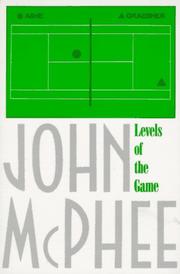
The book focuses on Ashe and Graebner’s semifinal at Forest Hills in 1968. Its structure alternates between detailed, nearly point-by-point match narration and profiles of the two men. Ashe is presented as Black, liberal, and improvisational; Graebner as white, conservative, and controlled. Their contrasting identities become part of how each interprets the other’s tennis.
Core ideas
Technique expresses personality
McPhee treats playing style as a visible form of character. Ashe’s less conventional movement and attacking imagination contrast with Graebner’s compact, orderly game. The important point is not that style mechanically reveals a person, but that players—and observers—use style to construct meanings about one another.
The match is a social encounter
Race, class, regional background, politics, family influence, and professional ambition are not detachable background details. They shape the players’ expectations, self-presentation, and interpretations of pressure. The court becomes a concentrated setting in which broader American divisions are made unusually visible.
Psychology matters under near-equality
When physical resources are relatively matched, small differences in confidence, tactical patience, emotional control, and willingness to attack can alter the match. McPhee’s slow temporal method makes momentum feel cumulative rather than mysterious.
Form creates meaning
The book’s distinctive achievement is structural: biography interrupts action, then action tests the biographical portrait. The reader is repeatedly asked to revise impressions of both men as the match develops. This is why the book operates as literary journalism rather than merely a match report.
Observation is interpretive
McPhee does not simply record strokes. He frames gestures, habits, histories, and political identities into an argument about the players. His descriptions are powerful partly because they show how an observer turns physical evidence into judgments about character.
Practical takeaways
- For writing about performance, alternate immediate action with the background that gives the action significance.
- Study oppositions—style, class, temperament, ideology—but avoid treating them as complete explanations.
- In high-pressure situations, examine the interaction between technical ability and the performer’s interpretation of the opponent.
- A narrow event can support broad cultural analysis when the reporting remains concrete and evidence-led.
- When making character judgments from behavior, distinguish what is observed from what is inferred.
Caveats and counterpoints
- The book is a shaped literary interpretation of one match, not a comprehensive biography of Ashe or Graebner. Its explanatory power comes from compression, which also means omission.
- Its racial, political, and class contrasts reflect the categories and language of the late 1960s; some formulations can feel reductive if treated as objective descriptions rather than part of McPhee’s framing.
- Because the match and its historical significance are known in advance, suspense comes mainly from process, perception, and tactical change—not uncertainty about the eventual historical outcome.
- The exact first edition was published by Farrar, Straus and Giroux in 1969; later editions vary in pagination. The supplied catalogue description concerns The John McPhee Reader, a different book, not Levels of the Game.
Questions worth revisiting
- When does McPhee’s contrast between the players illuminate them, and when does it risk turning them into symbols?
- How much of a player’s style can reasonably be interpreted as personality rather than training, tactics, or circumstance?
- Would the book’s argument change if written from Ashe’s or Graebner’s perspective?
- What does the point-by-point structure reveal that a conventional biography would likely conceal?
- How does knowing the historical importance of Ashe’s career affect the reading of this particular match?
Return to this when…
Return to this book when thinking about literary sportswriting, close observation, the relationship between biography and performance, or how a small competitive event can expose larger structures of race, class, and national culture.