
In one sentence
A society collapses when it mistakes voting, talk, money, and benevolence for truth, competence, and moral purpose. Carlyle argues that reform must restore contact with objective realities and organize people under leaders who can recognize and enforce what he calls the “laws” of the universe. His diagnosis of institutional failure is often penetrating; his preferred remedy is authoritarian and largely unspecified.
Overview
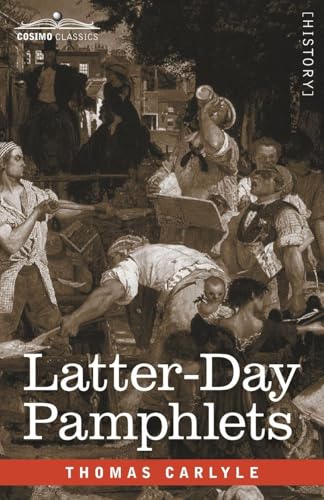
Published in 1850, the book consists of eight pamphlets: “The Present Time,” “Model Prisons,” “Downing Street,” “The New Downing Street,” “Stump-Orator,” “Parliaments,” “Hudson’s Statue,” and “Jesuitism.” Together they attack the political and moral atmosphere of post-1848 Britain. Carlyle moves from general diagnosis to prisons, government administration, parliamentary speech, public monuments, and religious institutions, but the essays remain polemical rather than programmatic.
Core ideas
Reality outranks procedure
Carlyle repeatedly contrasts the “Universe of Fact” with political “phantasms”: ballots, speeches, constitutional formulas, and popular opinion cannot make false judgments true. Institutions succeed only when their decisions correspond to the actual conditions of human nature and social life.
Leadership is a moral capacity
The rightful commander is not simply an officeholder or electoral winner but someone able to perceive enduring obligations and act on them despite opposition. Authority, in Carlyle’s ideal, is earned through insight, courage, discipline, and fidelity—not merely inherited or legally conferred.
Work is preferable to verbal politics
Carlyle distrusts eloquence detached from competence. The “stump-orator” represents a culture in which impressive speech circulates like counterfeit currency while practical problems remain unsolved. Political language has value only when backed by knowledge, character, and effective action.
Reform requires moral judgment
He rejects what he sees as indiscriminate philanthropy: helping everyone without distinguishing right from wrong, deservingness from manipulation, or remedy from indulgence. His preferred reform would cultivate responsibility, order, and purposeful labor rather than merely redistribute sympathy or benefits.
Institutions reveal social beliefs
In “Model Prisons,” Carlyle uses a clean, carefully designed prison to question whether humane administration without moral judgment actually reforms anyone. For him, treating wrongdoing as merely a technical or social problem can dissolve the distinction between culpability and innocence.
Administration should be active and purposeful
The Downing Street essays imagine a state that reduces ornamental bureaucracy and directs public power toward productive social organization, including the training of the poor for useful work. The proposals are less a workable policy program than an expression of his demand for energetic governance.
Religion supplies the book’s deepest vocabulary
Carlyle’s politics rests on quasi-theological assumptions: truth is objective, moral failure has consequences, and society is accountable to standards beyond human preference. This gives his criticism intensity, but it also makes his political conclusions resistant to democratic disagreement.
Its central weakness is prescription
The book is strongest as a diagnosis of empty rhetoric, administrative drift, and the moral costs of commercial individualism. It is weakest when it must specify who should rule, how authority should be limited, or how disagreement should be resolved. A later editorial assessment calls the pamphlets too general, too discursive, and too impractical, with promised policy recommendations that often never arrive.
Practical takeaways
- When assessing a political proposal, ask what facts and constraints it recognizes—not only how popular or morally appealing its language sounds.
- Separate competence from confidence: persuasive speech is not evidence of administrative ability.
- Treat institutional design and moral formation as related but distinct problems; cleaner systems do not automatically produce better people.
- When advocating reform, specify standards for responsibility, authority, accountability, and failure. Carlyle identifies the need for order but leaves these safeguards underdeveloped.
- Use the book diagnostically rather than programmatically: its warnings about performative politics can be useful, while its anti-democratic conclusions should be examined critically.
- Notice the danger in Carlyle’s method: contempt for public opinion can expose collective foolishness, but it can also become a license for unaccountable rule.
Caveats and counterpoints
- Carlyle’s argument is shaped by the political shock of the European revolutions of 1848; a contemporary editorial introduction argues that he misread democracy’s trajectory and wrote in a state of alarm.
- His preference for hierarchy and “heroic” authority does not provide a convincing mechanism for selecting, supervising, or removing leaders who claim superior insight.
- The rhetoric often treats complex social problems as symptoms of moral decay, underplaying economic structures, institutional incentives, and conflicts among legitimate interests.
- The prison and poverty discussions contain historically specific assumptions about discipline, deservingness, and social order that should not be imported uncritically into modern policy.
- The book’s famous intensity can obscure its lack of operational detail; its arguments are better remembered as provocations and categories of criticism than as a coherent governing blueprint.
Questions worth revisiting
- When does criticism of democratic procedure become an argument against democratic accountability itself?
- What evidence would distinguish a genuinely competent leader from a merely forceful authoritarian?
- Can Carlyle’s demand for objective standards be retained without accepting his hierarchical politics?
- Which of his targets—political rhetoric, commercialism, philanthropy, bureaucracy, or religious formalism—receives the most convincing treatment?
- How should a modern reformer balance moral judgment with compassion and structural analysis?
- What institutions can convert truthful diagnosis into accountable action?
- Does Carlyle offer a theory of reform, or mainly a theory of why existing reformers disappoint him?
Return to this when…
Return to this book when thinking about the difference between diagnosis and policy, the appeal and danger of anti-democratic leadership, or the gap between public language and practical competence. Its most durable use is as a sharp, deeply biased critique of performative politics—not as a reliable administrative program.
References
- Latter-Day Pamphlets by Thomas Carlyle | Project Gutenberg
- hetwebsite.net
- cruel.org
- Latter-day Pamphlets, by Thomas Carlyle
- gutenberg.org
- commons.wikimedia.org
- en.wikipedia.org
- The Works of Thomas Carlyle/Volume 20/Introduction - Wikisource, the free online library
- openlibrary.org
- books.google.com
- openlibrary.org
- en.wikisource.org