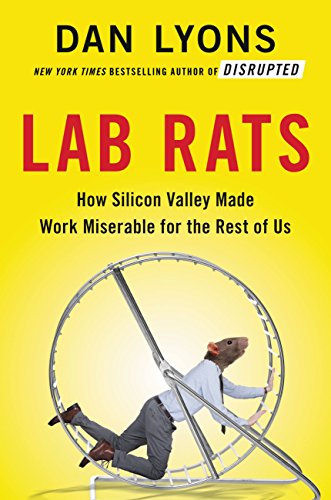

In one sentence
Silicon Valley exported a workplace model that treats employees as disposable experimental subjects: maximize investor returns, normalize insecurity and overwork, disguise control as culture, and use fashionable management techniques instead of genuine respect. Lyons argues that profitable companies need not operate this way, but restoring humane work requires rejecting the underlying social contract—not merely adding perks.
Overview
Published by Hachette’s Grand Central Publishing in 2018, the book combines reporting, observation, and satire. Lyons investigates workplaces and management practices ranging from Ford’s innovation efforts to holocracy, Agile, “serious play” with Lego, open offices, and technology-enabled monitoring. His target is not innovation itself but the power structure and incentives surrounding it: venture capital, inflated growth expectations, executive impunity, and consultants selling weakly supported ideas as science.
Core ideas
The new social contract is one-sided
Older expectations of stability, development, loyalty, and mutual obligation have been replaced by a transactional model: employers demand flexibility and commitment while retaining the right to restructure, monitor, or dismiss workers at will. Lyons connects this shift to the spread of startup economics and the erosion of worker protections.
Four sources of workplace misery
Lyons organizes the problem around inadequate or unequal compensation, job insecurity, constant and often pointless change, and dehumanization. These reinforce one another: insecurity makes workers tolerate intrusive systems, while “culture” can make exploitation appear voluntary or enjoyable.
Perks are not power
Ping-pong tables, snacks, retreats, games, and casual offices can create an appearance of belonging while leaving wages, autonomy, privacy, and security untouched. The memorable distinction is between employee experience as decoration and employee welfare as actual bargaining power.
Management fads can conceal managerial failure
Methods such as Agile, holocracy, Lego Serious Play, and “lean” startup thinking may contain useful techniques, but Lyons argues that companies often adopt their rituals without evidence that they solve the underlying problems. The fad becomes a substitute for judgment, accountability, and competent leadership.
Investor incentives shape employee experience
A startup financed for rapid growth and an eventual sale or public offering has reason to prioritize speed, optics, and valuation. Lyons’s argument is that workers absorb the downside when this model encourages underinvestment, churn, low wages, and managerial experimentation while investors and executives capture the upside.
Technology intensifies control
Digital systems can make work more measurable and connected, but they can also enable surveillance, constant availability, opaque performance scoring, and the removal of privacy. The issue is not technology in isolation; it is who controls the data and whether workers have meaningful consent or recourse.
Humane companies are a practical counterexample
Lyons ends with cautious optimism about firms such as Basecamp and Patagonia, and investors or organizations pursuing more inclusive, responsible models. His point is empirical and moral: treating workers decently is compatible with making money; cruelty is not an unavoidable price of competitiveness.
Practical takeaways
- When evaluating a workplace, inspect security, pay, autonomy, privacy, promotion paths, and turnover—not just perks or stated values.
- Treat slogans such as “we’re a family,” “move fast,” or “embrace change” as hypotheses to test against actual policies.
- Ask who benefits from a reorganization, new productivity system, or monitoring tool—and who bears the risks.
- Separate a useful management technique from the ideology or ritual packaged with it.
- Do not confuse employee happiness with entertainment: durable well-being usually depends on control, fairness, respect, and predictability.
- For leaders, the book’s implied test is simple: would you accept the same uncertainty, surveillance, and workload imposed on employees?
- For workers, document changing expectations and performance standards; ambiguity often shifts risk downward while preserving managerial discretion.
Caveats and counterpoints
- The book is an argumentative work of journalism, not a neutral survey of organizational research. Reviews generally accept the force of its critique but note its strongly polemical, sardonic presentation.
- Lyons places substantial blame on Silicon Valley and its “new oligarchs,” which can understate older causes of bad work: union decline, labor-market policy, inequality, globalization, and long-standing managerial practices.
- The examples are vivid but heterogeneous. A dysfunctional startup, a warehouse operation, and a large established corporation do not face identical constraints, so the book’s generalizations should be tested against sector and job type.
- Rejecting management fads wholesale would go too far. Some practices associated with Agile, flexible work, or employee monitoring can be useful under transparent, participatory conditions; Lyons’s stronger target is their coercive or superficial use.
- The hopeful alternatives are suggestive rather than a complete institutional program. Worker power, regulation, collective bargaining, and governance reforms receive less emphasis than the critique of corporate culture.
Questions worth revisiting
- Which workplace problems in my experience are caused by technology, and which are simply old power problems with new tools?
- What concrete evidence would distinguish authentic flexibility from shifted risk and unpaid availability?
- Which metrics does my organization optimize, and what human costs do those metrics hide?
- Are employee surveys, wellness programs, or culture initiatives changing decision rights—or merely managing discontent?
- What would meaningful worker voice look like in this organization?
- Where does Lyons’s Silicon Valley explanation illuminate my field, and where does it fail?
Return to this when…
Return to this book when a company introduces a new culture program, productivity system, office redesign, surveillance tool, or restructuring. Its central reminder is useful: evaluate the distribution of power and risk, not the novelty or friendliness of the presentation.
References
- LAB RATS | Kirkus Reviews
- catalog.losgatosca.gov
- Lab Rats: How Silicon Valley Made Work Miserable for the Rest of Us by
- goodreads.com
- Lab Rats: How Silicon Valley Made Work Miserable for the Rest of Us - Dan Lyons - Google Books
- hachettebookgroup.com
- catalog.eulesstx.gov
- books.google.com
- libraryjournal.com
- lightercapital.com
- cmc.marmot.org
- theguardian.com