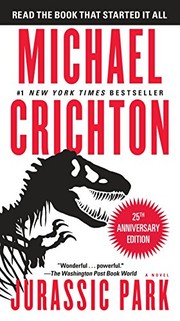

In one sentence
The novel argues that technological capability is not the same as understanding or control. Its central danger is not simply genetic engineering, but the institutional arrogance that treats a living ecosystem—and the risks surrounding it—as a manageable product.
Overview
A group of experts and visitors inspect an unfinished dinosaur park created by billionaire John Hammond’s company. Paleontologist Alan Grant, paleobotanist Ellie Sattler, mathematician Ian Malcolm, lawyer Donald Gennaro, and Hammond’s grandchildren encounter a system whose safeguards are weaker than its creators claim. The story combines survival thriller, scientific exposition, corporate intrigue, and monster fiction.
Core ideas
Control versus complexity
The park is designed as if enough fences, computers, procedures, and biological restrictions can make nature predictable. Malcolm’s chaos-theory perspective challenges that assumption: small failures can interact, amplify, and produce outcomes no central planner can foresee. Crichton uses this as the novel’s organizing idea, though the mathematics is presented mainly as a dramatic and philosophical framework rather than a rigorous treatment of chaos theory.
Scientific power without scientific responsibility
The novel does not condemn curiosity or research in the abstract. It targets the decision to pursue spectacular results before asking whether the resulting system can be responsibly governed. The genetic achievement becomes dangerous when its creators treat technical success as proof of wisdom.
Nature is not a museum exhibit
The dinosaurs are not merely attractions or reconstructed artifacts; they are living organisms with behavior, needs, and adaptive possibilities. The park’s attempt to freeze them into a commercial display exposes the mismatch between ecological reality and the visitor-friendly illusion of a controlled exhibit.
Business logic distorts science
Hammond’s vision links research to spectacle, revenue, secrecy, and investor confidence. This creates pressure to minimize warning signs and preserve the appearance of success. The park’s failures therefore arise from organizational incentives as much as from laboratory experimentation.
The novel’s human figures are thematic contrasts
Grant represents practical field knowledge and respect for animal behavior; Sattler brings ecological and medical attention; Malcolm supplies systemic skepticism; Hammond embodies entrepreneurial optimism and denial. Their disagreements make the novel’s argument visible, although critics have found some characters more like vehicles for ideas than fully rounded personalities.
Wonder and terror coexist
Crichton preserves the awe of seeing extinct animals alive while refusing to separate that wonder from vulnerability. The dinosaurs are frightening partly because they are not supernatural monsters: they are biological creatures placed inside an irresponsible human system.
Practical takeaways
- When evaluating a new technology, ask not only whether it works but what larger system it enters, who controls it, and what happens when assumptions fail.
- A safety mechanism can reduce risk without making a complex system predictable. Redundancy is not the same as mastery.
- Watch for organizations that describe uncertainty as temporary inconvenience or public-relations trouble.
- Distinguish admiration for an invention from trust in the people, incentives, and institutions managing it.
- The book is useful as a prompt to examine whether “impressive” has quietly replaced “responsible” in a project’s decision-making.
Caveats and counterpoints
- The novel’s scientific explanations are central to its appeal but are not a substitute for current genetics, paleontology, or complexity science. Some mechanisms are speculative, simplified, or now dated.
- Crichton’s exposition can interrupt the thriller’s momentum, and several characters function primarily as representatives of positions in an argument. Kirkus praised the information-rich suspense while noting the intrusive moralizing.
- The novel is darker and more violent than the 1993 film, and its character dynamics, plot emphasis, and treatment of John Hammond differ substantially from the adaptation. These notes concern Crichton’s novel, not the movie.
- “Chaos theory” is the book’s explanatory vocabulary, but the broader claim—that complex systems can defeat confident prediction—is more important here than precise technical exposition.
Questions worth revisiting
- Does the novel oppose genetic engineering itself, or the commercialization and governance of it?
- Which failures come from nature’s unpredictability, and which come from human secrecy, cost-cutting, or wishful thinking?
- Is Malcolm’s skepticism genuinely constructive, or does it become another form of intellectual performance?
- How does the park’s promise to give visitors a controlled experience shape what its designers refuse to see?
- Does the book’s use of children and visitors strengthen its ethical argument, or mainly intensify suspense?
Return to this when…
Return to this novel when thinking about technological hubris, safety culture, complex systems, or the gap between creating something and understanding its consequences. It is especially worth revisiting alongside a modern account of genetics or chaos theory to separate Crichton’s enduring questions from the period-specific science.