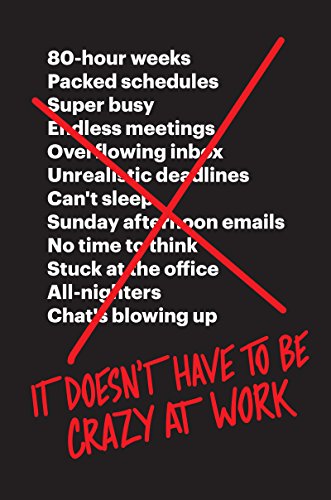

In one sentence
A company can be effective and profitable without manufacturing urgency. Calm is not passivity: it is a deliberate operating system built by protecting people’s time, narrowing priorities, limiting interruptions, and refusing growth or complexity that the business does not need.
Overview
The authors draw heavily on practices developed at Basecamp, their remote software company. They challenge long hours, busyness, constant communication, aggressive goals, excessive meetings, consensus-seeking, rapid scaling, and the assumption that more ambition is always better. Their alternative emphasizes focused work, asynchronous communication, modest workloads, small teams, fixed compensation, generous time off, and a clear sense of what is sufficient. The book is intentionally provocative and practical, but its evidence is primarily experiential rather than comparative or academic.
Core ideas
Calm is a design choice
Workplace chaos is often produced by policies and habits: too many priorities, interruptions, meetings, deadlines, and people involved in decisions. Leaders should treat calm as an organizational responsibility, not as an individual employee’s ability to cope.
Protect time and attention
Deep work requires uninterrupted stretches. The authors favor asynchronous, written communication; fewer meetings; office hours for questions; and norms that make interrupting someone costly rather than routine.
Do less, deliberately
The “low-hanging fruit” is not automatically worth picking. Ideas should be evaluated against available capacity, strategic fit, and maintenance costs. Leaving work undone can be a sound business decision.
Limit work in progress
Projects should have clear boundaries, small teams, and realistic time allocations. A finite cycle forces tradeoffs: add something only by removing or postponing something else.
Reject growth as an unquestioned virtue
The authors distinguish a healthy business from a company pursuing scale, market share, funding, or status for its own sake. “Enough” profit and size can preserve autonomy and reduce pressure to distort the business.
Prefer simple, durable management practices
The book favors straightforward policies over elaborate systems: equal pay for comparable work, market-based reviews, generous vacation, sustainable hours, and benefits that support life outside work rather than trapping people at the office.
Make decisions without endless consensus
Not every decision needs everyone’s agreement. A responsible decision-maker can listen, explain the rationale, act, and accept that disagreement is sometimes cheaper and healthier than prolonged alignment exercises.
Quality includes restraint
The goal is not perfection everywhere. Ship useful work, learn from real use, and reserve intense effort for problems that materially affect customers or the business. “Good enough” is a prioritization tool, not an excuse for carelessness.
Practical takeaways
- Audit the calendar for recurring meetings, notifications, and status rituals that consume attention without improving decisions.
- Create protected blocks for uninterrupted work and make asynchronous written updates the default.
- Set a visible limit on simultaneous projects; when a new priority appears, explicitly pause or remove another.
- Ask of every proposed feature, initiative, or hire: What problem does this solve, what will it add to ongoing complexity, and what happens if we do nothing?
- Define “enough” in concrete terms: acceptable workload, target profitability, desired company size, and boundaries on availability.
- Use smaller decision groups and assign clear ownership instead of seeking universal consensus.
- Evaluate jobs and employers by their actual operating norms—hours, interruptions, workload, autonomy—not by slogans about culture.
- Treat the book as a menu of experiments rather than a template: test one practice, observe effects, and adapt it to the work.
Caveats and counterpoints
- The book generalizes from Basecamp, a distinctive, founder-led, remote software company. Its practices may transfer poorly to hospitals, retail, manufacturing, emergency services, heavily regulated environments, or organizations with strict real-time coordination needs.
- Many recommendations assume leaders have authority to redesign workloads, compensation, communication, and priorities. Employees with little control may find the advice validating but difficult to implement directly.
- The authors’ confident, aphoristic style can make contingent choices sound universal. Independent reviewers note that the book offers limited evidence about when Basecamp’s model fails or how difficult transitions were managed.
- Calm can become paternalistic if leaders define it for everyone, suppress legitimate disagreement, or use “no politics” or “no drama” norms to avoid addressing real workplace inequities. The book’s ideal culture therefore needs checks for voice, fairness, and psychological safety.
- Fewer goals and less communication are not automatically better. Teams still need feedback, coordination, accountability, and timely escalation; the challenge is distinguishing necessary coordination from habitual busyness.
Questions worth revisiting
- Which parts of my workload are genuinely urgent, and which are merely visible or socially rewarded?
- What would I stop doing if I had to protect two uninterrupted hours each day?
- Where does my organization confuse activity, responsiveness, or growth with effectiveness?
- What is “enough” for this team, product, or career—and what would we protect by accepting it?
- Which recommendation depends on founder or managerial authority that I do not currently possess?
- Could a calm-work policy unintentionally silence important concerns or disadvantage people who need flexibility or support?
Return to this when…
Return to this book when work feels dominated by urgency, fragmented attention, excessive meetings, or pressure to grow without a clear reason. Revisit the “enough” and prioritization ideas during annual planning, a team redesign, or any decision to add projects, people, tools, or managerial layers.
Highlights
But what if you have a question on Monday and someone’s office hours aren’t until Thursday? You wait, that’s what you do. You work on something else until Thursday, or you figure it out for yourself before Thursday. Just like you would if you had to wait to talk to your professor. This might seem inefficient at first glance. Bureaucratic, even. But we’ve seen otherwise. Office hours have been a big hit at Basecamp.
Taking someone’s time should be a pain in the ass. Taking many people’s time should be so cumbersome that most people won’t even bother to try it unless it’s REALLY IMPORTANT! Meetings should be a last resort, especially big ones. When someone takes your time, it doesn’t cost them anything, but it costs you everything.
It’s JOMO that lets you turn off the firehose of information and chatter and interruptions to actually get the right shit done. It’s JOMO that lets you catch up on what happened today as a single summary email tomorrow morning rather than with a drip-drip-drip feed throughout the day. JOMO, baby, JOMO.
Here’s how he explained it in a New York Times interview: “Another concept we talk a lot about is something called a ‘trust battery.’ It’s charged at 50 percent when people are first hired. And then every time you work with someone at the company, the trust battery between the two of you is either charged or discharged, based on things like whether you deliver on what you promise.”
The same thing is true with weekday nights. If work can claim hours after 5:00 p.m., then life should be able to claim hours before 5:00 p.m. Balance, remember. Give and take.
Skeptical? Make the first Thursday of the month Library Rules day at the office. We bet your employees will beg for more.
Following group chat at work is like being in an all-day meeting with random participants and no agenda. It’s completely exhausting.
Most deadlines aren’t so much deadlines as dreadlines. Unrealistic dates mired by ever-expanding project requirements. More work piles on but the timeline remains the same. That’s not work, that’s hell.
Someone in charge has to make the final call, even if others would prefer a different decision. Good decisions don’t so much need consensus as they need commitment. Jeff Bezos put it well in his 2017 letter to shareholders: I disagree and commit all the time. We recently greenlit a particular Amazon Studios original. I told the team my view: debatable whether it would be interesting enough, complicated to produce, the business terms aren’t that good, and we have lots of other opportunities. They had a completely different opinion and wanted to go ahead. I wrote back right away with “I disagree and commit and hope it becomes the most watched thing we’ve ever made.” Consider how much slower this decision cycle would have been if the team had actually had to convince me rather than simply get my commitment. We totally agree. We’ve been practicing disagree and commit since the beginning, but it took Bezos’s letter to name the practice. Now we even use that exact term in our discussions. “I disagree, but let’s commit” is something you’ll hear at Basecamp after heated debates about specific products or strategy decisions.
We just needed to be fast enough and 15 minutes was fast enough. Even within the hour was fast enough. That popped the pressure release valve on our team, too. Everyone calmed down. They could spend more time thinking, helping, and writing—and less time rushing. Everything got better. Customers remained thrilled with our fast service—which was a bit slower than before but still way ahead of the industry—and our team chilled out and did better work. Win-win. Not only was it enough, it was plenty.
Management scholar Peter Drucker nailed it decades ago when he said “There is nothing so useless as doing efficiently that which should not be done at all.”
Nearly all product work at Basecamp is done by teams of three people. It’s our magic number. A team of three is usually composed of two programmers and one designer. And if it’s not three, it’s one or two rather than four or five. We don’t throw more people at problems, we chop problems down until they can be carried across the finish line by teams of three. We rarely have meetings at Basecamp, but when we do, you’ll hardly ever find more than three people around a table. Same with conference calls or video chats. Any conversation with more than three people is typically a conversation with too many people.
It’s taken us a long time and a number of missteps to learn this core truth about selling: Sell new customers on the new thing and let old customers keep whatever they already have. This is the way to keep the peace and maintain the calm.
Jean-Louis Gassée, who used to run Apple France, describes this situation as the choice between two tokens. When you deal with people who have trouble, you can either choose to take the token that says “It’s no big deal” or the token that says “It’s the end of the world.” Whichever token you pick, they’ll take the other. The hotel staff in the example above clearly took the “It’s no big deal” token and as a result forced you to take the “It’s the end of the world” token. But they could just as well have made the opposite choice. Imagine the staff answering something like this: “We’re so sorry. That’s clearly unacceptable! I can completely understand how it must be almost impossible to sleep when it’s so hot in your room. If I can’t fix this problem for you tonight, would you like me to refund your stay and help you find a different hotel room nearby? In any case, while we’re figuring out the solution, allow me to send up a bottle of ice water and some ice cream. We’re terribly sorry for this ordeal and we’ll do everything to make it right.” With an answer like that, you’re almost forced to pick the “It’s no big deal” token. Yeah, sure, some water and ice cream would be great! Everyone wants to be heard and respected. It usually doesn’t cost much to do, either. And it doesn’t really matter all that much whether you ultimately think you’re right and they’re wrong. Arguing with heated feelings will just increase the burn. Keep that in mind the next time you take a token. Which one are you leaving for the customer?