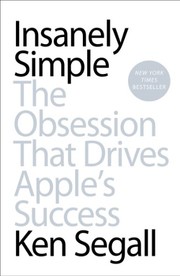

In one sentence
Apple’s advantage came from treating Simplicity as a governing worldview rather than a cosmetic style. By relentlessly reducing choices, participants, messages, product variations, and organizational friction, Apple could produce clearer ideas and faster, more distinctive decisions. Segall presents this as a transferable competitive principle, though his evidence is primarily anecdotal and Apple-centered.
Overview
Segall combines memoir, advertising case studies, and management advice. The book’s chapters move through principles such as thinking brutally honestly, thinking small, minimizing, using motion and iconic ideas, choosing memorable phrases, working casually and humanely, remaining skeptical, and anticipating the future. Stories from Apple and comparisons with companies such as Dell, Intel, and Microsoft illustrate how complexity weakens focus.
Core ideas
Simplicity is a system, not an aesthetic
Apple’s simplicity operates across product design, naming, advertising, meetings, structure, and customer experience. The point is not merely to make things look clean; it is to remove competing priorities so the central idea becomes unmistakable.
Focus requires exclusion
A small product line, a narrow objective, or a limited number of participants can concentrate resources and improve decisions. Segall treats saying “no” to attractive alternatives as a prerequisite for strong work.
Small groups protect idea quality
Large meetings and layered approval processes invite compromise and dilute accountability. Segall’s Apple examples favor compact groups of capable people who can debate directly and keep ownership clear.
Brutal clarity beats bureaucratic politeness
The book portrays direct criticism and plain speaking as tools for improving work quickly. This can prevent weak ideas from surviving, but it depends on trust, competence, and a culture able to distinguish useful candor from intimidation.
A simple message is strategically powerful
Campaigns such as “Think Different,” product names such as iMac, and memorable demonstrations show how compression can make a complicated technology understandable and emotionally resonant. Simplicity helps customers remember what matters.
Simplicity is hard because complexity is often safer
Organizations add features, words, people, and process to reduce perceived risk or satisfy internal stakeholders. Segall’s recurring challenge is to identify what is essential, accept the discomfort of omission, and defend the resulting idea.
The method is transferable—but not mechanically
Segall believes people outside Apple can adopt the principles, especially by clarifying goals, reducing choices, and protecting strong ideas. However, the book offers principles and stories more than a fully specified operating system or measurement framework.
Practical takeaways
- State the one outcome a project must achieve; treat additional goals as candidates for removal.
- Reduce the number of active priorities, product variants, messages, and decision-makers before trying to improve execution.
- Use small, accountable teams for important work; invite specialists when their contribution is essential, not merely customary.
- Rewrite presentations, names, and product descriptions until the core idea is immediately understandable.
- Build a criticism norm: challenge the work directly, explain why, and separate disagreement from personal status.
- Ask of every feature or process: does it materially improve the customer’s experience or the project’s central objective?
- Preserve skepticism late in a project; momentum and sunk costs should not automatically protect a weak idea.
Caveats and counterpoints
- Segall writes as a former advertising creative director and Apple insider, so the book is valuable firsthand testimony but not an independent study of Apple. Library Journal specifically notes that his perspective is not entirely objective.
- The narrative is strongly Jobs-centric and admiring. Kirkus judged it overly propagandistic, noting that the book gives limited attention to facts that complicate the heroic Apple story.
- The examples can make simplicity appear more causally decisive than it may have been; Apple’s results also depended on technology, timing, design, brand strength, distribution, and execution.
- Directness and extreme focus can become harmful when they suppress dissent, overload small teams, or turn a leader’s taste into an unquestionable standard.
- Some domains genuinely require complexity for safety, compliance, reliability, or customization. The useful lesson is to hide unnecessary complexity from users and decision-makers—not to eliminate necessary complexity itself.
Questions worth revisiting
- Where am I adding complexity because it improves the work, and where am I adding it to avoid making a difficult choice?
- What is the single idea a customer, colleague, or audience should remember?
- Which current priorities could be eliminated without damaging the core outcome?
- Is this a genuinely small, accountable team—or a large committee described as a team?
- Does blunt feedback here improve the work, or merely reward authority and aggression?
Return to this when…
Return to this book when a project is becoming crowded with features, stakeholders, explanations, or approval steps. Revisit the chapters on focus, small groups, minimalism, language, and skepticism when you need to recover a clear central idea. Read the caveats alongside it whenever “the Steve Jobs way” is being treated as a universal management formula.
Highlights
Your challenge is to become unbending when it comes to enforcing your standards. Mercilessly so. If you submit only the work you believe in 100 percent and approve only the work you believe in 100 percent, you own something that no one can take away from you: integrity.
Simplicity’s Best Friend: Small Groups of Smart People What Lorrie experienced was the strict enforcement of one of Simplicity’s most important rules: Start with small groups of smart people—and keep them small. Every time the body count goes higher, you’re simply inviting Complexity to take a seat at the table.
Everyone in the room should be there for a reason. There’s no such thing as a “mercy invitation.” Either you’re critical to the meeting or you’re not. It’s nothing personal, just business.
How to Have a Great Meeting 1.Throw out the least necessary person at the table. 2. Walk out of this meeting if it lasts more than 30 minutes. 3. Do something productive today to make up for the time you spent here.
You know how many committees we have at Apple? Zero. We’re organized like a start-up. We’re the biggest start-up on the planet.
The quality of work resulting from a project is inversely proportional to the number of people involved in the project.
People think focus means saying yes to the thing you’ve got to focus on. But that’s not what it means at all. It means saying no to the hundred other good ideas that there are. You have to pick carefully. I’m actually as proud of the things we haven’t done as the things we have done. Innovation is saying no to a thousand things.
Many years later, Mark Parker, president and CEO of Nike, asked Steve if he had any advice for him. Steve volunteered: Nike makes some of the best products in the world—products that you lust after, absolutely beautiful, stunning products. But you also make a lot of crap. Just get rid of the crappy stuff and focus on the good stuff.
Those who believe in Simplicity believe that good ideas need to be protected from those who would do them damage.
Leonard Bernstein captured this thought perfectly when he said: To achieve great things, two things are needed; a plan, and not quite enough time.
After a meeting in Cupertino, one of Apple’s senior marketing people had given me his assessment of what life was like inside Apple with the new CEO. “It’s like Sculley moved into a house that was all set up, with nice furniture in every room,” he explained. “Things were fine for a while, but then you’d notice that familiar things were no longer where you thought they’d be. Or the drapes would get changed to something that didn’t match the room. Or you’d notice some moving guys carrying a sofa away and yell, ‘Hey, wait, that’s my favorite couch!’ but they didn’t listen. Pretty soon, the whole place started to feel different. It was still the same house, it just didn’t feel like home anymore. And your friends didn’t want to come over anymore because it wasn’t as much fun as it used to be.”
To me, marketing is about values. This is a very complicated world, it’s a very noisy world, and we’re not going to get a chance to get people to remember much about us. No company is. And so we have to be really clear on what we want them to know about us. Now, Apple—fortunately—is one of the half a dozen best brands in the whole world. Right up there with Nike, Disney, Coke, Sony. It is one of the greats of the greats. Not just in this country, but all around the globe. But even a great brand needs investment and caring if it’s going to retain its relevance and vitality, and the Apple brand has clearly suffered from neglect in this area in the last few years. And we need to bring it back. The way to do that is not to talk about speeds and feeds. It’s not to talk about MIPS and megahertz. It’s not to talk about why we’re better than Windows. The dairy industry tried for twenty years to convince you that milk was good for you. It’s a lie, but they tried anyway. [Audience laughs.] And the sales have gone like this [down], and then they tried “Got milk?” and the sales have gone like this [up]. “Got Milk?” doesn’t even talk about the price—matter of fact the focus is on the absence of the price. But the best example of all, and one of the greatest jobs of marketing that the universe has ever seen, is Nike. Remember, Nike sells a commodity. They sell shoes. And yet when you think of Nike, you feel something different than a shoe company. In their ads, as you know, they don’t ever talk about the price. They don’t ever tell you about their air soles and why they’re better than Reebok’s air soles. What is Nike doing in their advertising? They honor great athletes, and they honor great athletics. That’s who they are, that’s what they are about. Apple spends a fortune on advertising. You’d never know it. . . . So, when I got here, Apple [had] just fired their agency and was in a competition with twenty-three agencies that, you know, four years from now they’d pick one. And we blew that up and we hired Chiat/Day, the ad agency that I was fortunate enough to work with years ago, who created some award-winning work, including the commercial voted the best ad ever made, 1984, by advertising professionals. And we started working with that agency again, and the question we asked was: Our customers want to know, “Who is Apple, and what is it that we stand for? Where do we sit in this world?” And what we’re about isn’t making boxes for people to get their jobs done, although we do that well. We do that better than almost anybody in some cases. But Apple is about something more than that. Apple at the core, its core value, is that we believe that people with passion can change the world for the better. That’s what we believe. . . . And that those people who are crazy enough to think they can change the world are the ones that actually do. And so what we’re going to do in our first brand marketing campaign in several years is to get back to that core value. A lot of things have changed. The market is a totally different place from what it was a decade ago. And Apple is totally different, and Apple’s place in it is totally different. . . . But values—and core values—those things shouldn’t change. The things that Apple believes in at its core are the same things that Apple really stands for today. And so we wanted to find a way to communicate this. And what we have is something that I am very moved by. It honors those people who have changed the world. Some of them are living; some of them are not. But the ones that aren’t, as you’ll see—you know that if they ever used a computer, it would have been an Apple. The theme of the campaign is Think different, honoring the people who think different and who move this world forward. And it is what we are about; it touches the soul of this company. . . . I hope that you feel the same way about it I do.
Mike was shocked when Steve Jobs walked into the room, ignored their work, and walked right up to the whiteboard. “Here’s the new application,” he said. “It’s got one window. You drag your video into the window. Then you click the button that says ‘Burn.’ That’s it. That’s what we’re going to make.”
Jan recapped the mission to set the context for Steve, telling him that this was being done to accommodate the addition of Color to the mix. Steve looked at the boxes, then looked up at the team. “Put the software in the box,” he said. The group was unsure what he meant. Explanation, please. “Put Color in the Final Cut Studio box. We sell one product. Period.” There was a beat of silence as the group absorbed that. “What next?” he said. Jan, bless her little heart, felt it was important for Steve to understand why they had done this. She explained that she’d promised the CFO that the software group would create a special edition so it could track and justify the cost of acquiring Color. “Looks like you made a big mistake,” said Steve. And that was it. Meeting over. Final Cut Studio 2 would remain a single box and a single product.
Looking back, I think it was one of those times when Complexity wasn’t even trying to be sneaky. It was staring us in the face, yet no one seemed to notice until Steve hit it with the Simple Stick.
In this case, it was Jan’s overexuberance that was to blame. She was convinced that if she could just find the right name, her product problem would be solved. Unfortunately, her entire quest was inspired by a competitor’s values—and not by Apple’s rules of Simplicity.
Process makes you more efficient. But innovation comes from people meeting up in the hallways or calling each other at 10:30 at night with a new idea, or because they realized something that shoots holes in how we’ve been thinking about a problem. It’s ad hoc meetings of six people called by someone who thinks he has figured out the coolest new thing ever and who wants to know what other people think of his idea.
Here’s to the crazy ones. The misfits. The rebels. The troublemakers. The round pegs in the square holes. The ones who see things differently. They’re not fond of rules. And they have no respect for the status quo. You can quote them, disagree with them, glorify or vilify them. About the only thing you can’t do is ignore them. Because they change things. They push the human race forward. And while some may see them as the crazy ones, we see genius. Because the people who are crazy enough to think they can change the world . . . are the ones who do.
Apple didn’t describe the original iPod as a 6.5-ounce music player with a five-gigabyte drive. It simply said, “1,000 songs in your pocket.” This is the way human beings communicate, so this is the way Apple communicates. Human-speak is a hallmark of Simplicity. It’s the recognition that the best way to connect with people is to put things in human terms and use the words that people use in everyday conversation.
It’s really hard to design products by focus groups. A lot of times, people don’t know what they want until you show it to them.
I succinctly described the four problem areas and asked for guidance. Fortunately, Steve wasn’t going to allow Complexity to do its dirty work. Just minutes after I hit the “send” button, his reply landed in my in-box. It wasn’t the most verbose email I’d ever received. But the first sentence so eloquently put things into perspective: Fuck the lawyers.
When you first start off trying to solve a problem, the first solutions you come up with are very complex, and most people stop there. But if you keep going, and live with the problem and peel more layers of the onion off, you can oftentimes arrive at some very elegant and simple solutions.
Simplicity can take you to fantastic heights. However, a bad idea remains bad no matter how you try to simplify it. And unfortunately, being a believer in Simplicity does not exempt you from having bad ideas.
Sometimes when you innovate, you make mistakes. It is best to admit them quickly, and get on with improving your other innovations.
“Simple can be harder than complex. You have to work hard to get your thinking clean to make it simple. But it’s worth it in the end, because once you get there, you can move mountains.” —Steve Jobs