
In one sentence
A life organized around a personally meaningful reason to live—an ikigai—can sustain motivation, engagement, social connection, and everyday wellbeing. The authors connect this idea with habits they observed among older Okinawans: staying active, eating moderately, maintaining close relationships, managing stress, and continuing purposeful activity throughout life.
Overview
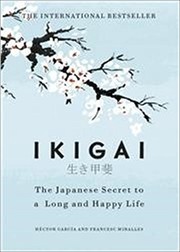
The book begins by introducing ikigai as a reason for being or something worth getting up for. It then draws on the authors’ interviews with more than 100 older residents of Ogimi, Okinawa, before broadening into discussions of flow, retirement, diet, exercise, stress, sleep, meditation, resilience, and social belonging. Its practical tone comes from short explanations, lists, diagrams, and suggestions rather than a single systematic method.
Core ideas
Ikigai is lived purpose, not necessarily a grand mission
The book presents ikigai as the activity, relationship, responsibility, or aspiration that makes life feel worth continuing. It need not be a career or exceptional calling; ordinary, repeatable sources of meaning count.
Purpose is reinforced by continued activity
The authors emphasize remaining engaged rather than treating old age as a complete withdrawal from useful activity. Work, hobbies, caring roles, and contribution can provide structure and identity.
Flow makes activity rewarding in itself
Deep absorption—working at an appropriately demanding task with concentrated attention—reduces self-consciousness and makes effort intrinsically satisfying. The practical implication is to seek activities that are challenging enough to hold attention but not overwhelming.
Longevity is presented as a lifestyle pattern
The Ogimi material highlights moderate eating, frequent low-intensity movement, time outdoors, sleep, stress management, and strong neighborhood relationships. The advice is cumulative: small daily behaviors matter more than occasional heroic efforts.
Community protects wellbeing
The book treats social ties as part of health rather than an optional extra. Okinawan mutual-support groups are used to illustrate how regular contact, shared responsibilities, and belonging can provide emotional and practical resilience.
Acceptance and resilience support purposeful living
The authors draw on ideas associated with mindfulness, stoicism, and logotherapy: accept what cannot be controlled, return attention to the present, and preserve a reason to continue despite hardship.
Moderation is a recurring behavioral rule
The discussion of food uses the Okinawan principle of stopping before feeling completely full. More broadly, the book favors sustainable routines, moderate exertion, and consistency over extreme diets or productivity programs.
Practical takeaways
- List activities that reliably make you feel engaged, useful, curious, or connected; look for recurring patterns rather than trying to invent a perfect life mission.
- Schedule one meaningful activity each day that is not dependent on external praise or a major achievement.
- Protect regular contact with a small circle of people and contribute something tangible to that circle.
- Use a modest daily movement routine—walking, stretching, gardening, or similar activity—that you can maintain indefinitely.
- Reduce automatic overconsumption by pausing before eating more and noticing whether you are comfortably satisfied.
- Choose one task for focused, uninterrupted work; adjust its difficulty until it is absorbing but manageable.
- When stressed, separate controllable actions from uncontrollable circumstances, then return attention to the next concrete action.
- Treat retirement or career change as a redesign of purposeful activity, not simply the removal of work.
Caveats and counterpoints
- The book’s central longevity claim is stronger than its evidence. It associates ikigai with the health and longevity of Ogimi residents but does not convincingly establish that ikigai causes longer life; a serious review describes the argument as correlation presented as causation.
- Much of the health advice is familiar and presented as a compilation of broadly sensible practices rather than as original research or a tightly tested intervention.
- The popular four-circle diagram—what you love, what you are good at, what the world needs, and what you can be paid for—is a useful modern career exercise, but it should not be mistaken for a complete definition of ikigai or the book’s sole organizing framework.
- The Okinawan examples are selective anecdotes. They can suggest questions about purposeful aging and community, but they cannot by themselves establish which habits matter most or transfer unchanged to other populations.
- Advice about diet, exercise, sleep, or mental health should be adapted to individual circumstances and, where relevant, checked against qualified professional guidance.
Questions worth revisiting
- What activities make an ordinary day feel worth having, even when nobody notices them?
- Which parts of my current routine provide genuine engagement, and which merely keep me busy?
- What form of contribution could I sustain for the next decade—not just for the next month?
- Who belongs to my dependable support network, and what do I contribute to it?
- Where am I pursuing intensity or optimization when a moderate, repeatable habit would serve me better?
- What would purposeful activity look like if my job, status, or income changed?
- Which claim in the book am I treating as evidence, when it is really an appealing anecdote or interpretation?
Return to this when…
Return when you are drifting into passive routines, overcomplicating the search for purpose, or designing a lifestyle around short bursts of motivation. The most useful reminder is that meaning can be ordinary and practiced: stay engaged, nurture relationships, move regularly, and keep a reason to participate in tomorrow.
Highlights
In the following chapters, we’ll take a look at the basic tools you’ll need to get moving along that path: finding flow in the tasks you’ve chosen to do, eating in a balanced and mindful way, doing low-intensity exercise, and learning not to give in when difficulties arise. In order to do this, you have to accept that the world—like the people who live in it—is imperfect, but that it is still full of opportunities for growth and achievement.
The Seven Conditions for Achieving Flow According to researcher Owen Schaffer of DePaul University, the requirements for achieving flow are: Knowing what to do Knowing how to do it Knowing how well you are doing Knowing where to go (where navigation is involved) Perceiving significant challenges Perceiving significant skills Being free from distractions
Many such artists might seem misanthropic or reclusive, but what they are really doing is protecting the time that brings them happiness, sometimes at the expense of other aspects of their lives. They are outliers who apply the principles of flow to their lives to an extreme. Another example of this kind of artist is the novelist Haruki Murakami. He sees only a close circle of friends, and appears in public in Japan only once every few years. Artists know how important it is to protect their space, control their environment, and be free of distractions if they want to flow with their ikigai.
References
- 'Ikigai: The Japanese Secret to a Long and Happy Life': Does happiness lie in your purpose in life? - The Japan Times
- Ikigai: The Japanese Secret to a Long and Happy Life by Hector Garcia, Francesc Miralles
- Ikigai - Penguin Random House India
- discover.hubpages.com
- penguinrandomhouse.com
- japan.go.jp
- openlibrary.org
- indigo.ca
- penguin.co.uk
- catalog.library.nashville.org
- penguin.co.uk
- gmworldbook.com