
In one sentence
Western societies have fallen from the “sun” of utopian modernity: twentieth-century wars, totalitarianism, and social disillusionment weakened faith in inevitable progress, while secular culture also discarded older religious sources of meaning. The result is not genuine liberation from transcendence but a “black market” of moral absolutes—rights, equality, emotion, and risk-aversion—whose hidden authority often goes unacknowledged. Delsol’s answer is neither a return to naïve utopianism nor a,
Overview
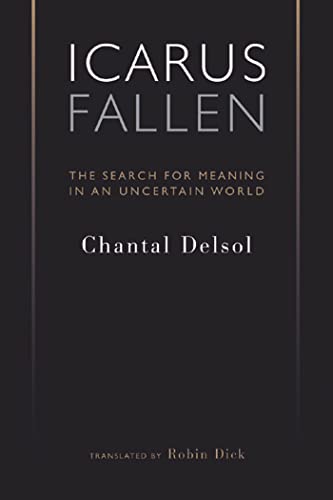
The English edition was published by ISI Books in 2003; it translates a French work first published in 1996. Its four-part structure moves from meaninglessness, through modern morality’s distortions, to the need for a “new anthropology,” and finally toward a more limited and vigilant way of mastering the world.
Core ideas
Icarus as a civilizational metaphor
Modern Western humanity tried to escape limitation through ideologies of perfectibility, historical progress, and unlimited transformation. After the catastrophes of the twentieth century, it has “fallen”: it no longer trusts those promises but has not recovered a stable account of why life matters.
Meaning cannot simply be abolished
Delsol argues that societies which reject religion, morality, or economic necessity do not eliminate them; they reappear unofficially or in disguised forms. A culture may deny objective moral order while continuing to treat certain commitments as sacred. This is the book’s idea of moral and ideological “black markets.”
The good without the true
Contemporary morality emphasizes compassion, inclusion, and the alleviation of suffering, but hesitates to claim that some beliefs or ways of life are objectively true. Delsol sees this as unstable: moral demands still require judgments about human nature and the good, even when those foundations are denied.
From virtue and honor to values and dignity
The book contrasts older ideals of enduring virtue, earned honor, and tragic acceptance with a culture centered on subjective values, protected dignity, personal fulfillment, and emotional indignation. The shift makes morality more accommodating, but potentially less demanding and less capable of judging the self.
Rights and democracy can become sacred substitutes
Delsol does not simply reject democracy or rights. Her concern is their sacralization: when procedural arrangements and individual claims are treated as beyond argument, they become substitutes for a wider worldview. Democracy may be valuable without being a complete answer to the question of meaning.
The modern fear of limits
The later chapters address equality, work and care, decision-making, risk, and the rejection of fixed identities or roles. Delsol’s broader point is that a society seeking zero risk and maximum choice may lose the categories—finitude, responsibility, sacrifice, dependence—through which human life becomes intelligible.
A new anthropology, not a new utopia
The proposed way forward is a changed understanding of the human person: finite, plural, exposed to uncertainty, and unable to eliminate evil or tragedy. Meaning must be recovered without pretending that history guarantees progress or that politics can redeem humanity. The conclusion stresses vigilance rather than certainty.
Practical takeaways
- When a culture claims to be purely pragmatic or value-neutral, ask which commitments it treats as non-negotiable.
- Separate the usefulness of democracy or rights from the larger claim that they can supply a complete worldview.
- Test moral language for hidden assumptions about human nature, the good, responsibility, and acceptable limits.
- Treat promises of total safety, perfect equality, or unlimited self-creation as possible utopian residues rather than neutral goals.
- Recover meaning through responsible action under uncertainty, not through confidence that history will deliver salvation.
Caveats and counterpoints
- The book is a broad philosophical diagnosis, not an empirical study: its claims about “Western society” compress major differences among countries, classes, religions, and political traditions.
- Its critique of subjectivism can understate how rights and dignity also protect people from inherited domination, arbitrary hierarchy, and genuine abuse.
- The proposed “new anthropology” is suggestive rather than fully specified; readers may want a clearer account of which institutions, virtues, or traditions should guide it.
- A later conservative review praises Delsol’s diagnosis but argues that she too quickly dismisses inherited wisdom and remains committed to aspects of modern emancipation. This is an interpretation by a reviewer, not necessarily Delsol’s own position.
Questions worth revisiting
- Can a society preserve universal rights without treating them as a substitute religion?
- What would count as an objective good if neither traditional theology nor progressive ideology is persuasive?
- Does Delsol distinguish adequately between liberation from oppressive roles and liberation from all meaningful limits?
- Is uncertainty a condition to be inhabited, or can institutions reduce it without promising to abolish tragedy?
- What concrete practices could reconnect dignity with responsibility rather than entitlement?
Return to this when…
Return to this book when thinking about post-progress politics, secularization, moral subjectivism, the limits of rights discourse, or why affluent societies can possess extensive freedom yet lack a shared account of purpose.
References
- Icarus fallen : the search for meaning in an uncertain world | WorldCat.org
- Chantel Delsol, Icarus fallen: the search for meaning in an uncertain world - PhilPapers
- isi.org
- Icarus Fallen: The Search for Meaning in an Uncertain World | Denver Journal
- Icarus Fallen: The Search for Meaning in an Uncertain World (Chantal Delsol) - The Worthy House • Towards A Politics of Future Past
- quaerens.blog
- Icarus Fallen: Search For Meaning In An Uncertain World by Chantal Delsol | Goodreads
- Wisdom of Dr. Chantal Delsol | ubcgcu
- modernagejournal.com
- libraries.visionrcl.org.uk
- goodreads.com
- campusstore.miamioh.edu