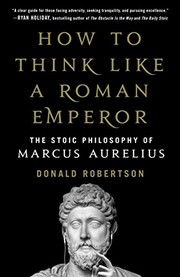

In one sentence
Stoicism is less a set of comforting beliefs than a trainable method for improving judgment and character. We cannot command events, other people, bodily conditions, or reputation; we can work on our interpretations, intentions, choices, and conduct. Emotional resilience follows from repeatedly practicing that distinction and orienting action toward wisdom, justice, courage, and self-control. Robertson presents Marcus Aurelius as a demanding example of this practice, while connecting Stoic “cogn
Overview
The book alternates between Marcus Aurelius’s biography, explanations of Stoic doctrine, and practical psychological exercises. Robertson emphasizes Marcus’s education, his relationship to Stoic teachers—especially Junius Rusticus—and the pressures of imperial responsibility. The central bridge to modern readers is cognitive-behavioral therapy: distress is shaped not simply by events, but by the judgments attached to them. The publisher describes the book as combining Marcus’s life, modern psychology, and Stoic guidance for emotional resilience.
Core ideas
Separate events from judgments
An event is not identical to the meaning or value we assign it. Pause before endorsing the first impression; describe what happened more precisely, identify the judgment added by the mind, and ask whether that judgment is justified or useful.
Control is ethical, not merely strategic
The important controllable sphere is not whether you win, stay healthy, or receive approval. It is the quality of your present response: your reasoning, purpose, effort, honesty, and treatment of others. Outcomes matter practically, but they do not determine moral worth.
Use the ideal sage as a compass
Marcus repeatedly models himself on exemplary teachers and philosophers. The point is not to imagine perfection but to make values concrete: What would a wise, fair, courageous, and restrained person do in this situation?
Train desire and aversion
Much suffering comes from demanding that reality satisfy personal preferences. Practice wanting to act well more than wanting circumstances to conform; this does not mean passivity, but directing effort toward effective action without making happiness conditional on success.
Rehearse adversity
Premeditation of possible losses, obstacles, illness, criticism, and death reduces surprise and clarifies priorities. Robertson treats this as mental rehearsal rather than pessimism: imagine the difficulty, identify your response, and return attention to the next deliberate action.
Regulate anger through interpretation and perspective
Anger is intensified by assumptions about insult, intentionality, fairness, and deserved punishment. Slow the reaction, consider ignorance and shared human weakness, widen the time horizon, and choose correction or firm action over revenge.
Adopt the view from above
Imagining oneself from a wider spatial and temporal perspective shrinks ego, status anxiety, and immediate outrage. The exercise is meant to restore proportion: individual troubles matter, but they are brief parts of a much larger human and natural order.
Accept mortality without wasting life
Death is presented as natural, unavoidable, and constantly relevant to prioritization. Remembering limited time should make present action more serious: perform today’s role well rather than postponing virtue until conditions become easier.
Practical takeaways
- When distressed, write two columns: observable facts and the judgments, predictions, or demands you added.
- Before an important task, define the outcome you want, then define the response you will respect even if the outcome fails.
- Use a brief pause—label the impression, test it, and choose an action aligned with your values.
- Keep a morning intention and an evening review: What did I try to do? Where did judgment or impulse take over? What will I practice tomorrow?
- For anger, ask: What exactly happened? What do I know about the other person’s intention? What response protects justice without adding needless harm?
- Treat health, money, praise, and success as preferred conditions—not as proof that life is good or that you are good.
- Use mortality and the view from above to identify what deserves attention now, not to dismiss legitimate grief or practical problems.
Caveats and counterpoints
- This is primarily an accessible Stoic self-help and interpretation book, not a comprehensive biography of Marcus Aurelius or a specialist study of Roman history. Robertson himself distinguishes it from his later, more in-depth biography.
- The Stoicism–CBT connection is illuminating but selective. Robertson highlights shared techniques such as examining thoughts and rehearsing responses; ancient Stoicism also includes a broader ethical and cosmological system that should not be reduced to modern therapy.
- Marcus is used as a model of disciplined leadership, but the example can idealize him. His imperial role, political decisions, slavery, warfare, and the limits of our evidence complicate any simple picture of a universally exemplary ruler.
- “Accept what is” can be misunderstood as resignation. In the book’s framework, acceptance concerns the facts and limits of a situation; it does not forbid resistance, planning, criticism, or action.
- Exercises such as negative visualization may help some readers but may intensify anxiety or rumination for others. Adapt them, especially when dealing with trauma, depression, or severe anxiety; they are not a substitute for professional care.
Questions worth revisiting
- Which current problem is painful because of the event itself, and which part comes from an added demand, prediction, or status judgment?
- What outcome am I treating as necessary when it is merely preferred?
- What would courage, justice, wisdom, and self-control each recommend here?
- What response would I still endorse if nobody praised me for it?
- Where would acceptance improve my effectiveness, and where would it become an excuse for avoiding action?
- What recurring impression—insult, failure, uncertainty, loss of control—most needs deliberate practice?
Return to this when…
Return when you are overreacting to criticism, facing an uncertain outcome, preparing for a difficult conversation, or confusing success with virtue. The most useful reread is the section on control, anger, or adversity rehearsal immediately before a demanding situation.