
In one sentence
Worry becomes most destructive when it is vague, repetitive, and disconnected from action. Carnegie’s central remedy is to convert worry into a defined problem, decide what can be done, act on that decision, and then redirect attention toward the present day.
Overview
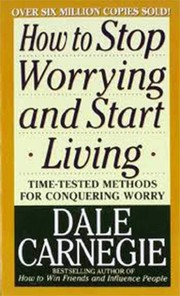
The book moves from immediate techniques for handling worry to broader attitudes that reduce its recurrence. Carnegie recommends living in “day-tight compartments,” analyzing problems systematically, estimating the real likelihood and cost of feared outcomes, accepting unavoidable facts, and using purposeful activity to crowd out rumination. Later sections address criticism, fatigue, boredom, insomnia, and adversity. The 2004 Gallery Books edition is a revised edition; chapter titles and pagination vary across editions.
Core ideas
Separate today from an unknowable future
Treat the current day as the unit of action. Past events cannot be changed, while distant possibilities cannot yet be acted on; returning attention to today reduces the mental space available for speculative worry.
Turn anxiety into an analysis
Define the problem precisely, identify the facts, list possible courses of action, choose one, and begin implementing it. The point is not perfect certainty but ending indefinite deliberation.
Use probability and proportionality
Ask what the feared event’s actual likelihood is and what its realistic consequences would be. This counters the mind’s tendency to treat vivid possibilities as probable certainties.
Accept what cannot be changed
When an outcome is unavoidable, resistance adds a second burden to the original difficulty. Acceptance is presented as a practical starting point for deciding how to respond, not as approval of the event.
Actively occupy attention
Constructive work, useful interests, and service to others can interrupt repetitive thought. Carnegie treats idleness and fatigue as conditions that often intensify worry, rather than assuming worry is solved by thinking harder.
Set a limit on losses and resentment
The book advises deciding in advance what amount of time, money, or emotional energy a problem is worth, then refusing to keep paying beyond that limit. It also argues that prolonged revenge and resentment mainly injure the person holding them.
Build preventive habits
Better organization, rest, variety, relaxation, and attention to fatigue make worry less likely to spiral. The final sections connect emotional distress with working conditions, boredom, and sleep-related anxiety.
Practical takeaways
- Write down the worry in one sentence: “What exactly is the problem?”
- Separate facts from assumptions and worst-case imagery.
- List all plausible options, choose the best available one, and set a time to act.
- Ask: “What is the probability?” and “What is the realistic worst outcome?”
- If the worst outcome occurred, decide what you would do next; preparation is more useful than repeated rehearsal.
- For an unavoidable fact, name what must be accepted and what remains within your control.
- When rumination starts, switch to a concrete task requiring attention rather than trying to argue endlessly with the thought.
- Use a personal stop-loss rule: decide how much time, money, or emotional effort a problem deserves, and stop exceeding it.
Caveats and counterpoints
- The book is a mid-twentieth-century self-help work, built heavily from anecdotes and moral/philosophical advice rather than contemporary clinical research. Its principles are useful heuristics, not a substitute for evidence-based treatment.
- Carnegie sometimes presents worry as a habit that can be overcome through attitude and action. That framing can understate anxiety disorders, trauma, depression, obsessive-compulsive symptoms, medical causes, or social conditions that require professional or structural help.
- “Accept the inevitable” is practical for uncontrollable facts, but it should not be used to normalize abuse, discrimination, unsafe work, or preventable harm.
- The advice is strongest for ordinary rumination and everyday decision paralysis; it is less sufficient when worry is persistent, disabling, accompanied by panic, or resistant to self-help.
Questions worth revisiting
- Which current worry can be converted into a specific decision today?
- What facts do I actually know, and which parts are predictions?
- Am I solving a problem, or repeatedly rehearsing an outcome?
- What would a proportionate response look like if the feared event were only moderately likely?
- Where am I paying beyond my personal stop-loss limit?
- What daily conditions—fatigue, boredom, disorganization, isolation—are feeding the worry?
- Which recommendation should be tested behaviorally for one week rather than merely admired?
Return to this when…
Return when worry feels diffuse or repetitive: use the analysis sequence, the probability check, and the acceptance/action distinction. Revisit the fatigue, work-habit, and insomnia sections when the problem is being amplified by exhaustion or unstructured time.
References
- dalecarnegie.com
- How to Stop Worrying and Start Living | Book by Dale Carnegie | Official Publisher Page | Simon & Schuster
- How to Stop Worrying and Start Living: Time-Tested Methods for Conquering Worry - Dale Carnegie - Google Books
- books.google.com
- simonandschuster.net
- openlibrary.org
- books.google.com
- books.google.com
- books.google.com
- books.google.com
- openlibrary.org
- printspublications.com