
In one sentence
Montaigne’s answer to “How should one live?” is not a doctrine but a practice: observe yourself honestly, remain open to revision, live sociably and sensibly, and accept that human beings are changeable, limited, embodied, and often contradictory. Bakewell presents this exploratory method as Montaigne’s lasting modernity.
Overview
Bakewell combines biography, intellectual history, literary interpretation, and reception history. She does not proceed as a strictly chronological life; instead, she organizes Montaigne’s life and Essays around twenty questions, including death, education, friendship, sex, politics, violence, solitude, illness, reading, and the problem of knowing oneself. The structure mirrors Montaigne’s own wandering, revisable style.
Core ideas
Live by testing, not by obeying a system
Montaigne’s “essays” are attempts: provisional trials of thought rather than finished teachings. He examines experience, classical philosophy, personal memory, and ordinary habits without pretending to reach final certainty. The useful model is intellectual flexibility—form judgments, but keep them revisable.
Self-knowledge requires skepticism
Montaigne treats the self as unstable and difficult to know. His famous inward focus is not a declaration that personal opinion is supreme; it is an experiment in discovering how partial, inconsistent, and context-dependent one’s opinions are. Skepticism becomes a defense against dogmatism.
Accept the body and ordinary life
Thinking well cannot be separated from eating, sleeping, illness, sex, aging, fear, and other bodily realities. Montaigne’s philosophy is deliberately grounded in daily life rather than abstract purity. A good life accommodates human nature instead of demanding that people become disembodied rational beings.
Friendship is an exceptional form of recognition
Bakewell emphasizes Montaigne’s friendship with Étienne de La Boétie as central to his life and writing. Friendship offers intimacy without the coercion or instrumental calculation found in many social relationships, though its rarity makes it different from ordinary sociability.
Be convivial, but preserve independence
Montaigne recommends living with others—conversation, hospitality, affection, civic involvement—while resisting total absorption into public opinion or social roles. Solitude is valuable when it restores one’s inner freedom; isolation and withdrawal are not automatically wisdom.
Learn to face death without letting it dominate life
Montaigne’s confrontation with mortality is practical rather than theatrical. Rehearsing the fact of death can reduce fear, but the aim is not morbid fixation. The deeper lesson is to inhabit the present more fully and avoid postponing life until perfect security arrives.
Humility is an ethical and political resource
Because certainty is fragile, people should be cautious about condemning customs, cultures, and individuals unlike themselves. Montaigne’s curiosity can encourage tolerance and humane judgment, especially in the context of the religious violence surrounding him. It does not eliminate disagreement, but it weakens fanaticism.
The book and the life continually reshape each other
Montaigne revised the Essays over time, and Bakewell treats those revisions, readers, translators, admirers, and critics as part of the work’s continuing life. The result is a biography not only of a man but of a long conversation among later readers.
Practical takeaways
- Treat opinions as working hypotheses rather than permanent identities.
- Use writing or conversation to observe how your thinking changes across situations.
- Include bodily needs and ordinary pleasures in any serious account of a good life.
- Practice skepticism toward both other people’s certainties and your own first reactions.
- Seek conviviality and real conversation, while protecting regular periods of private reflection.
- When facing disagreement, ask what your own customs look like from the outside.
- Think about death as a reason to clarify priorities, not as a reason to withdraw from living.
- Prefer humane, proportionate judgment to moral grandstanding.
Caveats and counterpoints
- This is a literary biography and interpretive guide, not a systematic reconstruction of Montaigne’s philosophy or a neutral digest of every scholarly dispute.
- Bakewell’s portrait is intentionally sympathetic and readable; critics may find that her conversational style and modern framing soften some historical and intellectual complexities.
- Montaigne’s advice emerges from a sixteenth-century French nobleman’s position, including privileges unavailable to most readers. His conclusions cannot simply be universalized.
- His skepticism can support tolerance, but it can also become passivity or indecision if detached from responsibility and action.
- The book’s thematic structure clarifies recurring questions but deemphasizes the precise chronology and evolution of Montaigne’s political circumstances.
Questions worth revisiting
- Which of Montaigne’s practices—reading, writing, conversation, solitude, travel, or attention to the body—would most improve my judgment?
- Where do I mistake confidence for knowledge?
- How can skepticism make me more humane without making me evasive?
- What forms of sociability genuinely enlarge my life, and which merely absorb my attention?
- Do I treat mortality as a clarifying fact or as something I use to avoid difficult choices?
- Where am I demanding consistency from myself or others that ordinary human nature cannot sustain?
- How much of my idea of a good life depends on privileges or conditions I did not choose?
Return to this when…
Return to this book when you want a humane antidote to certainty, productivity-only ideas of living, or overly abstract self-help. It is especially useful before reading Montaigne’s Essays, during periods of transition, grief, intellectual doubt, or conflict, and whenever you need to reconsider how to live without expecting one final answer.
Highlights
Death is only a few bad moments at the end of life, he wrote in one of his last added notes; it is not worth wasting any anxiety over.
He particularly liked the story of Marcellinus, who avoided a painful death from disease by a gentle method of euthanasia. After fasting for several days, Marcellinus laid himself down in a very hot bath. No doubt he was already weakened by his illness; the bath simply steamed the last breaths of life out of him. He passed out slowly, and then he passed away. As he went, he murmured languorously to his friends about the pleasure he was experiencing.
Philosophy looked more like a way of teaching people to unlearn the natural skill that every peasant had by birthright.
“Don’t worry about death” became his most fundamental, most liberating answer to the question of how to live. It made it possible to do just that: live.
If you don’t know how to die, don’t worry; Nature will tell you what to do on the spot, fully and adequately. She will do this job perfectly for you; don’t bother your head about it.
Only one thing is certain: that nothing is certain And nothing is more wretched or arrogant than man. (Pliny the Elder)
How can you think yourself a great man, when the first accident that comes along can wipe you out completely? (Euripides)
There is no more beautiful life than that of a carefree man; Lack of care is a truly painless evil. (Sophocles)
Seneca, in advising retirement, had also warned of dangers. In a dialogue called “On Tranquillity of Mind,” he wrote that idleness and isolation could bring to the fore all the consequences of having lived life in the wrong way, consequences that people usually avoided by keeping busy—that is, by continuing to live life in the wrong way. The symptoms could include dissatisfaction, self-loathing, fear, indecisiveness, lethargy, and melancholy. Giving up work brings out spiritual ills, especially if one then gets the habit of reading too many books—or, worse, laying out the books for show and gloating over the view.
That final coda—“though I don’t know”—is pure Montaigne. One must imagine it appended, in spirit, to almost everything he ever wrote. His whole philosophy is captured in this paragraph. Yes, he says, we are foolish, but we cannot be any other way so we may as well relax and live with it.
No one excelled in this more than his favorite writer of all: the Greek biographer Plutarch, who lived from around AD 46 to around 120 and whose vast Lives presented narratives of notable Greeks and Romans in themed pairs.
If Plutarch wants to tell us that the trick in living well is to make the best of any situation, he does it by telling the story of a man who threw a stone at his dog, missed, hit his stepmother instead, and exclaimed, “Not so bad after all!”
“Forget much of what you learn” and “Be slow-witted” became two of Montaigne’s best answers to the question of how to live. They freed him to think wisely rather than glibly; they allowed him to avoid the fanatical notions and foolish deceptions that ensnared other people; and they let him follow his own thoughts wherever they led—which was all he really wanted to do.
Whenever Montaigne sounds cool or detached from other people, as he sometimes does, one has to remember La Boétie. People should not, he writes, be “joined and glued to us so strongly that they cannot be detached without tearing off our skin and some part of our flesh as well.” These are the words of a man who knows what it feels like to be flayed in this way.
Such tricks of the imagination can be used in mundane situations as well as extreme ones; they are effective even against mild feelings of boredom or depression. If you feel tired of everything you possess, suggests Plutarch, pretend that you have lost all these things and are missing them desperately. Whether the object is a favorite plate, a friend, a mistress, or the good fortune of living in a time of peace and in good health, this exercise magically makes it seem worth having after all. The principle is the same as when brooding on death: faced with the idea of losing something now, you realize its value.
Do not seek to have everything that happens happen as you wish, but wish for everything to happen as it actually does happen, and your life will be serene.
Montaigne retold classical stories such as that of Lycas, who went about his daily life and successfully held down a job while believing that everything he saw was taking place on stage, as a theatrical performance. When a doctor cured him of this delusion, Lycas became so miserable that he sued the doctor for robbing him of his pleasure in life. Similarly, a man named Thrasylaus nurtured the belief that every ship that came in and out of his local port of Piraeus was carrying wonderful cargoes just for him. He was happy all the time, for he rejoiced each time a ship came safely to port, and did not seem to worry that the cargoes never materialized. Alas, his brother Crito had his delusion treated, and that was the end of it.
He did not mention the subjects of anger or revenge at all: I let the passion alone and applied myself to making him relish the beauty of a contrary picture, the honor, favor, and good will he would acquire by clemency and kindness. I diverted him to ambition. That is how it is done.
From his own experience of nearly dying, Montaigne would learn that the best antidote to fear was to rely on nature: “Don’t bother your head about it.” From losing La Boétie, he had already discovered that this was the best way of dealing with grief. Nature has its own rhythms. Distraction works well precisely because it accords with how humans are made: “Our thoughts are always elsewhere.” It is only natural for us to lose focus, to slip away from both pains and pleasures, “barely brushing the crust” of them. All we need do is let ourselves be as we are.
The key to the trick is the revelation that nothing in life need be taken seriously. Pyrrhonism does not even take itself seriously. Ordinary dogmatic Skepticism asserts the impossibility of knowledge: it is summed up in Socrates’s remark: “All I know is that I know nothing.” Pyrrhonian Skepticism starts from this point, but then adds, in effect, “and I’m not even sure about that.” Having stated its one philosophical principle, it turns in a circle and gobbles itself up, leaving only a puff of absurdity.
Whatever affection he felt for Françoise probably built up after marriage rather than before. He had entered into wedlock like an unresisting prisoner being put into handcuffs. “Of my own choice, I would have avoided marrying Wisdom herself, if she had wanted me. But say what we will, the custom and practice of ordinary life bears us along.” He did not really mind having such business arranged for him: he often felt that other people had better sense than he did anyway. But he still needed persuasion, being in an “ill-prepared and contrary” state of mind. Had he been free to choose, he would not have been the marrying kind at all. “Men with unruly humors like me, who hate any sort of bond or obligation, are not so fit for it.” Later, he made the best of things, and even attempted to remain faithful—with, he said, more success than he had expected. He became contented, in a way, as he discovered was often the case with developments one would rather have avoided. “For not only inconvenient things, but anything at all, however ugly and vicious and repulsive, can become acceptable through some condition or circumstance.”
Nietzsche wrote of certain “free-spirited people” who are perfectly satisfied “with a minor position or a fortune that just meets their needs; for they will set themselves up to live in such a way that a great change in economic conditions, even a revolution in political structures, will not overturn their life with it.” He adds that such a person will tend to have “cautious and somewhat shortwinded” relationships with those around him.
The idea was that people were happier when they lived uncluttered lives close to nature, like Adam and Eve in the Garden of Eden. Stoics had made much of this “Golden Age” fantasy: Seneca fantasized about a world in which property was not hoarded, weapons were not used for violence, and no sewage pipes polluted the streams. Without houses, people even slept better, for there were no creaking timbers to wake them with a start in the middle of the night.
“Because it is you, because it is I.”
As Nietzsche could have warned Montaigne: Moderation sees itself as beautiful; it is unaware that in the eye of the immoderate it appears black and sober, and consequently ugly-looking.
What he had first realized after his fall into unconsciousness was now amply confirmed: nature does everything for you, and there is no need to trouble your head about anything. It leads us by the hand, he wrote, as if “down a gentle and virtually imperceptible slope, bit by bit.” We hardly need to look where we are going. By making him ill, nature gave him what he had sought for so long: ataraxia, and thus eudaimonia. The greatest moments of well-being he had known in life came immediately after an attack, when the stone passed through. There was physical relief, but also a liberating spiritual lightness.
References
- goodreads.com
- goodreads.com
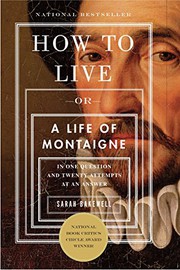
- How to Live: A Life of Montaigne in One Question and Twenty Attempts at an Answer by
- Review of How to Live (9781590514252) — Foreword Reviews
- otherpress.com
- goodreads.com
- en.wikipedia.org
- libraryjournal.com
- otherpress.com
- historicalnovelsociety.org
- forewordreviews.com
- penguinrandomhouse.com