In one sentence
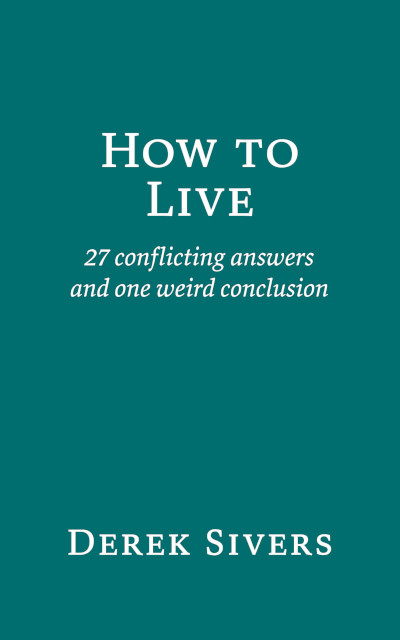
There is no single universally correct way to live. Different, even contradictory philosophies can each be useful in different circumstances; wisdom lies in choosing, combining, and changing them deliberately rather than obeying one doctrine.
Overview
The book is structured as 27 short chapters, each offering an emphatic answer to “How should you live?” The sequence intentionally creates friction: be independent, then commit; fill your senses, then do nothing; pursue pain, then do whatever you want now; get rich, then live for others. Sivers has described the chapters as thought experiments: temporarily inhabit one worldview and follow its logic to see what it reveals. The final image—a 27-instrument orchestra seating chart—suggests that these approaches can be used together, with the reader acting as composer or conductor.
Core ideas
Contradiction is the method
The contradictions are not an editing flaw or a puzzle with one hidden doctrine. Each chapter makes a strong case for one value, then the next chapter destabilizes it. This exposes the limits of advice that claims to work for everyone.
Use philosophies as instruments
Independence can protect you from unhealthy dependence; commitment can create depth. Present-focused living can restore attention; long-term thinking can support projects and people who need patience. The practical move is not to average everything into bland moderation, but to know when to bring a particular “instrument” forward.
Try on a worldview before judging it
The chapters ask the reader to temporarily accept premises such as “the future matters most,” “pain is instructive,” “money measures value,” or “life is for others.” Following each premise to its consequences makes abstract philosophies easier to evaluate than merely labeling them.
Temperament and context matter
A philosophy that liberates one person may burden another. Sivers has noted that readers can respond very differently to the same chapter, including the “do nothing” argument. Advice should therefore be tested against personality, current circumstances, responsibilities, and actual results.
A full life may be plural
Rather than optimizing for one permanent identity, a person can deliberately experience different modes of living across time: mastering something, reinventing oneself, creating, loving, making mistakes, pursuing change, and eventually balancing competing aims.
The ending changes the question
The point is not to discover the one correct answer hidden behind the 27 answers. It is to ask which values deserve attention now, which should remain available as counterweights, and how the combination creates a richer life than any single philosophy could provide.
Practical takeaways
- When facing a decision, write two or three forceful arguments for opposing choices before deciding; this prevents one-sided advice from masquerading as truth.
- Separate principles from timing: independence may be right during exploration, while commitment may be right when depth or responsibility matters.
- Use a “philosophy rotation” review: ask which value has dominated recently—achievement, pleasure, security, generosity, learning, or novelty—and whether another needs more room.
- Treat discomfort as information, not proof. Pain may signal growth, but it may also indicate damage, poor fit, or an avoidable constraint.
- Keep a small personal repertoire of operating modes: focus, rest, experimentation, service, connection, and long-term building.
- Prefer experiments over identity claims. Try living by one principle for a defined period, observe the consequences, and revise without treating the result as a verdict on your character.
Caveats and counterpoints
- The book is intentionally aphoristic and compressed. It offers prompts and mental models more than evidence, detailed plans, or tested behavioral protocols; readers wanting research-backed productivity guidance may find it underdeveloped.
- Some chapter arguments are deliberately extreme. Taking any one of them literally—such as pursuing pain, getting rich, or doing whatever you want now—can become harmful when detached from context, obligations, health, or other values.
- “Balance everything” is not necessarily a simple compromise. The book’s orchestra metaphor implies active composition: different principles may be emphasized at different times rather than blended equally.
- The author’s official page uses the subtitle “27 conflicting answers and one weird conclusion,” not “one weird question.” The latter appears to be an untrusted catalogue variant; the book itself is the same work if the author and title otherwise match.
Questions worth revisiting
- Which apparently contradictory pair best describes the tension in my current life: freedom versus commitment, present pleasure versus future investment, or independence versus belonging?
- Which philosophy am I using as a universal rule when it would be better treated as a temporary tool?
- What value has been neglected because another value—money, achievement, safety, comfort, or service—has become too dominant?
- What would I learn by conducting a one-week experiment based on the chapter I resist most?
- If my life were an orchestra, which instruments are too loud, which are silent, and who is currently conducting?
Return to this when…
Return to this book when advice starts sounding absolute, when two good values are in conflict, or when your life has become over-optimized around one mode—achievement, comfort, security, novelty, or service. Its main use is not to supply a rule, but to restore flexibility and widen the range of choices you can see.