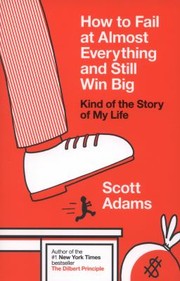

In one sentence
Adams argues that success is less about extraordinary talent or a single passionate calling than about designing a repeatable system that increases energy, develops a useful combination of ordinary skills, and exposes you to enough opportunities for luck to matter. Failure becomes valuable when it produces skills, knowledge, or better judgment.
Overview
The book combines autobiographical episodes—corporate work, inventions, investments, restaurants, health problems, and the eventual creation of Dilbert—with advice about productivity, diet, exercise, confidence, persuasion, and career design. Adams presents himself as an unreliable but observant narrator rather than a universal expert; the humor and deliberately provocative claims are part of the method.
Core ideas
Systems outperform goals
A goal is a finish line; a system is a recurring practice. Adams prefers routines that keep producing progress after a specific target has been reached. The useful question is not only “What do I want?” but “What daily or weekly process makes favorable outcomes more likely?” This is especially applicable to health, writing, learning, and business.
Failure can be an asset
Repeated attempts are not automatically productive, but failed projects often leave behind transferable skills, contacts, market knowledge, or clearer preferences. Adams’s career narrative is meant to show accumulation: apparently unrelated experiments can later combine into an opportunity.
Build a talent stack
Rather than trying to become world-class at one ability, become unusually capable across several complementary abilities. Adams connects drawing, writing, business knowledge, technology, humor, and presentation to explain why a distinctive combination may be more valuable than mastery of any single component.
Energy is a leading indicator
Adams treats personal energy—not abstract time management—as a central resource. He recommends arranging work around periods of alertness, avoiding tasks and environments that reliably drain motivation, and using sleep, food, and exercise to improve the baseline from which decisions are made.
Simplify before optimizing
Simple ideas, products, explanations, and routines are easier to execute and easier for others to understand. The book repeatedly favors reducing friction over relying on willpower or elaborate plans.
Persuasion and confidence are trainable behaviors
Adams describes shyness, public performance, and self-presentation as skills that can be practiced. His advice sometimes involves acting “as if” one is confident or using harmless self-beliefs to sustain effort. The underlying practical point is behavioral: confidence can follow repeated action rather than precede it.
Luck needs exposure and persistence
Adams does not present success as fully controllable. His system is intended to increase the number of attempts, relationships, and visible outputs through which favorable chance can operate. Persistence matters, but so does choosing arenas where repeated attempts are affordable.
Practical takeaways
- Replace one outcome goal with a repeatable process—for example, a scheduled writing block, exercise routine, or weekly outreach target.
- List your existing skills, then look for combinations that are distinctive and useful rather than pursuing prestige in only one area.
- After a failed project, record the specific assets it produced: skills, contacts, data, credibility, or a clearer next experiment.
- Track energy as well as time. Put demanding work in your strongest periods and redesign recurring sources of depletion.
- Prefer simple routines that survive low motivation; reduce the number of decisions required to begin.
- Run small, reversible experiments before making large commitments. Treat results as feedback rather than as a verdict on your identity.
- Use the book as a source of hypotheses, not commandments. Adams’s own career path is unusually entrepreneurial and shaped by hindsight.
Caveats and counterpoints
- The memoir’s success story is survivorship-biased: many people can build skills and systems without becoming famous or wealthy. The advice explains Adams’s path more convincingly than it establishes general causal laws.
- “Systems over goals” is a useful corrective to rigid goal obsession, but goals still help define direction, measure progress, and coordinate teams. A system without a meaningful objective can become efficient drift.
- The talent-stack idea is plausible for creative and entrepreneurial work, but some fields require deep specialization, formal credentials, or sustained mastery.
- Advice about diet, exercise, affirmations, and “delusion” is presented as personal experience and provocative interpretation, not as a substitute for medical or psychological evidence.
- The book’s humorous, contrarian tone can blur the line between memorable rhetoric and well-supported claims; its strongest value is as a set of experiments for career design, not a scientifically validated theory of success.
Questions worth revisiting
- Which of my current skills become more valuable when combined rather than improved separately?
- What recurring system would make progress likely even when motivation is low?
- What did my last failure leave me with that could be reused?
- Which activities increase my energy, and which merely consume time?
- Am I choosing a field where repeated attempts can realistically compound?
- Where does Adams’s personal story stop being a useful model for my circumstances?
Return to this when…
Return to the sections on systems, talent stacking, energy, and failure whenever you are overfocused on a single outcome, tempted to interpret a setback as final, or considering a new project. Revisit the caveats before applying the book’s health, confidence, or success claims too literally.
Highlights
In our messy, flawed lives, the nearest we can get to truth is consistency. Consistency is the bedrock of the scientific method. Scientists creep up on the truth by performing controlled experiments and attempting to observe consistent results. In your everyday, nonscientist life you do the same thing, but it’s not as impressive, nor as reliable. For example, if every time you eat popcorn, one hour later you fart so hard that it inflates your socks, you can reasonably assume popcorn makes you gassy. It’s not science, but it’s still an entirely useful pattern. Consistency is the best marker of truth that we have, imperfect though it may be.
The system-versus-goals model can be applied to most human endeavors. In the world of dieting, losing twenty pounds is a goal, but eating right is a system. In the exercise realm, running a marathon in under four hours is a goal, but exercising daily is a system. In business, making a million dollars is a goal, but being a serial entrepreneur is a system.
For our purposes, let’s say a goal is a specific objective that you either achieve or don’t sometime in the future. A system is something you do on a regular basis that increases your odds of happiness in the long run. If you do something every day, it’s a system. If you’re waiting to achieve it someday in the future, it’s a goal.
The minimum requirement of a system is that a reasonable person expects it to work more often than not. Buying lottery tickets is not a system no matter how regularly you do it.
Warren Buffett’s system for investing involves buying undervalued companies and holding them forever, or at least until something major changes. That system (which I have grossly oversimplified) has been a winner for decades. Compare that with individual investors who buy a stock because they expect it to go up 20 percent in the coming year; that’s a goal, not a system. And not surprisingly, individual investors generally experience worse returns than the market average.
One of the best pieces of advice I’ve ever heard goes something like this: If you want success, figure out the price, then pay it. It sounds trivial and obvious, but if you unpack the idea it has extraordinary power.
Optimizing is often the strategy of people who have specific goals and feel the need to do everything in their power to achieve them. Simplifying is generally the strategy of people who view the world in terms of systems. The best systems are simple, and for good reason. Complicated systems have more opportunities for failure. Human nature is such that we’re good at following simple systems and not so good at following complicated systems. Simple systems are probably the best way to achieve success. Once you have success, optimizing begins to have more value. Successful people and successful businesses
Tidiness is a personal preference, but it also has an impact on your energy. Every second you look at a messy room and think about fixing it is a distraction from your more important thoughts.
And so it has been with about 90 percent of the topics that have intimidated me throughout my career. When you start asking questions, you often discover that there’s a simple solution, a Web site that handles it, or a professional who takes care of it for a reasonable fee. Keep in mind that every time you wonder how to do something, a few hundred million people have probably wondered the same thing. And that usually means the information has already been packaged and simplified, and in some cases sold. But it’s usually free for the asking.
That will be easier if you understand how important psychology is to everything you want to accomplish in life. On a scale of one to ten, the importance of understanding psychology is a solid ten.
Business writing also teaches that brains are wired to better understand concepts that are presented in a certain order. For example, your brain processes “The boy hit the ball” more easily than “The ball was hit by the boy.” In editors’ jargon, the first sentence is direct writing and the second is passive. It’s a tiny difference, but over the course of an entire document, passive writing adds up and causes reader fatigue. Eventually I learned
I’ve found that the most effective way to stop people from trying to persuade me is to say, “I’m not interested.” You should try it. Don’t offer a reason why you aren’t interested. No one can say why a thing holds interest for some and not for others. There’s no argument against a lack of interest. Repeat your claim of disinterest as often as it takes to end the conversation. You might be surprised how effective this method is. I’ve been using it for years. It’s a total conversation killer.
I Don’t Do That Another good persuasion sentence is “I don’t do that.” It’s not a reason and barely tries to be. But it sounds like a hard-and-fast rule. If someone asks you to attend the annual asparagus festival, don’t say it doesn’t sound fun; that’s just begging the asparagus lovers in your group to endlessly describe just how joyous it could be if only you would try it. Instead, say something like “I don’t do food festivals.” And if anyone asks why, say, “I’m just not interested.” Some of these persuasive sentences work well in tandem.
Just Wanted to Clarify … Sometimes you hear statements that are so mind-numbingly stupid, evil, or mean that you know a direct frontal assault would only start a fight. People tend to double down when challenged, no matter how wrong they are. A more effective way to approach a dangerous social or business situation is sideways, by asking a question that starts with “I just wanted to clarify …” That approach might look like this: “I just wanted to clarify: Are you saying you’re okay with an 80 percent chance of going to jail, or did I hear your plan wrong?” If you phrase your clarification question correctly, it will shine an indirect light on the problem and provide a face-saving escape path.
Decisiveness No one is decisive all the time. The world is a complicated place, and often we’re only guessing which path will be best. Anyone who is confident in the face of great complexity is insane. However, some people act much more decisively than others. And that can be both persuasive and useful. Decisiveness looks like leadership. Keep in mind that most normal people are at least a little bit uncertain when facing unfamiliar and complicated situations. What people crave in that sort of environment is anything that looks like certainty. If you can deliver an image of decisiveness, no matter how disingenuous, others will see it as leadership. Don’t confuse your artificial sense of decisiveness with a need to be right all of the time. Life is messy and you’re going to be right only sometimes. You’ll do everyone in your life a favor by acting decisively, though, even if you have doubts on the inside.
Be proactive. Begin with the end in mind. (Imagine a good outcome.) Put first things first. (Set priorities.) Think win-win. (Don’t be greedy.) Seek first to understand then be understood. Synergize. (Use teamwork.) Sharpen the saw. (Keep learning.)
Overcomplaining is never funny. Don’t overdo the self-deprecation. Don’t mock people. Avoid puns and wordplay.
Recapping the happiness formula: Eat right. Exercise. Get enough sleep. Imagine an incredible future (even if you don’t believe it). Work toward a flexible schedule. Do things you can steadily improve at. Help others (if you’ve already helped yourself). Reduce daily decisions to routine.
Bananas Protein bars Peanuts Mixed nuts Cheese Whole wheat pasta Edamame (soybeans) Broccoli Cauliflower Brussels sprouts Fish Lettuce Tomatoes Apples Pears Carrots Radishes Cucumbers Quinoa Brown rice Berries
Pay attention to your energy level after eating certain foods. Find your pattern. Remove unhealthy, energy-draining food from your home. Stock up on convenient healthy food (e.g., apples, nuts, bananas) and let laziness be your copilot in eating right. Stop eating foods that create feelings of addiction: white rice, white potatoes, desserts, white bread, fried foods. Eat as much healthy food as you want, whenever you want. Get enough sleep, because tiredness creates the illusion of hunger. If your hunger is caused by tiredness, try healthy foods with fat, such as nuts, avocados, protein bars, and cheese, to suppress the hungry feeling. If you’re eating for social reasons only, choose the healthiest options with low calories. Learn how to season your healthy-yet-bland foods.
If you want to make a habit of something, the worst thing you can do is pick and choose which days of the week you do it and which ones you don’t. Exercise becomes a habit when you do it every day without fail. Taking rest days between exercise days breaks up the pattern that creates habits. It also makes it too easy to say today is one of your nonexercise days, and maybe tomorrow too.