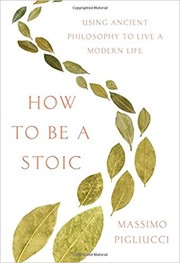

In one sentence
Stoicism is a demanding practice of character: focus effort on what is genuinely within your power, judge externals as secondary, and consistently choose wisdom, courage, justice, and temperance. Pigliucci argues that ancient Stoicism remains useful when its ethical core is retained but outdated cosmology and overly simple claims about control are revised.
Overview
The book is organized around the three Stoic disciplines: desire, action, and assent. Pigliucci uses Epictetus as the primary interlocutor, supplemented by Socrates, Seneca, Marcus Aurelius, and modern philosophy and science. The closing chapter turns the framework into practical exercises, including attention, self-examination, negative visualization, and reflection on mortality.
Core ideas
Control is a tool for directing effort, not a promise of mastery
Separate your judgments, intentions, and choices from events and outcomes. Act energetically where influence is possible, then accept the remainder. Pigliucci also qualifies the traditional dichotomy: control is not simply all-or-nothing, and modern psychology shows that even thoughts are not fully voluntary.
Virtue is the only true good
Stoics treat health, money, reputation, and relationships as preferred or dispreferred externals—not as the foundation of happiness. They can reasonably be pursued, but never at the price of wisdom, justice, courage, or temperance. This makes Stoicism more ethically demanding than generic advice to stay calm.
Live according to nature
This means living as a rational, social human being: understand reality as best you can, recognize your limits, and fulfill your roles toward other people. Pigliucci presents the ancient idea without requiring belief in Stoic providence; his modern version can be compatible with atheism and contemporary science.
Emotions are judgments to examine, not enemies to suppress
Stoicism is not emotional numbness. Notice the initial impression, question the interpretation attached to it, and choose a response that expresses sound character. The aim is not to eliminate feeling but to prevent fear, anger, anxiety, or desire from governing action.
Character is trained through roles and examples
Ask what a good parent, friend, citizen, colleague, or professional would do in the situation. Role models make abstract virtues concrete, while ordinary conduct—not philosophical self-description—reveals whether Stoicism has been learned.
Relationships are part of Stoic practice
Love and friendship are not distractions from philosophy. They are settings in which justice, affection, patience, responsibility, and appropriate attachment are tested. Care deeply, but remember that other people’s choices and continued presence are not possessions under your control.
Practical exercises create attention before crisis
The book recommends repeated exercises rather than occasional inspiration: review the day, anticipate possible setbacks, distinguish impressions from judgments, contemplate death, and rehearse the values you want to enact. The purpose is preparedness and moral attention, not grimness.
Practical takeaways
- When distressed, write two columns: what depends on my judgment or action, and what depends on circumstances or other people.
- Before pursuing an external goal, ask: What would success require of my character, and what would remain outside my control?
- Replace “This is terrible” with a more precise description of the event, your interpretation, and the next virtuous action available.
- Use preferred externals—health, security, success, comfort—without treating them as necessary for a good life.
- At day’s end, review one moment of sound judgment, one failure of character, and one specific improvement for tomorrow.
- For anger or anxiety, pause between the first impression and assent; identify the belief that is intensifying the emotion.
- Treat Stoicism as an ethical training program, not a productivity system or a technique for tolerating injustice.
Caveats and counterpoints
- The book is an accessible modern interpretation, not a comprehensive scholarly history of Stoicism; readers seeking detailed textual or historical analysis should consult primary texts and academic studies.
- Pigliucci’s naturalistic adaptation leaves tension with ancient Stoic theology and providence. He presents this as a reason to update Stoicism, but traditionalists may regard the result as substantially revised.
- The Stoic emphasis on agency can be misapplied to blame people for suffering, disability, mental illness, poverty, or oppression. Pigliucci addresses disability and mental illness, but the framework still requires careful attention to structural conditions and unequal options.
- “Virtue is the only good” is philosophically powerful but psychologically demanding. It may understate how strongly health, relationships, material security, and social recognition affect human flourishing, even if they should not determine moral worth.
- The imagined dialogue with Epictetus is a literary teaching device, not a historical conversation; it should not be mistaken for direct evidence about what Epictetus would say on every modern issue.
Questions worth revisiting
- Which external do I currently treat as a condition of happiness rather than as something merely preferred?
- Where do I have partial influence rather than total control, and what would responsible effort look like there?
- What recurring emotion is being amplified by an unexamined judgment?
- Which role or relationship most exposes a gap between my stated values and my conduct?
- Would adopting Stoic standards make me more just and courageous—or merely more tolerant of circumstances I should help change?
Return to this when…
Return when you are confusing calmness with Stoicism, treating success or comfort as moral goods, or feeling overwhelmed by outcomes you cannot command. Revisit the three disciplines—desire, action, assent—and the practical exercises chapter when you need a compact framework for responding to adversity without surrendering ethical responsibility.
Highlights
Although Stoicism was designed from the beginning as a very practical philosophy, it would not be a “philosophy” if it were not based on a theoretical framework of some sort. That framework is the idea that in order to live a good (in the sense of eudaimonic) life, one has to understand two things: the nature of the world (and by extension, one’s place in it) and the nature of human reasoning (including when it fails, as it so often does).
The Stoics used several metaphors to get their point across. One of the most incisive is that of a garden, introduced by Chrysippus, who said that the fruits of the garden represent the ethics. To get good fruits we must nurture the plants with fine nutrients: the soil of the garden, then, is the physics, providing our understanding of the world in which we live. Moreover, our “garden” needs to be fenced off from unwanted and destructive influences, or it will be taken over by weeds and nothing good will grow in it: the fence is the logic, keeping bad reasoning out of the way.
We must make the best of those things that are in our power, and take the rest as nature gives it. —EPICTETUS, DISCOURSES, I.1
God, grant me the serenity to accept the things I cannot change, Courage to change the things I can, And wisdom to know the difference.
What then is the proper training for this? In the first place, the principal and most important thing, on the very threshold so to speak, is that when you are attached to a thing, not a thing which cannot be taken away but anything like a water jug, or a crystal cup, you should bear in mind what it is, that you may not be disturbed when it is broken. So should it be with persons; if you kiss your child, or brother, or friend… you must remind yourself that you love a mortal, and that nothing that you love is your very own; it is given you for the moment, not for ever nor inseparably, but like a fig or a bunch of grapes at the appointed season of the year, and if you long for it in winter you are a fool. So too if you long for your son or your friend, when it is not given you to have him, know that you are longing for a fig in winter time.
There are wonderful stories about Diogenes. One tells us that he was thirsty one day, and so pulled out a bowl while approaching some running water. He then saw a boy helping himself to the water by simply cupping his hands to hold the liquid. Diogenes threw away his bowl in disgust, muttering that even a boy was wiser than him. On another occasion, he was visited by Alexander the Great, who had heard of the famous philosopher and went to pay his respects (presumably, in front of the tub). When Alexander magnanimously (or so he thought) asked Diogenes what he, the most powerful man in the world, could do on behalf of the philosopher, the latter looked up and said something along the lines of “you could move, you are blocking my sun.” That ought to give you an idea of why the Cynics were both much admired and much despised.
species. The Stoics derived their understanding of virtue from Socrates,
The Stoics derived their understanding of virtue from Socrates, who believed that all virtues are actually different aspects of the same underlying feature: wisdom. The reason why wisdom is the “chief good,” according to Socrates, is rather simple: it is the only human ability that is good under every and all circumstances.
What both Arendt and Epictetus are getting at is a crucial Stoic concept, one that originally derives from Socrates: people don’t do “evil” on purpose, they do it out of “ignorance.” Whenever I say this, someone is guaranteed to get outraged. What? Do I seriously mean to say that Hitler wasn’t evil? How could I possibly be so naive? Or perhaps I harbor questionable sympathies? But as with many terms in philosophy, “evil” and “ignorance” don’t mean quite what we expect.
Specifically, Medea lacks wisdom and is affected by amathia, the sort of dis-knowledge that brings ordinary people to make unreasonable judgments about certain situations that then lead them to what outsiders correctly perceive as horrible acts. If we internalize this Stoic attitude—or its equivalent in Buddhism or Christianity—we indeed will be angry or indignant with no one; there will be no one we revile, blame, hate, or are offended by. I submit that the resulting world would be significantly better than the one we currently live in. Epictetus elaborated on why he thought
about the very meaning of the term. The
The other thing to remember about role models—and the Stoics understood this very well—is that they are not perfect human beings, for the simple reason that there is no such thing. Moreover, making perfection an integral part of our concept of role model means that we are setting a standard that is impossibly high. Some religions do this of course. For Christians, the model of universally good behavior is Jesus, but that’s a tough role model to actually attempt to emulate, since believers are literally trying to be like gods. Bound to fail, we have to accept the divinity’s mercy as our path to salvation.
I must die, must I? If at once, then I am dying: if soon, I dine now, as it is time for dinner, and afterwards when the time comes I will die. —EPICTETUS, DISCOURSES, I.1
Even the Stoics’ archrivals, the Epicureans, thoroughly agreed. As the founder of their school wrote in his “Letter to Menoeceus”: “Death, therefore, the most awful of evils, is nothing to us, seeing that, when we are, death is not come, and, when death is come, we are not.”
Yesterday I had an iron lamp beside my household gods, and hearing a noise I rushed to the window. I found the lamp had been carried off. I reasoned with myself, that the man who took it yielded to some plausible feeling. What do I conclude? Tomorrow, I say, you will find one of earthenware. I lost my lamp, because in the matter of vigilance the thief was a stronger man than I. But he bought his lamp for this price: for a lamp he became a thief, for a lamp he broke his faith, for a lamp he became a brute.
have been written by Epictetus—reminds us: “Logic
“Logic defeats anger, because anger, even when it’s justified, can quickly become irrational. So use cold hard logic on yourself.”
“When I see a man in a state of anxiety, I say, ‘What can this man want? If he did not want something which is not in his power, how could he still be anxious? It is for this reason that one who sings to the lyre is not anxious when he is performing by himself, but when he enters the theatre, even if he has a very good voice and plays well: for he not only wants to perform well, but also to win a great name, and that is beyond his own control.’”
- Virtue is the highest good, and everything else is indifferent.
- Follow nature. That is, apply reason to social life. The Stoics thought that we should take a hint from how the universe is put together in figuring out how to live our lives. Since human beings are naturally social animals capable of reason, it follows that we should strive to apply reason to achieve a better society. 3. Dichotomy of control. Some things are under our control, and others are not (though we may be able to influence them). If we are sufficiently healthy mentally, our decisions and behaviors are under our control. Outside of our control is everything else. We should concern ourselves with what is under our control and handle everything else with equanimity.
Moreover, while engaging in the exercises proposed here, remember that they are supposed to further your mastery of the four Stoic virtues: (Practical) wisdom: Navigating complex situations in the best available fashion Courage: Doing the right thing, both physically and morally, under all circumstances Justice: Treating every human being—regardless of his or her stature in life—with fairness and kindness Temperance: Exercising moderation and self-control in all spheres of life
- Remind yourself of the impermanence of things. “In the case of particular things that delight you, or benefit you, or to which you have grown attached, remind yourself of what they are. Start with things of little value. If it is china you like, for instance, say, ‘I am fond of a piece of china.’ When it breaks, then you won’t be as disconcerted. When giving your wife or child a kiss, repeat to yourself, ‘I am kissing a mortal.’ Then you won’t
“Remember, it is not enough to be hit or insulted to be harmed, you must believe that you are being harmed. If someone succeeds in provoking you, realize that your mind is complicit in the provocation. Which is why it is essential that we not respond impulsively to impressions; take a moment before reacting, and you will find it is easier to maintain control.”
- Speak little and well. “Let silence be your goal for the most part; say only what is necessary, and be brief about it. On the rare occasions when you’re called upon to speak, then speak, but never about banalities like gladiators, horses, sports, food and drink—common-place stuff. Above all don’t gossip about people, praising, blaming or comparing them.”
- Speak without judging. “Someone bathes in haste; don’t say he bathes badly, but in haste. Someone drinks a lot of wine; don’t say he drinks badly, but a lot. Until you know their reasons, how do you know that their actions are vicious? This will save you from perceiving one thing clearly, but then assenting to something different.”
The spirit ought to be brought up for examination daily. It was the custom of Sextius when the day was over, and he had betaken himself to rest, to inquire of his spirit: “What bad habit of yours have you cured to-day? What vice have you checked? In what respect are you better?” Anger will cease, and become more gentle, if it knows that every day it will have to appear before the judgment seat. What can be more admirable than this fashion of discussing the whole of the day’s events? How sweet is the sleep which follows this self-examination? How calm, how sound, and careless is it when our spirit has either received praise or reprimand, and when our secret inquisitor and censor has made his report about our morals? I make use of this privilege, and daily plead my cause before myself: when the lamp is taken out of my sight, and my wife, who knows my habit, has ceased to talk, I pass the whole day in review before myself, and repeat all that I have said and done: I conceal nothing from myself, and omit nothing: for why should I be afraid of any of my shortcomings, when it is in my power to say, “I pardon you this time: see that you never do that anymore”?… A good man delights in receiving advice: all the worst men are the most impatient of guidance.