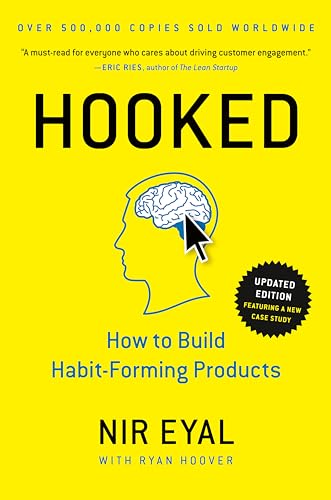

In one sentence
Products gain durable engagement when they repeatedly connect a user’s internal need with an easy action, an uncertain or variable reward, and an investment that improves future use. Eyal argues that habit-forming products can reduce dependence on advertising by becoming the user’s automatic, first-to-mind response.
Overview
The book is aimed chiefly at product designers, entrepreneurs, marketers, and startup teams. Its central framework is the Hook Model: a repeating cycle that moves users from a cue to behavior, reward, and commitment. Eyal combines behavioral-psychology concepts with product examples and ends by addressing the ethical responsibility involved in shaping users’ habits.
Core ideas
1. Habits reduce dependence on conscious decision-making
A habit is behavior performed with little conscious thought. For a product, the strategic goal is to become associated with a recurring situation or emotion—such as boredom, loneliness, uncertainty, or the desire for social connection—so the user thinks of the product without an external advertisement.
2. The Hook Model has four stages
Trigger: an external cue, such as a notification, or an internal cue, such as boredom. Action: the simplest behavior likely to produce a result. Variable reward: an outcome with enough uncertainty to sustain anticipation. Investment: user effort—content, data, relationships, preferences, or reputation—that makes the product more valuable and increases the likelihood of returning.
3. Internal triggers are the long-term advantage
External prompts can start usage, but repeated use becomes more durable when the product is linked to an internal emotional state. The product is not merely solving a functional problem; it is becoming the user’s habitual response to a recurring feeling or context.
4. Reduce friction before trying to increase motivation
The Action stage depends on making the desired behavior easy. Clear interfaces, fewer steps, and an obvious next action matter because even a motivated user may abandon a product when the effort or uncertainty is too high.
5. Variable rewards sustain attention—but should serve a real user need
Unpredictable social, informational, or achievement-related outcomes can make users keep exploring. The relevant design question is not simply whether a reward is variable, but whether the reward is meaningful enough to justify continued use rather than empty engagement.
6. Investment makes the next cycle stronger
Users strengthen the product when they add content, follow people, state preferences, build a history, or learn the system. This investment should improve future rewards or personalize the experience; otherwise it is merely extraction of labor or data.
7. Habit formation depends on frequency and perceived utility
A hook is more plausible when the problem occurs often enough and the product provides clear value. A product cannot manufacture a durable habit through interface tricks alone if the underlying need is infrequent, weak, or poorly served.
8. The framework is also an ethical test
Eyal acknowledges that the same techniques can manipulate people. A useful ethical check is whether the maker would willingly use the product, whether it genuinely benefits users, and whether the behavior being encouraged is consistent with users’ interests rather than only the company’s retention metrics.
Practical takeaways
- Map one target behavior as: internal trigger → simplest action → meaningful variable reward → investment that improves the next experience.
- Identify the emotion or situation that precedes use. If you cannot name a recurring user problem, you may be optimizing engagement without a genuine habit opportunity.
- Measure where the cycle breaks: do users fail to notice the trigger, hesitate at the action, find the reward weak, or lack a reason to invest?
- Design the investment step early: saved preferences, accumulated progress, social connections, personal content, or a history that makes future use more useful.
- Treat notifications and other external triggers as prompts, not the product strategy. Overuse can create annoyance, distrust, or reactive behavior.
- Use retention as one measure of value, not the definition of value. Check whether repeated use produces the promised outcome for users.
- Apply the model cautiously outside frequently used digital products; the book’s examples and strongest claims are concentrated in technology and app-like services.
Caveats and counterpoints
- The book is intentionally practical and simplified. Its Hook Model is a useful design heuristic, but it should not be treated as a complete or universally validated theory of habit formation.
- The examples largely reflect Silicon Valley-style digital products, so the framework transfers less directly to infrequent purchases, complex services, or products whose value appears only after long delays.
- The book’s language of getting users “hooked” can blur the distinction between beneficial routine, engagement, and compulsive use. Critics argue that it can assume products such as social platforms are solving loneliness or boredom when they may also intensify those problems.
- Variable rewards may increase exploration and attention, but attention is not proof of satisfaction, learning, well-being, or customer value.
- The ethical discussion is important but comparatively brief; teams dealing with children, vulnerable users, financial risk, health, or highly persuasive notifications need stronger safeguards than the book itself supplies.
Questions worth revisiting
- What recurring user problem or emotion is the product addressing?
- How often does that problem occur, and is the product’s value strong enough to justify repeated use?
- What is the smallest useful action a user can take?
- What exactly is variable about the reward, and why is that uncertainty beneficial rather than manipulative?
- What user investment makes the next experience better for the user—not merely harder to leave?
- Would the product team recommend the resulting habit to people they care about?
- What evidence would show that retention reflects genuine value rather than friction, compulsion, or loss aversion?
Return to this when…
Return to the Hook Model when diagnosing weak retention, designing onboarding, evaluating notification strategy, or auditing whether a product’s engagement loop creates user value. Pair it with research on motivation, addiction, persuasive design, privacy, and digital well-being when the product can materially affect vulnerable users.
Highlights
Variable Reward What distinguishes the Hook Model from a plain vanilla feedback loop is the hook’s ability to create a craving. Feedback loops are all around us, but predictable ones don’t create desire. The unsurprising response of your fridge light turning on when you open the door doesn’t drive you to keep opening it again and again. However, add some variability to the mix — say a different treat magically appears in your fridge every time you open it — and voila, intrigue is created.
“Are you building a vitamin or painkiller?” is a common, almost clichéd question many investors ask founders eager to cash their first venture capital check. The correct answer, from the perspective of most investors, is the latter: a painkiller. Likewise, innovators in companies big and small are constantly asked to prove their idea is important enough to merit the time and money needed to build it. Gatekeepers such as investors and managers want to invest in solving real problems — or, meeting immediate needs — by backing painkillers.
As Evan Williams, co-founder of Blogger and Twitter said, the Internet is, “a giant machine designed to give people what they want.”[xlviii] Williams continued, “We often think the Internet enables you to do new things … But people just want to do the same things they’ve always done.”
As Erika Hall, author of Just Enough Research writes, “When the research focuses on what people actually do (watch cat videos) rather than what they wish they did (produce cinema-quality home movies) it actually expands possibilities.”[xlix] Looking for discrepancies exposes opportunities. Why do people really send SMS messages? Why do they take photos? What role does watching television or sports play in their lives? Ask yourself what pain these habits solve and what the user might be feeling right before one of these actions. What would your user want to achieve by using your solution? Where and when will they use it? What emotions influence their use and will trigger them to action?
Jack Dorsey, co-founder of Twitter and Square, shared how his companies answer these important questions, “[If] you want to build a product that is relevant to folks, you need to put yourself in their shoes and you need to write a story from their side. So, we spend a lot of time writing what's called user narratives.”
Fogg describes six “elements of simplicity” — the factors that influence a task’s difficulty.[lxi] These are: - Time - How long it takes to complete an action. - Money - The fiscal cost of taking an action. - Physical Effort - The amount of labor involved in taking the action. - Brain Cycles - The level of mental effort and focus required to take an action. - Social Deviance - How accepted the behavior is by others. - Non-Routine - According to Fogg, “How much the action matches or disrupts existing routines.” To increase the likelihood of a behavior occurring, Fogg instructs designers to focus on simplicity as a function of the user's scarcest resource at that moment. In other words, identify what the user is missing. What is making it difficult for the user to accomplish the desired action? Is the user short on time? Is the behavior too expensive? Is the user exhausted after a long day of work? Is the product too difficult to understand? Is the user in a social context where the behavior could be perceived as inappropriate? Is the behavior simply so far outside of the user’s normal routine that its strangeness is off-putting? These factors will differ by person and context, so designers should ask, "What is the thing that is missing that would allow my users to proceed to the next step?" Designing with an eye toward simplifying the overall user experience reduces friction, removes obstacles, and helps push the user across Fogg’s action line.
The fact is, increasing motivation is expensive and time-consuming. Website visitors tend to ignore instructional text. Their attention is split on several tasks at once and they have little patience for explanations about why or how they should do something. Instead, influencing behavior by reducing the effort required to perform an action is more effective than increasing someone’s desire to do it. Make your product so simple that users already know how to use it, and you’ve got a winner.
The researchers had study participants sample wine while in an fMRI machine. As the machine scanned the blood flow in the various regions of their brains, the tasters were informed of the cost of each wine sampled. The sample started with a $5 wine and progressed to a $90 bottle. Interestingly, as the price of the wine increased, so did the participant's enjoyment of the wine. Not only did they say they enjoyed the wine more but their brain corroborated their feelings, showing higher spikes in the regions associated with pleasure. Little did the study participants realize, they were tasting the same wine each time. This study demonstrates how perception can form a personal reality based on how a product is framed, even when there is little relationship with objective quality.
Two groups of customers were given punch cards awarding a free car wash once the cards were fully punched. One group was given a blank punch card with 8 squares and the other given a punch card with 10 squares but with two free punches. Both groups still had to purchase 8 car washes to receive a free wash; however, the second group of customers — those that were given two free punches — had a staggering 82 percent higher completion rate. The study demonstrates the endowed progress effect, a phenomenon that increases motivation as people believe they are nearing a goal.
Only by understanding what truly matters to users can a company correctly match the right variable reward to their intended behavior. Recently, “gamification” — defined as the use of game-like elements in non-gaming environments — has been used with varying success. Points, badges, and leaderboards can prove effective, but only if they scratch the user’s itch. When there is a mismatch between the customer’s problem and the company’s assumed solution, no amount of gamification will help spur engagement. Likewise, if the user has no ongoing itch at all — say, no need to return repeatedly to a site that lacks any value beyond the initial visit — gamification will fail because of a lack of inherent interest in the product or service offered. In other words, gamification is not a one-size-fits-all solution for driving user engagement. Variable rewards are not magic fairy dust that a product designer can sprinkle onto a product to make it instantly more attractive. Rewards must fit into the narrative of why the product is used and align with the user's internal triggers and motivations.
As part of a French study, researchers wanted to know if they could influence how much money people handed to a total stranger asking for bus fare by using just a few specially encoded words. They discovered a technique so simple and effective it doubled the amount people gave. The turn of phrase has not only proven to increase how much bus fare people give, but has also been effective in boosting charitable donations and participation in voluntary surveys. In fact, a recent meta-analysis of 42 studies involving over 22,000 participants concluded that these few words, placed at the end of a request, are a highly-effective way to gain compliance, doubling the likelihood of people saying “yes.”[xcii] The magic words the researchers discovered? The phrase, “but you are free to accept or refuse.” The “but you are free” technique demonstrates how we are more likely to be persuaded when our ability to choose is reaffirmed. Not only was the effect observed during face-to-face interactions, but also over email. Although the research did not directly look at how products and services might use the technique, the study provides an important insight into how companies maintain or lose the user’s attention.
The more users invest time and effort into a product or service, the more they value it. In fact, there is ample evidence to suggest that our labor leads to love.
addicted users. However, for the overwhelming majority of users, addiction to a product will never be a problem. Even though the world is becoming a potentially more addictive place, most people have the ability to self-regulate their behaviors. The role of facilitator fulfills the moral obligation for entrepreneurs building a product they will use, and which they believe materially improves the lives of others. As long as they have procedures in place to assist those who form unhealthy addictions, the designer can act with a clean conscience. To take liberties with Mahatma Gandhi’s famous quote, facilitators “build the change they want to see in the world.” The
Heady altruistic ambitions can at times outpace reality. Too often, designers of manipulative technology have a strong motivation to improve the lives of their users, but when pressed, they admit they would not actually use their own creations. Their holier-than-thou products often try to “gamify” some task no one actually wants to do by inserting run-of-the-mill incentives such as badges or points that don’t actually hold value for their users. Fitness apps, charity websites, and products that claim to suddenly turn hard work into fun often fall in this quadrant. But possibly the most common example of peddlers is in advertising. Countless companies convince themselves they’re making ad campaigns users will love. They expect their videos to go viral and their branded apps to be used daily. Their so-called “reality distortion fields” keep them from asking the critical question, “Would I actually find this useful?”[cxxii] The answer to this uncomfortable question is nearly always “No,” so they twist their thinking until they can imagine a user they believe might find the ad valuable.
It’s just that the odds of successfully designing products for a customer you don’t know extremely well are depressingly low. Peddlers tend to lack the empathy and insights needed to create something users actually want. Often the peddler's project results in a time-wasting failure because the designers did not fully understand their users. As a result, no one finds the product useful.
As we saw in chapter six, being a “facilitator” is not only a moral imperative, it also makes for better businesses practices. Creating a product the designer uses and believes materially improves people’s lives increases the odds of delivering something people want. Therefore, the first place for the entrepreneur or designer to look for new opportunities is in the mirror. Paul Graham advises entrepreneurs to leave the sexy-sounding business ideas behind and instead build for their own needs: “Instead of asking ‘what problem should I solve?’ ask ‘what problem do I wish someone else would solve for me?’”
References
- BOOK REVIEW: “Hooked: How to Build Habit-Forming Products” by Nir Eyal
- goodreads.com
- Hooked
- walturn.com
- purposefocuscommitment.com
- publishersweekly.com
- oreilly.com
- Hooked: How to Build Habit-Forming Products by Nir Eyal | Goodreads
- Nick Pateras | Hooked — NICK PATERAS
- dualwaters.com
- neurorelay.com
- outsidetheratrace.com