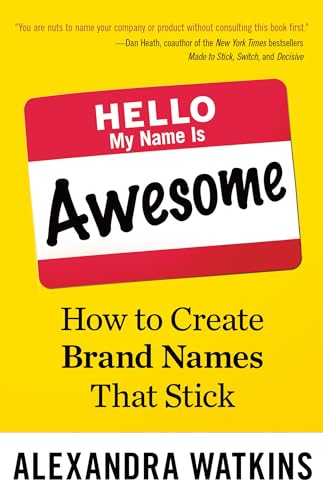

In one sentence
A brand name is not merely an identifier; it is an early marketing asset. The strongest names are distinctive and emotionally suggestive without creating unnecessary friction in spelling, pronunciation, comprehension, or future expansion. Watkins’s process turns subjective naming into a structured creative exercise, though her rules work best as heuristics rather than universal laws.
Overview
The book’s central framework is the contrast between names that make people “SMILE” and names that make them “SCRATCH” their heads. The 2019 second edition expands the original with additional brainstorming resources, domain-name strategies, new examples, and a chapter on using creative names inside organizations.
Core ideas
SMILE: qualities of a sticky name
A strong name is Suggestive of the brand experience, Meaningful to its audience, rich in Imagery, capable of generating creative “Legs” for campaigns and extensions, and Emotional enough to create a positive response. The point is not that every name must satisfy each quality equally, but that generic labels usually provide little memory or marketing value.
SCRATCH: predictable naming failures
Screen candidates for Spelling challenges, Copycat resemblance, Restrictiveness, Annoyance or forced cleverness, Tameness, the Curse of Knowledge, and pronunciation difficulty. These problems add friction: people may fail to find, repeat, understand, or remember the name.
Begin with a creative brief
Before brainstorming, define the audience, competitive context, desired personality, brand promise, and boundaries. This prevents teams from generating disconnected wordplay and gives later criticism something more useful than personal preference to address. Publishers Weekly identifies the creative brief as one of the book’s especially valuable recommendations.
Brainstorm broadly, judge later
Naming benefits from separating idea generation from evaluation. Explore familiar words, associations, metaphors, imagery, themes, and sound patterns before narrowing the list through the SMILE/SCRATCH filters. The book treats creativity as a learnable process rather than a gift reserved for linguists or professional namers.
A name should have room to grow
Avoid names tied too tightly to one location, product, customer segment, or temporary trend. A name with “legs” can support taglines, product families, campaigns, and brand stories; a restrictive name can become a liability when the business changes direction.
Practical usability matters
Test names aloud and in realistic conditions: Can someone pronounce the name after seeing it? Spell it after hearing it? Find it online? Understand its intended associations without insider knowledge? Domain availability matters, but forcing an awkward name merely to obtain an exact domain undermines the larger goal.
Do not let consensus flatten the name
Group decisions often reward safe, familiar, middle-of-the-road options. Watkins recommends guardrails for group feedback and a disciplined selection process so that disagreement reveals a genuine problem rather than automatically pushing the team toward bland compromise.
Practical takeaways
- Write a one-page naming brief before generating names.
- Create a large list first; shortlist only after the creative phase.
- Run every serious candidate through both SMILE and SCRATCH.
- Ask people outside the project to spell, pronounce, and explain the name after a brief exposure.
- Check competitor usage, trademark risk, cultural meanings, searchability, and domain options early—not after emotional investment has formed.
- Prefer a name that is distinctive, understandable, and extendable over one that is merely clever.
- Use audience feedback to test clarity and appeal, not to outsource the final creative judgment.
- Treat the framework as a filter for discussion, not a numerical scoring system that can mechanically produce the right answer.
Caveats and counterpoints
- Watkins’s criteria are practical naming heuristics, not a demonstrated universal law of brand success. A name that violates one rule can still work when supported by strong positioning, distribution, design, advertising, or cultural momentum; one reader review specifically notes successful counterexamples to several alleged “deal breakers.”
- The book emphasizes memorability and emotional resonance more than rigorous empirical validation. For high-stakes launches, supplement the framework with trademark counsel, linguistic and cultural screening, customer research, and pronunciation testing in relevant markets.
- “Hard to pronounce,” “annoying,” and “tame” are audience- and category-dependent judgments. A name that feels playful in one market may seem childish, confusing, or culturally inappropriate in another.
- Domain availability should influence the search, but it should not become the primary definition of a good name. The broader brand, legal, linguistic, and customer experience still matter more.
Questions worth revisiting
- Which audience must understand the name immediately, and which audience can be intrigued first and educated later?
- What future products, markets, or business models would this name accidentally exclude?
- Can a stranger hear the name once and reproduce its spelling?
- What visual, verbal, or campaign ideas does the name naturally generate?
- Is the name distinctive because it is genuinely meaningful, or merely because it is unfamiliar?
- Which weaknesses are acceptable trade-offs for this category, and which would create costly friction?
- Have legal, linguistic, cultural, and search checks been performed independently of the creative team?
Return to this when…
Return to these notes whenever naming a company, product, service, event, feature, or internal initiative. The most useful sequence is: brief → broad brainstorm → SMILE/SCRATCH screen → audience usability tests → legal and market checks → final decision.
Highlights
The most powerful brand names connect with people and move them to buy because they are based on familiar words and concepts that they understand and appreciate: Kryptonite locks, Mayday tech support, Obsession perfume, Leap Frog toys, Ninja blender—these are the names that speak volumes.
SMILE: The 5 Qualities of a Super-Sticky Name Suggestive — evokes something about your brand Meaningful — resonates with your audience Imagery — is visually evocative to aid in memory Legs — lends itself to a theme for extended mileage Emotional —moves people SCRATCH: The 7 Deadly Sins Spelling challenged —looks like a typo Copycat —is similar to competitors’ names Restrictive —limits future growth Annoying —is forced or frustrates customers Tame —is flat, descriptive, uninspired Curse of Knowledge —makes sense only to insiders Hard to pronounce —is not obvious or is unapproachable
I love seeing the grin on someone’s face when I say that I named a Spanish language school in Colombia Gringo Lingo. I get the same reaction when I mention the robotic vacuum I named Neato. And most people laugh out loud when they hear about the Church of Cupcakes. Imagine if before people were even customers of yours, they loved your product or company simply because they loved the name. Maybe they’d even pay to buy a T-shirt with the name on it. That’s the power of a name that makes people smile.
Blog name: The Kitchen Sink info@email: hungry@eatmywords.com Service packages: Snack, the Whole Enchilada, and Just the Meat Client parking sign: “Eat My Words’ client parking only. Violators will be eaten.” Business card: pink retro refrigerator (a replica of the one in our office, which we use as a bookcase) Wireless network name: Candyland Meeting materials: toast coasters, pens that look like licorice sticks, “Food for Thought” notepads Corporate workshops: Spilling the Beans
While I’d love to share more sales figures with you, name metrics cannot be quantified unless a name is changed. And even then, with refreshed branding and new advertising, the name cannot take all the credit. Hotel Vitale can attribute the 25 percent increase in wedding sales to the name changes because they were simply words listed in a guide. Nothing else changed. Restaurants can try this by changing the name of a dish on a menu. Something as simple as changing Chicken Soup to the more emotionally driven Grandma’s Chicken Soup will increase sales.
When you’re starting out with a blank slate, don’t curse your name with any disadvantages. Every time you have to help people spell, pronounce, and understand your name, you are essentially apologizing for it, which devalues your brand. Unique spellings, nonsensical words, and unfamiliar expressions may differentiate you, but just because it’s different doesn’t mean it’s good. There’s a terribly misguided belief that unique equals creative, which equals great. Think of a time when you’ve been in an art gallery, at a garage sale, or in the home of a friend, and you eyed a strange oil painting, turned to the person next to you, and whispered, “What were they smoking?” People react the same way to strange names. For a glimpse at the seriously strange, you need to look no further than the annual winners of TechCrunch Disrupt, a breeding ground of awesome startups with not-so-awesome names. Past winners include Atmosphir, Bojam, GazoPa, plaYce, Shwowp, Tollim, and Tweegee. Distinctive names? Yes. Good names? Hardly.
As you know from the previous chapter, the SMILE & SCRATCH name evaluation test is based on my philosophy, “A name should make you smile instead of scratch your head.” We’ve covered SMILE, the acronym for the five qualities of a great name. SCRATCH is an acronym for the seven deal breakers. A good way to remember this: if it makes you scratch your head, scratch it off the list.
Plus, because they could cause customer confusion, you open yourself up to trademark infringement, which can be very costly.
Don’t get locked into a name that you may outgrow down the road. Plan ahead, and choose a name that will be a wide enough umbrella to cover your future product and service offerings.
Pop culture references make great names because they are familiar. I named a janitorial company Eat My Dust, which was the name of a campy race car movie in the 70s. The name always gets a smile, even from people too young to remember the movie.
As with book titles, song titles (as well as album titles and band names) can’t be trademarked and are up for grabs when it comes to brand names. And song titles make super sticky names because, just like the songs themselves, they get stuck in our head. A song-inspired brand name that I love is the car-sharing company Getaround. Every time I hear or see that name, that classic Beach Boys song starts playing in my head: “Round round get around, I get around, yeah.” One
References
- Hello, My Name Is Awesome: How to Create Brand Names That Stick by Alexandra Watkins | Goodreads
- Hello, My Name Is Awesome: How to Create Brand Names That Stick by Alexandra Watkins | Goodreads
- Hello, My Name Is Awesome: How to Create Brand Names that Stick by Alexandra Watkins
- hobblethewobble.com
- Hello, My Name Is Awesome by Alexandra Watkins: 9781523099986 | PenguinRandomHouse.com: Books
- booksrun.com
- perlego.com
- Hello, My Name Is Awesome: How to Create Brand Names That Stick - Alexandra Watkins - Google Books
- walmart.com
- books.google.com
- Hello, My Name Is Awesome: How to Create Brand Names That Stick by Alexandra Watkins | Goodreads
- andrewclark.co.uk