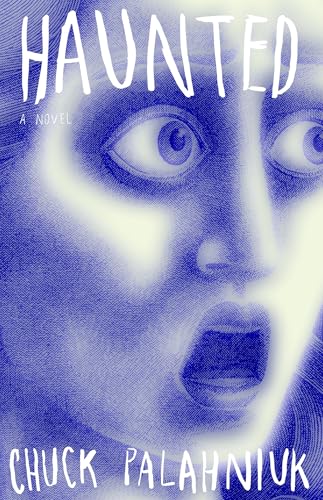

In one sentence
Haunted presents storytelling as both survival strategy and commercial performance: people manufacture suffering, identity, and transgression because misery becomes valuable once it can be packaged for an audience.
Overview
The book uses a frame narrative: a group of writers answers an advertisement for a retreat, only to find themselves confined in an abandoned theater under increasingly severe conditions. Between episodes of the group story are twenty-three poems and short narratives attributed to participants. The structure is less a conventional novel than a deliberately unstable “novel of stories.”
Core ideas
Suffering as publicity
The writers gradually recognize that a dramatic captivity story could make them famous. Their hardship therefore becomes entangled with self-promotion: pain is not only endured but staged, shaped, and imagined as future media.
The attention economy before social media fully matured
The book mocks the desire to become exceptional through spectacle. Its characters understand that shocking content attracts attention, and that attention can be converted into status, money, or artistic legitimacy.
The storyteller as unreliable performer
Each participant’s tale is a self-presentation as much as a confession. The stories reveal obsessions and fears, but they also invite suspicion: the narrator may be exaggerating, manipulating an audience, or borrowing a recognizable Palahniuk persona.
Isolation produces community—and cruelty
The retreat’s confinement creates a miniature society. Shared danger can generate solidarity, but competition for narrative importance turns the participants against one another. The group behaves like both a literary workshop and a reality-TV cast.
The body as the last undeniable reality
Sex, illness, mutilation, disgust, and physical vulnerability recur because the body resists polished self-invention. Palahniuk uses bodily extremity to puncture abstractions about art, identity, and personal freedom.
A satire that also risks becoming its target
The book criticizes audiences hungry for grotesque spectacle while supplying grotesque spectacle in abundance. That tension is central to its design: readers are made to ask whether disgust exposes exploitation or simply reproduces it.
Form mirrors the argument
The alternating poems, embedded stories, and frame episodes make the book feel assembled from competing acts of self-mythology. The fragmented structure suggests that identity is made from stories—and that stories can escape their makers.
Practical takeaways
- When someone tells a dramatic personal story, notice both what is being revealed and what audience response the story seems designed to produce.
- Ask whether an act of rebellion is genuinely liberating or merely another recognizable performance of nonconformity.
- Remember that confession can be a form of control: the person who tells the story may also be directing how others judge them.
- The book is useful for thinking about the ethics of consuming other people’s pain as entertainment.
- If the shock wears off, examine the recurring structure underneath it: ambition, envy, loneliness, status-seeking, and fear of being ordinary.
Caveats and counterpoints
- The book’s premise and structure are distinctive, but its characters often share Palahniuk’s clipped, declarative narrative voice. Some readers experience this as deliberate collective narration; others see it as weak differentiation between characters.
- The satire is not detached from the material it mocks. The novel condemns spectacle while relying heavily on gore, sexual extremity, and disgust, so its critique can feel self-undermining rather than neatly resolved.
- The frame narrative is more important than the individual stories for the book’s overall argument, but several stories are commonly remembered more vividly than the retreat plot. This unevenness is part of why the book is often described as a hybrid or “fix-up.”
- Content warnings include graphic violence and bodily horror, sexual material, disease, death, offensive language, and deliberately provocative treatment of taboo subjects. It is not a conventional ghost story despite its title and horror classification.
Questions worth revisiting
- Which participants seem to be seeking art, and which seem primarily to be seeking recognition?
- At what point does a survival narrative become a marketing strategy?
- Does the novel expose the audience’s appetite for spectacle, or does it mainly reward that appetite?
- Are the participants victims, collaborators, performers, or all three at once?
- Which forms of disgust in the book reveal social anxieties rather than merely trying to shock?
- Does the fragmented structure deepen the novel’s ideas, or would the individual stories work better without the frame?
Return to this when…
Return to Haunted when thinking about transgressive fiction, unreliable confession, literary ambition, reality-TV logic, or the ethics of turning suffering into entertainment. Revisit the framing structure after remembering individual stories; its significance lies in how the stories become a collective performance rather than isolated shocks.