
In one sentence
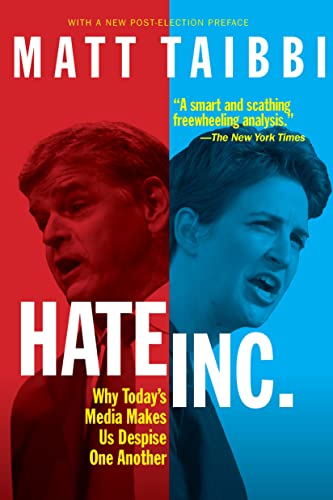
Taibbi’s central claim is that news organizations increasingly sell attention rather than information. Financial pressures, audience segmentation, partisan branding, and competitive fear encourage outlets to produce emotionally charged narratives that reinforce identity and hostility. The result is a public sphere organized around managed outrage, even when the underlying facts or stakes are more complicated.
Overview
Published by OR Books in 2019, the book began partly as a serial project and later appeared in an updated post-election edition. Taibbi combines media criticism, reporting anecdotes, historical examples, and personal confession. He attacks right- and left-leaning outlets alike, while focusing especially on cable news, political journalism, and the internet’s advertising model.
Core ideas
News as an engagement business
The book treats news less as a public service than as bait for attracting and sorting consumers. Content that provokes fear, anger, or partisan loyalty keeps audiences watching and makes them easier to target with advertising. The “hate” is therefore not merely an editorial attitude; it is part of the revenue system.
Polarization as a product format
Modern media presents politics as a permanent fight between opposing tribes. Each side receives a simplified enemy image, while disagreement within each coalition and conflicts involving class, economics, or institutional power receive less attention. Taibbi’s “both sides” framing is meant to expose a shared system, not claim that every outlet or claim is equally harmful.
The ten rules of media conflict
Taibbi describes recurring techniques: personalize complex issues, dramatize minor offenses, frame opponents as existential threats, reward certainty, and turn moral judgment into spectacle. These tactics convert news into a contest between performers and identities rather than an investigation of causes and consequences.
The Iraq War as institutional failure
The press’s acceptance of claims about Iraqi weapons of mass destruction serves as Taibbi’s major example of herd behavior. He argues that prestigious outlets, editors, and reporters failed by treating official claims as credible, minimizing dissent, and later avoiding full accountability. The example supports his broader concern about elite consensus and professional incentives.
Russiagate as a repetition of the pattern
Taibbi compares coverage of the Trump–Russia investigation to the earlier WMD episode, arguing that speculative or incomplete claims were sometimes presented with excessive confidence because they fit an emotionally satisfying political narrative. This is one of the book’s most contested applications of its framework; critics regard the analogy as too sweeping and insufficiently attentive to differences in evidence and stakes.
Journalists are participants, not neutral observers
Reporters and editors operate inside corporations, professional cultures, political assumptions, and competitive news cycles. Taibbi’s insider perspective emphasizes how choices about framing, omission, sourcing, and story selection can distort public understanding without requiring an explicit conspiracy.
Audience complicity
The system works because audiences seek confirmation, identity, and emotional stimulation as well as facts. Readers should therefore examine not only whether a story is technically true, but also what fear, resentment, or status competition it invites them to feel—and what important context it leaves outside the frame.
A polemic rather than a complete reform program
The book is strongest as a diagnosis and repertoire of warning signs. It offers journalists some guidance about resisting institutional pressures, but provides limited, systematic solutions for rebuilding public-interest media. A scholarly review similarly notes that audiences receive few concrete remedies beyond disengaging from much conventional news.
Practical takeaways
- Ask what business incentive the story serves: subscriptions, ratings, clicks, donations, political influence, or advertising data.
- Separate reporting from commentary, prediction, outrage, and performance—even when they appear in the same program or article.
- Look for omitted actors and issues: who is absent, which material interests are unexamined, and whether policy has been replaced by personality conflict.
- Treat claims of certainty during fast-moving political scandals as provisional; compare primary documents with multiple outlets before adopting a narrative.
- Notice emotional narrowing: if a story mainly tells you whom to despise, it may be optimizing engagement rather than improving understanding.
- Do not apply Taibbi’s critique mechanically. The fact that both partisan media systems use outrage does not mean their factual accuracy, institutional power, or social consequences are identical.
Caveats and counterpoints
- Taibbi writes as an experienced journalist and polemicist, not as a detached media-effects researcher; anecdotes and sharp examples carry much of the argument.
- His critique sometimes groups diverse institutions under “the media,” which can blur important differences among investigative reporting, opinion programming, local journalism, public media, and digital platforms.
- The book’s equal-opportunity attack can understate asymmetries in evidence, political power, audience reach, and harm between competing narratives.
- Some examples, especially the comparison between Russiagate and the Iraq WMD coverage, are interpretations that critics may find overstated rather than settled historical conclusions.
- The analysis is anchored in the U.S. media environment of the late 2010s; the updated edition extends the discussion through the 2020 election period, but the underlying platforms and news economics continue to change.
Questions worth revisiting
- When does “both sides” criticism clarify a shared incentive system, and when does it flatten meaningful differences?
- Which parts of the news ecosystem—local, nonprofit, investigative, or subscription-supported—best resist the incentives Taibbi describes?
- Can audiences reduce polarization without withdrawing from news altogether?
- What evidence would distinguish deliberate manipulation from ordinary deadline pressure, error, or ideological bias?
- How should a reader evaluate Taibbi’s strongest historical analogies rather than simply accepting or rejecting his overall polemic?
Return to this when…
Return to this book when a political story feels unusually addictive, morally intoxicating, or certain before the evidence is complete. Use it as a diagnostic checklist for incentives, framing, omission, and audience manipulation—not as a substitute for checking primary sources or comparing the strength of competing claims.
References
- bookmarks.reviews
- Hate Inc.: Why Today’s Media Makes Us Despise One Another by Matt Taibbi
- kirkusreviews.com
- Book Review: Hate, Inc.: Why today's media makes us despise one another by Matt Taibbi - Philip S. Poe, 2022
- bookey.app
- HATE INC.(2ND EDITION): Why Today’s Media Makes Us Despise One Another | Matt Taibbi | OR Books
- search.worldcat.org
- en.wikipedia.org
- bookey.app
- sobrief.com
- goodreads.com
- researchgate.net