
In one sentence
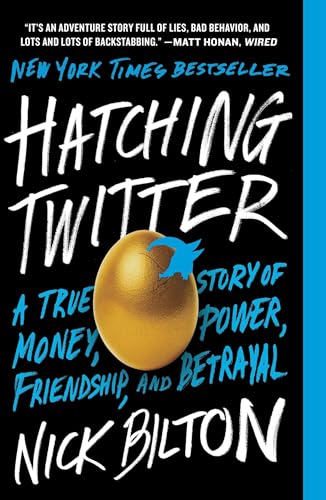
Twitter was not the product of a clear, unified master plan. It emerged from accidental experimentation, technical improvisation, cultural timing, and the complementary—often incompatible—contributions of Evan Williams, Jack Dorsey, Biz Stone, Noah Glass, and later executives. Its success was accompanied by unresolved battles over credit, control, and the company’s identity.
Overview
Bilton reconstructs Twitter’s origin inside Odeo, a struggling podcasting startup, then follows the service’s rapid growth and institutional turmoil. The narrative centers on four founders: Williams, Dorsey, Stone, and Glass. Their different visions—personal status updates, information discovery, democratic communication, and communal enthusiasm—helped shape the product, but their relationships deteriorated as money, fame, and authority accumulated. Noah Glass, especially, is presented as an important early contributor who was later removed from the company’s official story.
Core ideas
Accidental products can become strategic platforms
Twitter began as a side project responding to Odeo’s crisis rather than as a fully specified business. The lesson is not that planning is useless, but that organizations need mechanisms for recognizing and funding promising uses that were not part of the original strategy.
Different founder strengths can create both advantage and conflict
The founders supplied distinct assets: Williams’s product and entrepreneurial experience, Dorsey’s design-oriented vision, Stone’s communication and diplomacy, and Glass’s energy and early evangelism. Complementarity helped the service form; unclear ownership and incompatible ambitions later made collaboration brittle.
A product’s meaning is discovered socially
The founders did not agree on what Twitter fundamentally was. Its eventual identity was shaped by users, public events, media attention, and emergent behavior—not only by executive intent. This is a useful reminder that platforms acquire meaning through participation.
Equity and authority are different currencies
The book’s recurring power struggles show that founding status, technical contribution, public visibility, board influence, operational competence, and formal ownership do not automatically align. Startups need explicit decision rights and credit mechanisms before success makes those ambiguities expensive.
Narrative control is part of corporate power
Who gets remembered as a founder affects reputation, leverage, recruiting, and perceived legitimacy. Bilton treats Twitter’s official history as contested, especially around Glass, showing that organizational memory is not neutral.
Growth can expose weaknesses rather than solve them
Rapid adoption and rising valuation amplified unresolved interpersonal and governance problems. A company can achieve extraordinary product-market traction while still lacking stable leadership, shared values, or a coherent operating model.
Practical takeaways
- Define founder roles, decision rights, vesting, and attribution before the company becomes valuable.
- Separate product disagreements from personal loyalty; friendship is not a governance system.
- Preserve dissenting records and credit contributors whose work is not publicly visible.
- Treat unexpected user behavior as evidence about the product, not merely as noise.
- Build operating discipline before scale turns informal arrangements into political contests.
- When reading origin stories, distinguish documented events from the author’s dramatic framing and character judgments.
Caveats and counterpoints
- Bilton’s account is investigative narrative nonfiction, not an impartial corporate archive; reviewers praised its research and readability but criticized its overblown prose and simplified, highly conflict-driven character portrayals.
- The book is strongest on personalities, alliances, and power struggles. It offers less technical depth than a dedicated product or engineering history.
- Because the story is organized as a business thriller, causality can appear cleaner and motives more legible than they probably were in real time. Treat judgments about who was visionary, manipulative, or loyal as Bilton’s reported interpretation rather than settled fact.
- The book ends in the context of Twitter’s 2013 public-market era; it should not be used as a current account of the company or platform.
Questions worth revisiting
- Which contributions should count most in a founding story: the initial idea, implementation, financing, recruiting, culture-building, or later execution?
- What governance structure might have preserved the founders’ complementary strengths without allowing personal conflict to dominate?
- When does a company’s need for a simple public origin story become a distortion?
- Would Twitter’s success have been less likely—or merely different—if its founders had agreed early on what the product was?
- Which lessons here apply to startups generally, and which depend specifically on social platforms and media attention?
Return to this when…
Return to this book when reviewing founder conflict, startup governance, contested intellectual credit, or the difference between deliberate strategy and emergent product success. Pair it with a more technical or institutionally balanced account if you need Twitter’s engineering, moderation, advertising, or later corporate history.
Highlights
“It seems to me, there are three reasons to sell a company,” Ev wrote in an e-mail to the board outlining why they should decline Facebook’s offer. 1. The price is good enough or a value that the company will be in the future. (“We’ve often said Twitter is a billion dollar company. I think it’s many, many times that,” Ev wrote.) 2. There’s an imminent and very real threat from a competitor. (Nothing is going to “pose a credible threat of taking Twitter to zero.”) 3. You have a choice to go and work for someone great. (“I don’t use [Facebook]. And I have many concerns about their people and how they do business.”)
When it was Ev’s turn to talk, he asked his first question: “What’s the worst thing I can do as CEO to fuck the company up?” Without skipping a beat, Campbell responded: “Hire your fucking friends!” He went into a ten-minute tirade about friends and business and how they don’t mix. Ev scribbled in his notepad.
References
- HATCHING TWITTER by Nick Bilton | Kirkus Reviews
- smallbusinessfocus.org
- goodreads.com
- Book review: Hatching twitter, By @Nick Bilton | The Independent | The Independent
- Hatching Twitter by Nick Bilton | Hachette UK
- blinkist.com
- culttt.com
- Hatching Twitter by Nick Bilton – review | Technology books | The Guardian
- Hatching Twitter: A True Story of Money, Power, Friendship, and Betrayal by Nick Bilton (9781591846017)
- allbookstores.com
- superception.fr
- lareviewofbooks.org